
What Are You Actually Buying? Crypto vs Stocks Explained
Before comparing crypto vs stocks, start with the most basic question: what does your money actually buy?
🏢 Stocks Mean Ownership in a Real Business
When you buy a stock, you own a small piece of a company. That company has revenue, employees, and published financial statements. Its price reflects how investors feel about its future earnings. Some stocks pay dividends — a share of profits sent directly to shareholders.
The value is tied to something real and measurable.
🌐 Crypto Means Exposure to a Digital Network
When you buy Bitcoin or Ethereum, you do not own a company. You own a digital asset on a decentralised network. Its value is driven by supply and demand, adoption, and market sentiment. There are no earnings reports. No dividends. No shareholder rights.
The value is real — but it works on entirely different logic.
💡 Why This Distinction Matters
Different foundations require different analysis tools.
- Stocks reward fundamental research: earnings, margins, and management quality.
- Crypto rewards understanding network adoption, on-chain activity, and macro sentiment.
Apply the wrong framework to the wrong asset and you will make poor decisions — fast.
Six Key Differences Between Crypto and Stocks
Here is where the crypto vs stocks comparison gets practical. These six dimensions affect how you trade, how exposed you are, and how much protection you have.
| Dimension | Stocks | Crypto |
|---|---|---|
| Trading Hours | Weekdays only, set hours | 24/7, 365 days a year |
| Regulation | Strict — SEC, FCA, etc. | Evolving, varies by country |
| Volatility | Typically 1–3% daily moves | Can swing 10–15%+ in a day |
| Custody | Broker holds assets, regulated | Self-custody possible; you hold the key |
| Value Driver | Earnings, dividends, fundamentals | Sentiment, adoption, supply/demand |
| Investor Protection | Strong legal frameworks | Limited or absent in many regions |
🕐 Trading Hours — Stocks Close, Crypto Never Does
Stock markets run on business hours, Monday to Friday. Crypto markets never close. You can check crypto prices at any hour and act instantly.
More access means more opportunity — and more moments when emotion can push you into a bad trade.
⚖️ Regulation — One Has Rules, One Is Still Figuring Them Out
Stocks come with mandatory disclosures, audited accounts, and legal investor protections. Crypto regulation is still being written. Rules vary sharply by country. Investor protections are weaker or absent in many markets.
📈 Volatility — Crypto Swings Harder
Blue-chip stocks typically move 1–3% on a normal session. Bitcoin or Ethereum can move 10–15% in a single day — and smaller altcoins can go much further. High volatility creates opportunity. It also creates risk. You cannot separate the two.
🔐 Custody — Who Holds Your Asset Matters
Stocks held through a licensed broker fall under regulatory protection schemes. With crypto, self-custody means you hold your private key — and full responsibility. Lose your key and your assets are gone permanently. Always review a platform's proof of reserves before depositing funds.
Risk Is Real in Both — But It Looks Different
Many people assume stocks are safe and crypto is dangerous. That framing is too simple.
🔴 Crypto Risk: Fast, Loud, Sentiment-Driven
- Prices can collapse on a single tweet or regulatory headline
- Liquidity is thin for smaller tokens
- Scams, hacks, and project failures are real threats
- The market can move against you faster than you can react
🟡 Stock Risk: Slower, But Still Real
- Individual companies can — and do — go bankrupt
- Fraud and industry disruption can wipe out value
- Even broad index funds dropped 30%+ during the 2008 crisis and the 2020 pandemic crash
- Slower-moving risk is still risk
🧠 Emotional Risk Affects Both Markets
The biggest threat for most people is not the market — it is their own reaction to it.
Buying because prices are rising (FOMO) and selling because prices are falling (panic) destroys returns in both crypto and stock markets.
The more volatile the asset, the harder it is to stay rational. Ask yourself: if my portfolio dropped 40% overnight, what would I actually do?
Which One Fits You? A Simple Self-Check
There is no single right answer to crypto vs stocks. The right choice depends entirely on you.
✅ Four Questions to Ask First
- What is my time horizon? Short-term needs call for lower volatility. Long-term goals can absorb more swings.
- How much can I afford to lose without affecting my life? Only invest what you can genuinely afford to lose.
- How much time can I give to monitoring markets? Crypto demands more active attention. Stocks can be more passive.
- What is my actual goal? Growth, income, diversification, or simply learning — each points in a different direction.
🗂️ Investor Profile Reference (not a recommendation — a reference frame)
| Profile | Likely Starting Point |
|---|---|
| Cautious first-timer | Stocks — lower volatility, more intuitive fundamentals |
| Growth-oriented | Both — explore each to understand how they behave differently |
| Active trader | Both markets offer opportunities, but risk management is non-negotiable |
| Curious learner | Build knowledge before building any position |
Can You Hold Both? Portfolio Thinking Basics
🔀 Diversification Reduces Concentration, Not Total Risk
Holding both crypto and stocks does not make you immune to losses. In sharp market downturns, both can fall simultaneously. Diversification limits concentration in one asset — it does not eliminate drawdown.
🎯 Core vs Satellite: One Framework
One common mental model:
- Core position → lower-volatility, well-understood assets
- Satellite position → higher-risk, higher-potential assets in a smaller allocation
This is a way of organising your thinking, not a specific allocation to copy.
🔄 Review, Don't Set and Forget
Markets change. Your life changes. Review your holdings regularly and ask: does what I own still match my goals? Rebalancing is not about timing the market — it is about staying aligned with your plan. Always factor in the fee structure on any platform you use, as costs compound quietly over time.
Want Stock-Price Exposure via Crypto? Try TradFi Perpetuals on Tapbit
If you are thinking about crypto vs stocks and want to engage with stock price movements from within a crypto platform, Tapbit offers TradFi perpetual contracts.
⚠️ What Are TradFi Perpetuals?
TradFi perpetuals are derivative contracts that track the price of traditional stocks like NVIDIA, Apple, Amazon, Microsoft, and Tesla.
Important: These are NOT direct stock ownership. You hold no shareholder rights and receive no dividends. Leverage amplifies both gains and losses — losses can exceed your initial margin.
Step 1 — Go to Tapbit Futures
Log in to your Tapbit account and navigate to the Futures section. Open the trading pair selection panel.
Step 2 — Select TradFi Under Perpetual
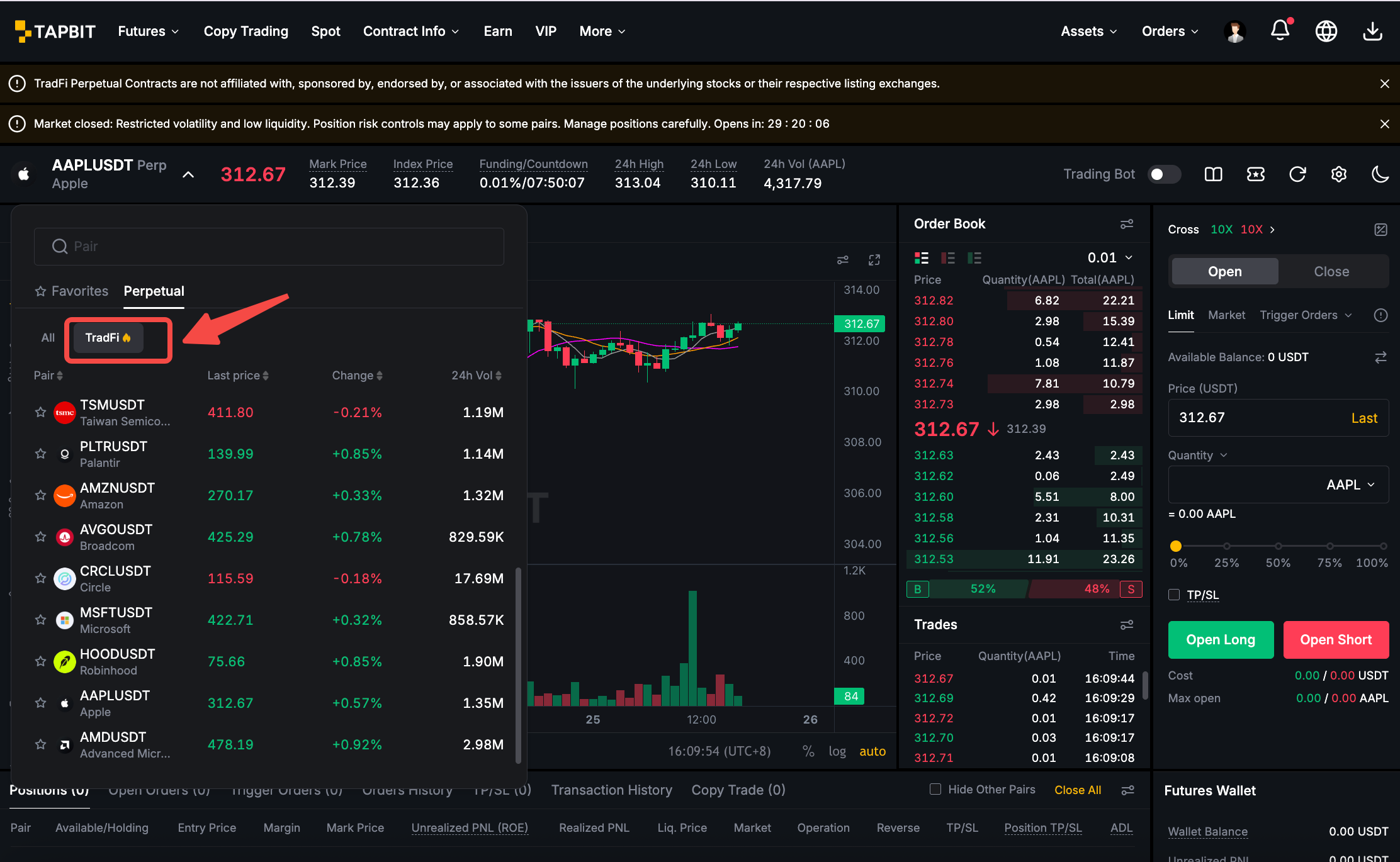
Under the Perpetual category, choose TradFi. You will see stock-based perpetual contracts including NVIDIA, Apple, Amazon, Microsoft, and Tesla.
Step 3 — Review the Market Data First
Before placing any order, examine:
- 📊 Price chart and trend
- 🏷️ Mark Price and Index Price
- 📉 24h High / Low and volume
- 📖 Order book depth
- 💸 Funding rate
Do not enter based on price alone.
Step 4 — Set Your Order with Care
Choose your margin mode (cross or isolated), leverage level, order type, and direction. Keep leverage low if you are new to futures. New to the platform? Create an account and start with a small position to learn the mechanics. 24/7 support is available if you need help. You can also explore NVDA futures trading directly to see how the product works in practice.
Final Word: Crypto vs Stocks Is a Both/And Question
🏁 The Real Question Is Not Which Is Better
Crypto vs stocks is not a competition with a declared winner. They are different tools with different risk profiles, different structures, and different use cases. Framing it as a binary choice misses the point.
📚 Build Knowledge Before Building Positions
The most common beginner mistake: buying first, learning second. Understand what you own, why it moves, and what could go wrong — before you put real money in.
🛠️ Use Tools That Match Your Level
Tapbit offers spot trading, futures, and TradFi perpetuals across a range of markets. Start with what you understand. Add complexity only when your knowledge genuinely catches up.
The crypto vs stocks question is ultimately a question about you — your goals, your risk tolerance, and your willingness to learn the market before the market teaches you. Answer that honestly, and the path forward becomes much clearer.
FAQ
1. Is crypto riskier than stocks?
Generally, yes — crypto is more volatile and less regulated than stocks. Major cryptocurrencies can swing 10–15% in a single session, while large-cap stocks typically move far less. That said, individual stocks can also lose most of their value. Risk depends on what you hold, how much leverage you use, and how disciplined your risk management is.
2. Do I need a lot of money to start with crypto or stocks?
No. Many crypto platforms allow very small starting amounts, and some stock brokers offer fractional shares. The more important question is whether what you invest is money you can genuinely afford to lose. Starting small while you learn is the most sensible approach in both markets.
3. Are crypto gains taxed differently than stock gains?
In many countries, yes. Tax treatment for crypto varies significantly by jurisdiction — some treat it as property, others as currency, and rules are still evolving. Stock gains typically fall under established capital gains frameworks. Always consult a qualified tax professional in your region before trading either asset.
4. Why does Bitcoin sometimes crash when stocks crash too?
During extreme fear or a liquidity crunch, investors sell everything — including crypto. This correlation tends to spike during major market stress events, which is why holding both does not always work as a hedge when you need it most.
5. What is a perpetual contract and how is it different from buying stocks?
A perpetual contract is a derivative that tracks an asset's price but never expires. With TradFi perpetuals on Tapbit, you can track the price of stocks like NVIDIA or Apple without owning actual shares. There are no shareholder rights, no dividends, and leverage amplifies losses as well as gains.
6. Can I lose more than I invested in crypto or stock trading?
With spot trading, your maximum loss is what you put in. With leveraged products like futures or perpetuals, losses can exceed your initial margin — if the market moves against you and your margin is exhausted, your position gets liquidated. This is why leverage requires strict risk management, especially for those new to derivatives.


