
"Can XDC reach $1?" is one of the most searched questions in the XDC community — and one of the most frequently answered with either blind optimism or dismissal. Neither serves you well as an investor.
XDC is trading at $0.030 as of April 2026. Getting to $1 means a 33x gain from here. That's not impossible in crypto, but it's not a number you should throw around without doing the math first. What does a 33x gain actually require in terms of market capitalization? How does that compare to the realistic size of XDC's addressable market? And what would the competitive landscape need to look like for that scenario to materialize?
This article doesn't deliver a yes or no. It delivers the framework — market cap math, RWA market sizing, competitive analysis, and historical context — so you can form an honest opinion rather than a hopeful one.
The Market Cap Math: What $1 Actually Requires
This is the section most $1 predictions skip. Let's not.
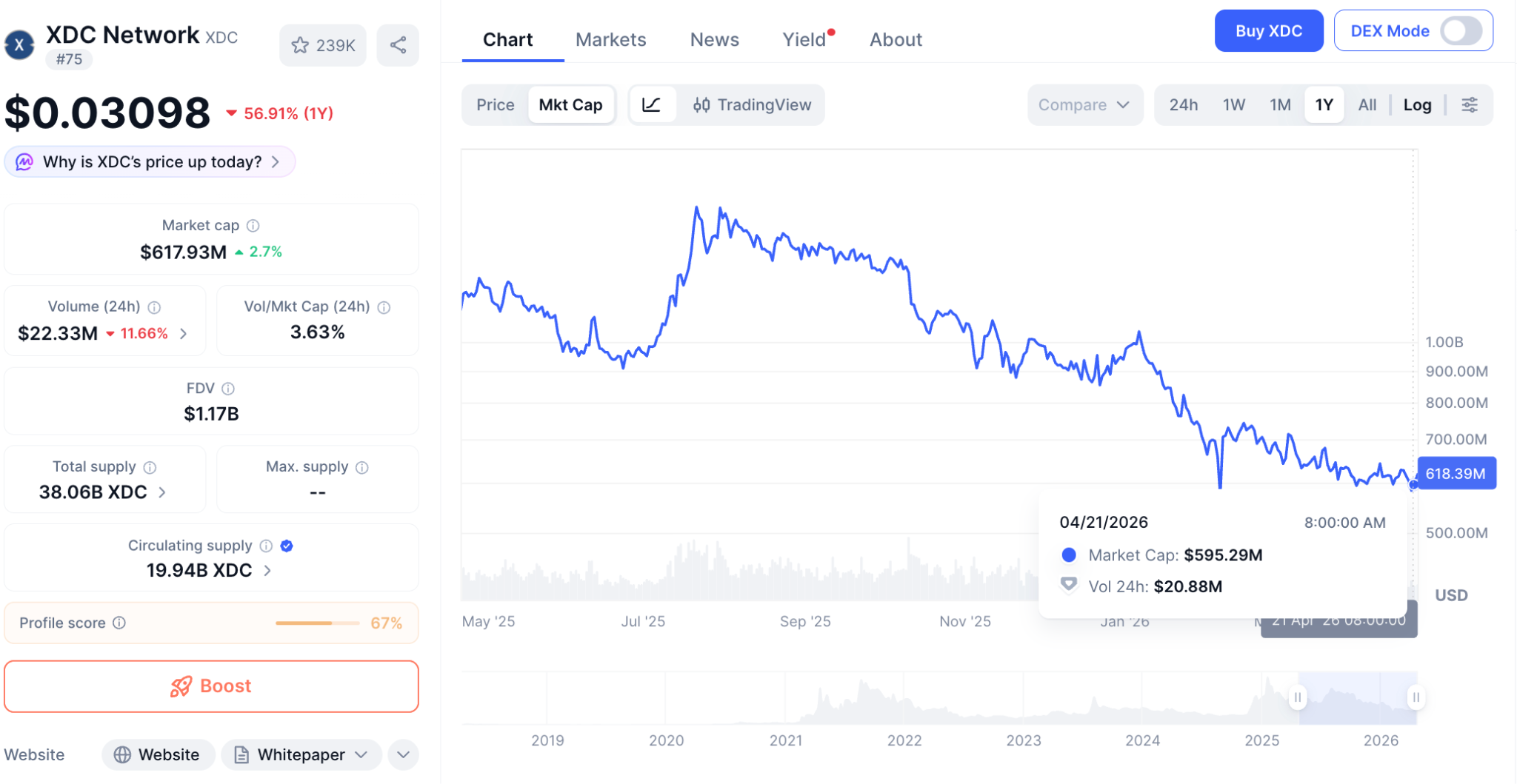
Current figures (April 2026):
|
Metric |
Data |
|
Current Price |
$0.030 |
|
Circulating Supply |
~37.8B XDC |
|
Current Market Cap |
~$600M |
The $1 calculation: $1 × 37.8B XDC = ~$37.8B market cap
To put that number in context: a $38B market cap would currently place XDC roughly in the top 15–20 cryptocurrencies globally. As of April 2026, that's approximately twice the market cap of Chainlink, ten times that of Ondo Finance, and in the same neighborhood as the market caps that Solana and BNB have occupied at their respective cycle peaks.
This is not a valuation that XDC can reach by virtue of a good quarter or a favorable news cycle. It requires a sustained, multi-year accumulation of institutional adoption, ecosystem growth, and favorable macro conditions — all compounding together.
One additional note for the thorough reader: the figures above use circulating supply. XDC's total supply is significantly higher. If token unlocks continue over the coming years and total supply approaches full circulation, the market cap required to sustain a $1 price would be proportionally larger — making the target even more demanding.
XDC's RWA Opportunity: What's the Total Addressable Market?
To evaluate whether a $38B market cap is achievable, you first need to understand the ceiling of the market XDC is trying to serve.
Global trade finance by the numbers:
The International Chamber of Commerce estimates the global trade finance gap — the difference between demand for trade financing and what banks currently provide — at approximately $2.5 trillion annually. This is the structural problem XDC is building infrastructure to address.
Blockchain can't capture all of that. But even conservative estimates of blockchain penetration into trade finance point to a substantial opportunity:
|
Scenario |
Blockchain Penetration |
Addressable Pool |
|
Conservative |
5% |
~$125B |
|
Moderate |
10% |
~$250B |
|
Optimistic |
20% |
~$500B |
XDC's current position: $717M in tokenized RWAs as of late 2025. Against even the conservative $125B addressable pool, that's less than 1% penetration.
What would $1 require from this market?
If XDC captures 8% of a $125B blockchain-enabled trade finance market — roughly $10B in on-chain RWA value — and the market values that at a 3–5x TVL-to-market-cap ratio (consistent with how DeFi infrastructure has historically been valued), the resulting market cap lands in the $30B–$50B range. That's the range where $1 becomes mathematically supportable.
The question, then, is not whether the math works in theory. It does, under specific assumptions. The question is whether those assumptions are realistic — and over what timeline.
XDC vs. Competitors: How Does It Stack Up in the RWA Race?
XDC doesn't exist in a vacuum. Four other well-capitalized projects are competing for portions of the same RWA market, and understanding the competitive landscape is essential to evaluating XDC's long-term ceiling.
|
Dimension |
XDC Network |
Ondo Finance |
Chainlink |
Polygon |
|
Core Focus |
Trade finance specialization |
Treasury/fixed-income tokenization |
Oracle infrastructure + CCIP |
General RWA infrastructure |
|
Current RWA Scale |
$717M |
~$800M |
N/A (infrastructure layer) |
~$1.2B |
|
Market Cap (Apr 2026) |
~$600M |
~$3B |
~$18B |
~$5B |
|
Institutional Partnerships |
BitGo, SBI, Archax |
BlackRock, Franklin Templeton |
SWIFT, DTCC |
Polygon Labs |
|
Regulatory Compliance |
In progress |
U.S. compliant |
Highly compliant |
Partial |
|
Transaction Cost |
$0.00001 (extremely low) |
Ethereum-level |
Ethereum-level |
Below Ethereum |
*Market cap data as of April 22, 2026. Source: CoinMarketCap. RWA figures sourced from respective project official announcements and DeFiLlama. Chainlink RWA scale marked N/A as it operates as infrastructure layer, not a direct RWA holder.
What the table tells you:
XDC's differentiation is genuine. No other chain has built the same depth of trade finance-specific infrastructure — ISO 20022 compatibility, XDC-native trade documentation protocols, and a node network that includes regulated financial institutions. The $0.00001 gas fee is not a marketing point; it's a practical requirement for high-frequency invoice settlement that makes Ethereum-based alternatives unworkable at scale.
But the competitive threat is real and growing. Chainlink's CCIP is becoming the connectivity layer for cross-chain RWA settlement regardless of which underlying chain is used. Ondo's compliance infrastructure is more mature in U.S. regulatory terms. Polygon is actively courting the same enterprise clients XDC targets.
The $1 implication: For XDC to support a $38B market cap, it can't just participate in the RWA race — it needs to win the trade finance vertical decisively while competitors dominate adjacent segments. That's a narrower and more specific outcome than XDC bulls sometimes acknowledge.
Historical Price Context: Has XDC Been Close to $1 Before?
Understanding where XDC has been is important for calibrating where it can realistically go.
|
Period |
Price Event |
|
2021 Bull Peak |
All-time high ~$0.19 — still 81% below $1 |
|
2021–2022 |
XDC failed to sustain above $0.10 even during peak crypto euphoria |
|
2022 Bear Market |
Dropped to $0.018–$0.025 range |
|
2024 Recovery |
Partial bounce to $0.06–$0.08 |
|
April 2026 |
Current price $0.030, near historical lows |
The most important data point in this table is the 2021 all-time high: $0.19. That price was reached during the most broadly favorable crypto market conditions in the asset class's history — Bitcoin at $69,000, institutional adoption narratives everywhere, retail FOMO at peak levels. And even then, XDC topped out at $0.19.
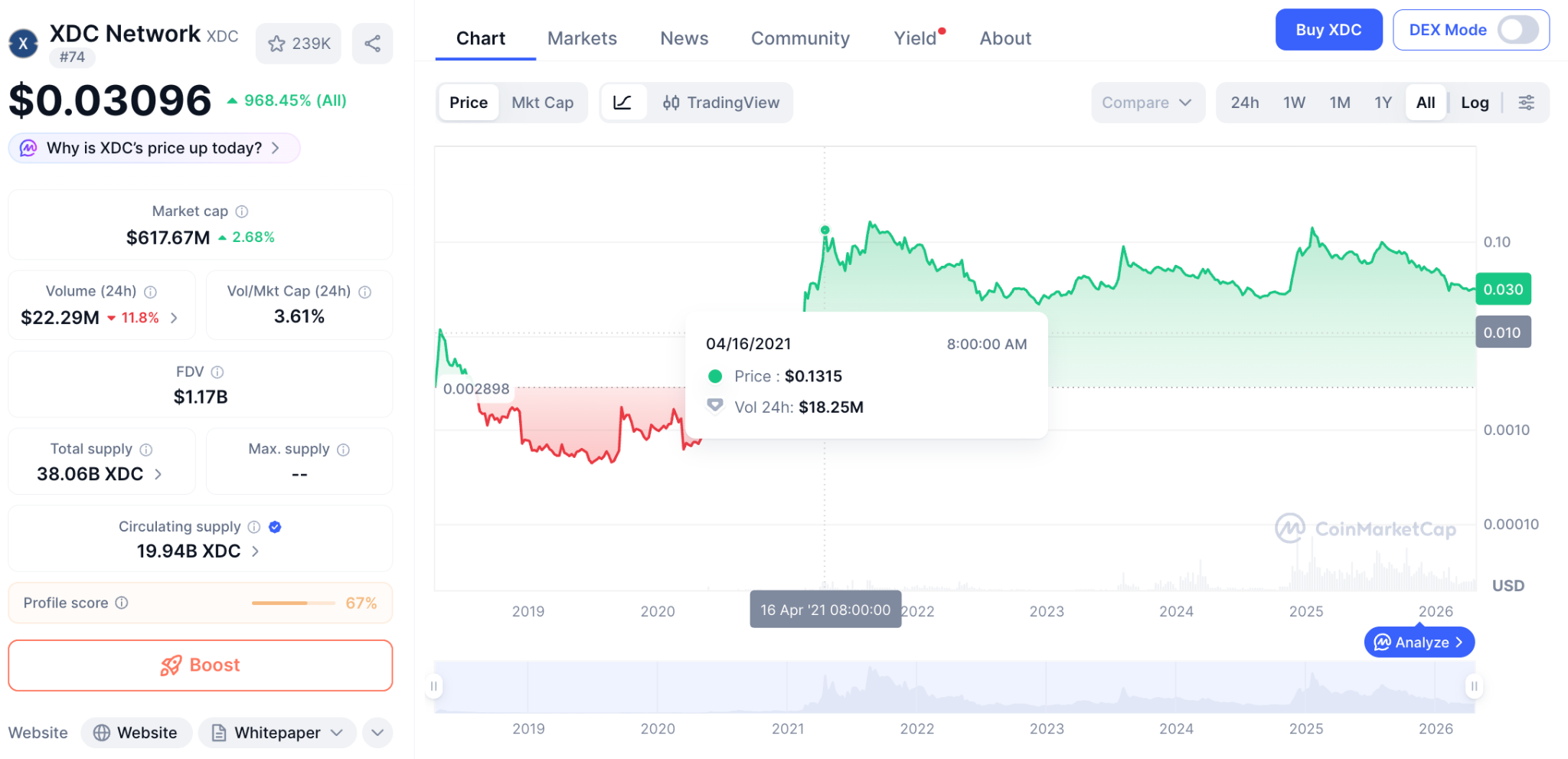
Getting from $0.19 to $1 requires another 5x from the all-time high. Getting from $0.030 to $1 requires 33x from today. History tells us that XDC reaching $1 isn't just a matter of riding the next bull cycle — it requires a fundamentally different level of adoption and market positioning than XDC has ever demonstrated.
That's not a reason to dismiss the possibility. It's a reason to be specific about what conditions would need to be true.
Scenarios for XDC to Reach $1 — and When
❌ 2026: Probability Below 1%
This estimate is based on the gap between XDC's current market cap ($600M) and the $38B required for $1, combined with the absence of any analyst forecast above $0.25 for 2026 and the historical precedent that no asset of this size has achieved 33x in a single year.
No credible analyst has published a 2026 XDC forecast above $0.25. Even the most optimistic projections — 99Bitcoins at $0.13–$0.23, TokenMetrics at up to $0.21 — fall far short of $1. At a current market cap of $600M, XDC has already grown beyond the phase where small-cap explosive moves are typical. A 33x gain in a single year would require a combination of circumstances that has no historical parallel in assets of this size and liquidity profile.
⚠️ 2027–2030: Probability 5%–10% (All Conditions Must Hold)
This range is derived from a scenario analysis requiring three independent conditions to be simultaneously true — each with its own probability below 50%. The joint probability of all three materializing within the same window is what drives the 5%–10% estimate.
The 2027–2030 window offers a more plausible — but still demanding — path. Three conditions would need to be simultaneously true:
Condition 1 — RWA Market Penetration: Blockchain-based trade finance grows to at least 10% of the addressable market, and XDC captures more than 25% of that share. This implies XDC's on-chain RWA value exceeding $6B–$10B within four years — roughly a 9–14x increase from the current $717M milestone. The growth trajectory from 2024 to 2025 was promising, but sustaining that pace across multiple years against growing competition is not guaranteed.
Condition 2 — Bitcoin Supercycle: A new crypto supercycle, comparable in magnitude to 2020–2021, occurs in the 2028–2029 timeframe. This would be consistent with the approximate four-year halving cycle if that pattern holds. Without a macro crypto tailwind of significant size, XDC's RWA adoption alone is unlikely to drive a top-20 market cap valuation.
Condition 3 — Regulatory Clarity: The U.S. CLARITY Act passes and major jurisdictions establish workable RWA tokenization compliance frameworks. This removes the legal uncertainty that currently prevents most institutional capital from meaningfully allocating to non-ETH RWA protocols.
All three conditions must be present. If any one is missing, the math doesn't work. The 5%–10% probability assigned here reflects the genuine possibility that all three align — while acknowledging that each individually faces real obstacles.
🟡 2031–2035: Probability 15%–25% (Conditional on Establishing Infrastructure Standard)
The wider probability range here reflects genuine uncertainty over a 10-year horizon. The 15%–25% estimate incorporates the possibility that XDC compounds ecosystem growth across two full crypto cycles, achieves regulatory clarity in major jurisdictions, and establishes network effects comparable to incumbent financial messaging infrastructure.
The longer the time horizon, the more plausible a $38B valuation becomes — but only if XDC achieves something specific: becoming the functional equivalent of SWIFT for trade finance blockchain transactions.
SWIFT processes approximately 45 million messages per day across 11,000+ financial institutions. If XDC reaches even a fraction of that embedded utility — where enterprise-grade trade finance simply runs on XDC the way interbank messaging runs on SWIFT — the network effects compound in ways that make a $38B market cap a reflection of genuine infrastructure value rather than speculative premium.
This is a 10-year thesis, not a 4-year trade. The 15%–25% probability reflects real optionality, not a high-conviction prediction.
Three Things That Must Happen Before XDC Reaches $1
Distilling the scenarios above into concrete prerequisites:
1. Tokenized RWA Scale Must Cross $10B on XDC
From $717M to $10B is approximately a 14x increase. Based on 2024–2025 growth rates of roughly 3–4x annually, reaching $10B would theoretically take until 2028–2029 if growth maintains pace — but real-world adoption rarely compounds at venture-stage rates indefinitely. A more conservative 2x annual growth rate puts $10B at 2031–2032.
2. Tier-1 Exchange Listing and Institutional Product Availability
Binance and Coinbase spot listings, combined with the emergence of an XDC-based structured product or ETF, would be required to open capital inflows at the scale necessary to support a $38B market cap. BitGo custody is a prerequisite for this; it is not sufficient by itself.
3. Competitive Moat Must Deepen, Not Erode
XDC's current advantages — gas fees, trade finance specialization, institutional node network — must remain differentiated even as Chainlink, Polygon, and new entrants continue developing. If the RWA infrastructure layer commoditizes and XDC becomes one of several interchangeable options, the premium valuation evaporates.
What Would XDC Look Like at Different Price Milestones?
Rather than anchoring on $1 as the only goalpost, setting staged milestones gives you a more actionable investment framework.
|
Price Milestone |
Implied Market Cap |
Multiple from Today |
Realistic Difficulty |
|
$0.05 |
~$1.9B |
1.7x |
Moderate — achievable in 2026 base case |
|
$0.10 |
~$3.8B |
3.3x |
Challenging — requires bull market + RWA catalyst |
|
$0.25 |
~$9.5B |
8.3x |
Difficult — needs strong cycle + major breakthrough |
|
$0.50 |
~$19B |
16.7x |
Very difficult — requires industry-standard positioning |
|
$1.00 |
~$38B |
33x |
Low probability before 2030; conditional possibility 2031+ |
This table is useful not just as a return calculator but as a conversation about what has to be true at each level. The step from $0.05 to $0.10 is about market conditions. The step from $0.10 to $0.25 is about ecosystem fundamentals. The step from $0.25 to $1.00 is about XDC's role in global financial infrastructure — a very different kind of claim.
XDC Long-Term Price Predictions 2027–2030
For readers who want a multi-year prediction table as a reference point:
|
Year |
Bear Case |
Base Case |
Bull Case |
|
2027 |
$0.030 |
$0.075 |
$0.18 |
|
2028 |
$0.035 |
$0.10 |
$0.25 |
|
2029 |
$0.040 |
$0.14 |
$0.38 |
|
2030 |
$0.045 |
$0.20 |
$0.57 |
How to read this table: The base case assumes normal crypto market development, XDC RWA scale reaching $2B–$3B by 2030, and no major regulatory setbacks. The bull case assumes a 2028–2029 supercycle with RWA as a primary narrative theme. The bear case assumes macro headwinds persist and RWA adoption grows more slowly than current momentum suggests.
Notice that even the 2030 bull case lands at $0.57 — still 43% short of $1. That's the honest reality of where the numbers point over a four-year horizon.
All figures are research estimates, not financial advice.
Honest Verdict: Should You Buy XDC for the $1 Target?
If your investment thesis is "I'll buy XDC and hold until $1," here is what that actually means in practice:
You are making a bet that XDC will become one of the 15–20 most valuable crypto assets in the world over the next 5–10 years, that it will do so by dominating a niche of global finance (trade finance blockchain infrastructure) that is currently underpenetrated, and that it will achieve this while fending off well-capitalized competitors and navigating a still-evolving regulatory environment.
That's not an unreasonable long-term thesis. But it's a decade-long thesis with real execution risk, not a cycle trade.
More practical frameworks:
-
If you believe in the RWA thesis broadly: Diversifying across XDC, Ondo, and Chainlink gives you exposure to the theme without single-asset concentration risk
-
If you're positioned in XDC already: Setting staged profit targets at $0.05, $0.10, and $0.20 lets you capture meaningful gains without waiting for a $1 scenario that may take a decade to develop
-
If you're considering entry now: At $0.030 near historical lows, the risk-reward is more favorable than at $0.08–$0.10 where XDC traded in 2024 — but technical confirmation of a trend reversal (weekly close above $0.042) remains absent
The investors best positioned to benefit from an eventual XDC appreciation are those who size their position honestly — large enough to matter if the thesis plays out, small enough to hold through years of potential sideways action without being forced to exit.
Interested in Exploring the Crypto Market?
Whether the RWA narrative plays out for XDC or spreads across the broader sector, having a reliable exchange to track and trade emerging opportunities matters. Tapbit offers spot trading across a wide range of cryptocurrencies with transparent fees and a straightforward interface. Create a free account to explore the full market — and review the fee structure before you trade.
Frequently Asked Questions
Q1: Can XDC realistically reach $1?
Realistically, no — not within a 4-year horizon. $1 requires approximately $38B in market capitalization, which would place XDC in the global top 15–20 cryptocurrencies. Before 2030, the probability is below 5%. In a 2031–2035 scenario where XDC becomes the dominant infrastructure for global trade finance blockchain settlement, a $38B valuation has conditional plausibility — but it requires a very specific set of market, regulatory, and competitive conditions to align.
Q2: What would XDC's market cap be at $1?
Using the current circulating supply of approximately 37.8 billion XDC, a $1 price corresponds to roughly $37.8 billion in market capitalization. That's approximately twice the current market cap of Chainlink and around ten times that of Ondo Finance as of April 2026.
Q3: What is the XDC price prediction for 2030?
The base case for 2030 is $0.15–$0.20, assuming steady RWA growth to $2B–$3B on XDC and a normal crypto market environment. The bull case for 2030 reaches $0.40–$0.57, contingent on a new supercycle and RWA becoming a major market narrative. A $1 price in 2030 remains a very low probability outcome even in optimistic scenarios.
Q4: How does XDC compare to Ondo for long-term investment potential?
XDC and Ondo target adjacent but distinct segments of the RWA market. Ondo focuses on treasury and fixed-income tokenization with mature U.S. regulatory compliance — its institutional relationships (BlackRock, Franklin Templeton) reflect that positioning. XDC focuses on trade finance infrastructure, with advantages in transaction cost and vertical protocol specialization. Ondo currently carries a higher market cap (~$3B vs. XDC's ~$600M), which reflects its more established compliance narrative. Long-term potential for each depends on which RWA sub-market reaches scale first.
Q5: What is XDC's all-time high and how far is $1 from there?
XDC's all-time high was approximately $0.19, reached during the 2021 bull market peak. From that all-time high, $1 still requires a further 5.3x gain. From the current price of $0.030, the distance to $1 is 33x. Even the 2021 peak — reached during peak crypto market euphoria — was less than 20% of the way to $1.
Q6: Is XDC a good long-term investment in 2026?
XDC offers genuine fundamental support: $717M in live tokenized RWAs, institutional custody through BitGo, a purpose-built protocol for trade finance, and extremely low transaction costs. These are real differentiators, not vaporware. The investment case is strongest for those with a 5–10 year horizon who believe trade finance blockchain adoption will be substantial and XDC will maintain a leading position within it. The risks — competitive pressure, execution on XDC 2.0 and ecosystem growth, macro conditions — are also real and deserve proportionate weight in any position sizing decision.
References:
-
XDC Network Official: xdc.org
-
CoinMarketCap XDC Data: coinmarketcap.com
-
International Chamber of Commerce: Trade Finance Gap Report
-
Ondo Finance Official Data
-
Changelly / 99Bitcoins / TokenMetrics XDC Forecast Comparison
-
CertiK XDC 2.0 Audit Report


