
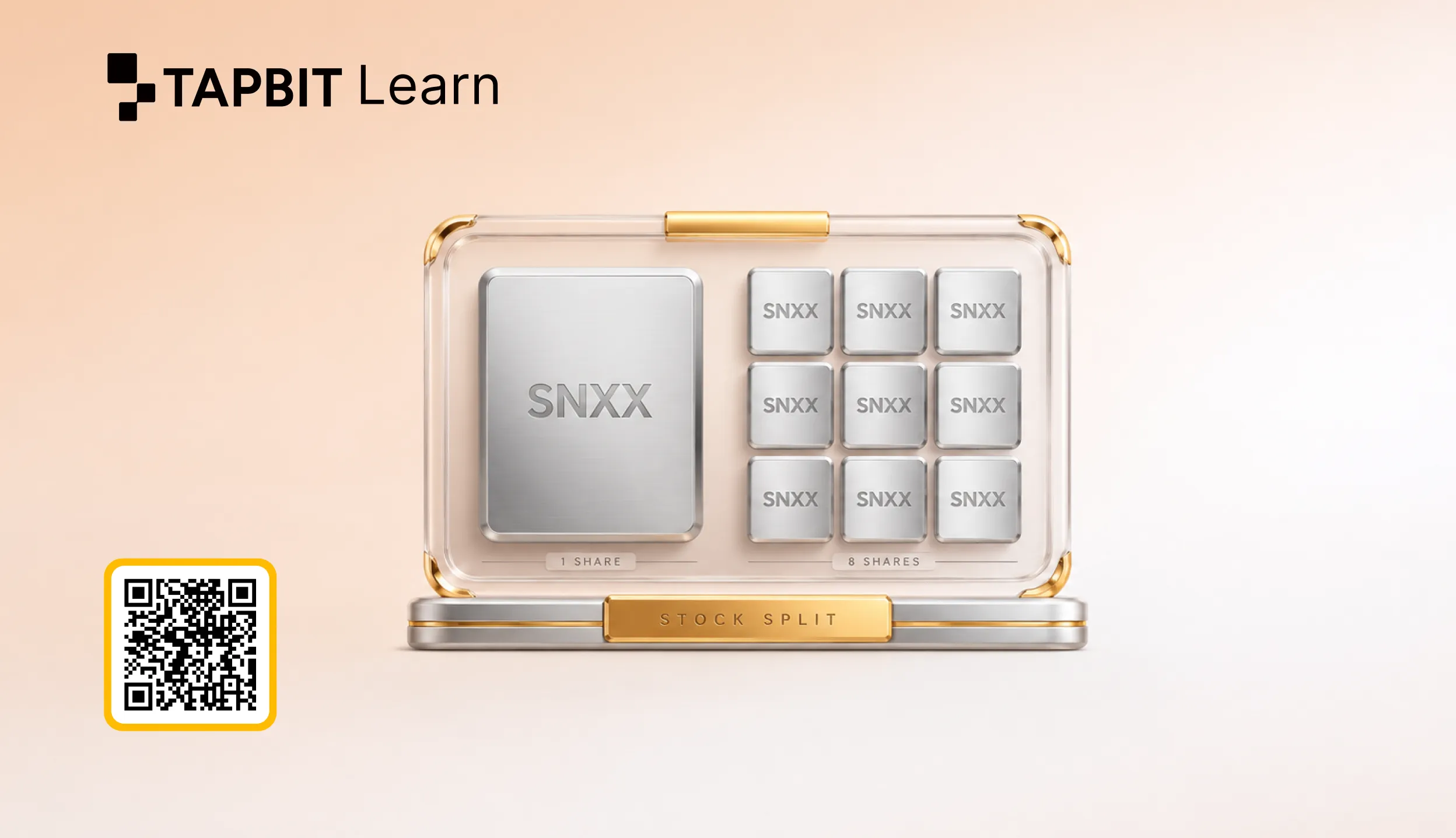
The SNXX stock split was an 8-for-1 forward split that took effect for split-adjusted trading on June 3, 2026. SNXX is the Tradr 2X Long SNDK Daily ETF, so the event changed the number of ETF shares and the nominal price per share, but it did not change the fund's underlying 2X daily investment objective.
The official SEC filing gives a simple illustration: 10 shares at a hypothetical $80 NAV before the split would become 80 shares at approximately $10 each afterward. The total value remains about $800 before normal market movement. This is the clearest way to understand the SNXX stock split: more shares, lower price per share, same economic value at the moment of adjustment.
SNXX Stock Split Date and Ratio
| Event | Date / Detail |
|---|---|
| Split Ratio | 8-for-1 forward split |
| Record Date | June 1, 2026 |
| Payment Date | June 2, 2026 |
| Split-Adjusted Trading | June 3, 2026 |
| Additional Shares | Seven new shares for each share already owned |
These dates matter because charts, brokerage statements and derivative reference prices may show the adjustment at different points in their data processing. The economic event itself is straightforward: the SNXX stock split increased share count by a factor of eight.
How Did the SNXX Stock Split Change the Price?
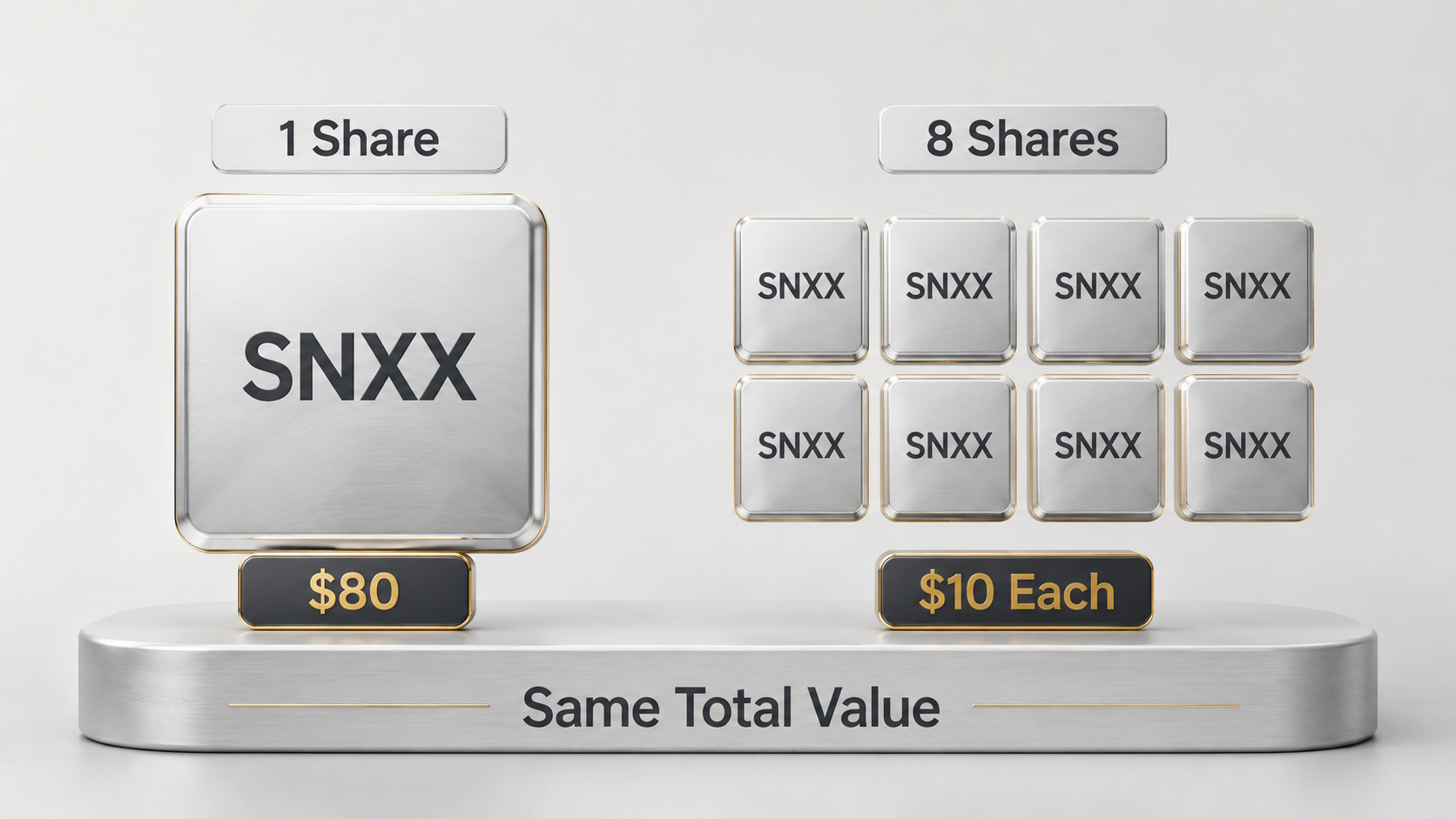
The SEC supplement stated that per-share NAV and the opening market price were expected to be approximately one-eighth of their pre-split amounts. If SNXX had been $80 immediately before the adjustment, a mechanically equivalent post-split price would be about $10.
| Example | Before Split | After 8-for-1 Split |
|---|---|---|
| Shares | 10 | 80 |
| Illustrative Price | $80 | $10 |
| Illustrative Position Value | $800 | $800 |
The lower post-split price therefore should not be interpreted as an 87.5% economic loss. A split changes the unit size, not the total value by itself.
Why Did SNXX Use an 8-for-1 Forward Split?
The official filing describes the corporate action but does not claim that it changed the fund's investment thesis. In practice, forward splits reduce the nominal price per share while increasing the number of shares outstanding. That can make smaller share quantities easier to trade and keep a rapidly appreciating leveraged ETF at a more accessible nominal price.
This context is relevant because SNXX had experienced major price expansion alongside Sandisk before the SNXX stock split. The split adjusted the trading unit after that move without changing the fund's basic exposure.
Did the SNXX Stock Split Change Its 2X Leverage?
No. SNXX still seeks approximately 200% of the daily percentage performance of Sandisk common stock before fees and expenses. The split changed share count and nominal price, not the daily leverage target.
This is important because a lower post-split quote can make the ETF look less risky. It is not. A 10% daily decline in the underlying SNDK stock can still translate into an approximately 20% daily target move for SNXX before fees and tracking effects.
Why Split-Adjusted Charts Matter
The SNXX stock split can create misleading technical analysis when a chart provider does not adjust older prices consistently. A raw pre-split quote should not be compared directly with a post-split quote.
For example, a pre-split price of $64 corresponds mechanically to about $8 on an 8-for-1 adjusted basis. Comparing $64 with a later $8 quote without adjustment would falsely imply an enormous market loss. Professional price services usually back-adjust history, but traders should still check the methodology before drawing support or resistance from older data.
Forward Split vs Reverse Split
The June event was a forward split. A forward split increases the number of shares and reduces the nominal price per share. A reverse split does the opposite by combining several old shares into fewer new shares.
This distinction matters for leveraged ETFs because reverse splits are also common in the category after prolonged declines. The official SNXX filing is explicit: the 2026 event was an 8-for-1 forward split.
What Does the Split Mean for Derivatives?
Options, indexes and perpetual derivatives may require corporate-action adjustments. A direct ETF holder receives the new share count automatically, but a derivative trader owns a contract rather than the underlying ETF shares.
For that reason, users should verify how the venue's index price, mark price and historical chart incorporate the SNXX stock split. An apparent overnight price gap may be a corporate-action adjustment rather than a market profit or loss.
What Should Traders Check After the Split?
After the corporate action, traders should confirm that their chart provider, brokerage or derivative venue is using split-adjusted history. The most useful checks are the June 3 adjustment, historical highs and lows, option strikes and any index methodology used by a derivative product. This prevents a mechanical price reset from being mistaken for a real market crash and keeps technical analysis consistent across the pre-split and post-split periods.
How to Trade SNXX-USDT on Tapbit
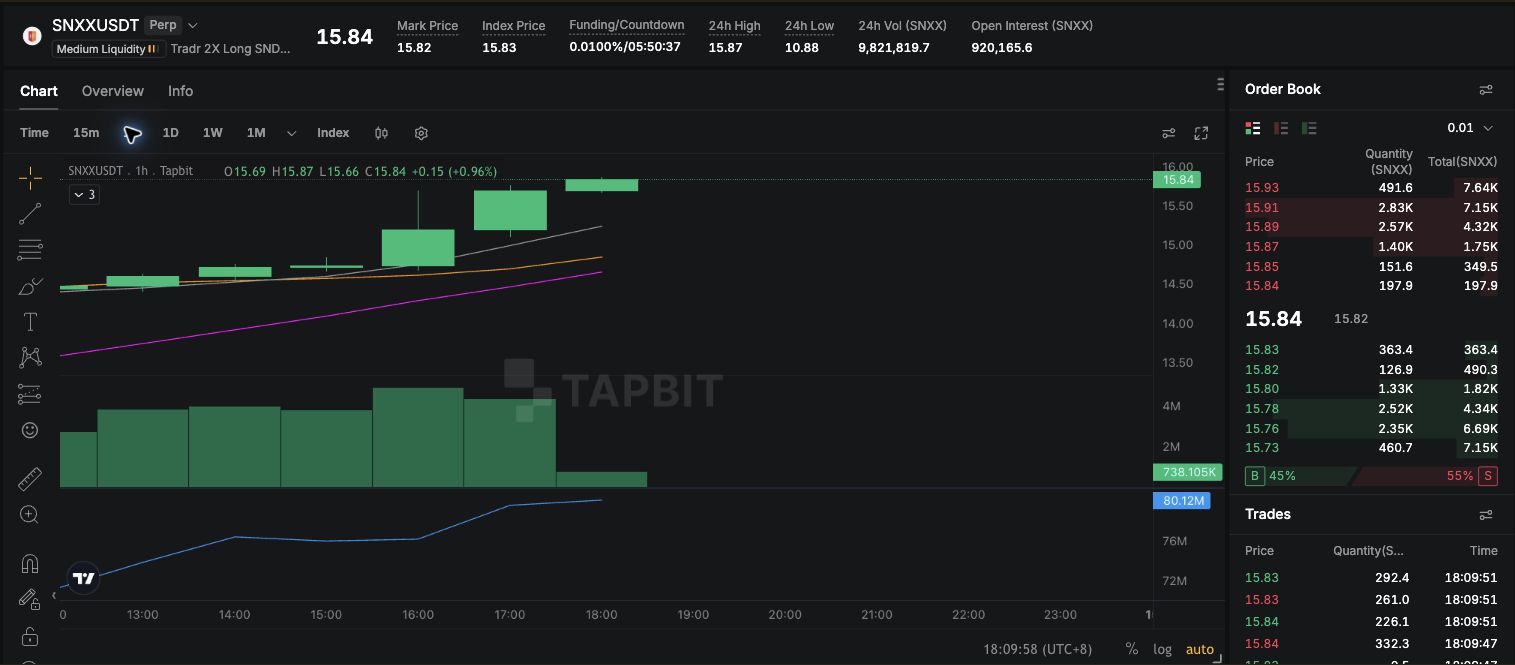
Tapbit offers SNXX-USDT perpetual futures. The contract provides SNXX-linked derivative exposure and is not direct ownership of the Tradr ETF or Sandisk shares.
-
Create an account or log in.
-
Open SNXX-USDT and verify the contract name, mark price, index price and funding countdown.
-
Choose Limit, Market or Trigger, then set quantity, leverage, margin mode and long/short direction.
-
Add TP/SL and monitor margin, Positions, Open Orders, Trigger Orders and liquidation risk.
Bottom Line
The SNXX stock split was a mechanical 8-for-1 forward split, with split-adjusted trading beginning June 3, 2026. The official example shows why price alone can be misleading: a hypothetical $80 share becomes roughly eight $10 shares, while total value remains unchanged. The split did not reduce SNXX's core risk. It remains a daily 2X SNDK ETF, so split-adjusted charts and derivative index checks are essential before trading.
FAQ
When was the SNXX stock split?
SNXX began trading on an 8-for-1 split-adjusted basis on June 3, 2026.
Was the SNXX split a reverse split?
No. It was an 8-for-1 forward split. Each pre-split share became eight post-split shares.
Did investors lose value because of the split?
No. The split itself did not change the total value of a position. Share count increased while NAV and market price per share adjusted proportionally lower.
Does SNXX still target 2X SNDK?
Yes. SNXX continues to target 200% of Sandisk's daily percentage move before fees and expenses.


