
Bitcoin has been under pressure again, trading near the $63,000 level after another round of market weakness. The move has revived a familiar debate: is this simply another painful correction in a volatile asset, or is Bitcoin losing momentum at a time when AI has become the market’s dominant trade?
Michael Saylor, Executive Chairman of Strategy, has offered a clear answer. In his view, Bitcoin’s recent decline is not a sign that its long-term value has been damaged. Instead, he argues that capital is temporarily rotating into AI infrastructure, where investors are chasing one of the strongest growth stories in global markets.
That explanation does not remove the short-term pressure on BTC. ETF outflows, weaker risk appetite, and Strategy’s rare sale of a small amount of Bitcoin have all weighed on sentiment. But it does frame the sell-off differently: less as a collapse in Bitcoin’s core thesis, and more as a liquidity problem in a market where AI is absorbing a large share of institutional attention.
Bitcoin’s problem right now is not just price — it is capital competition
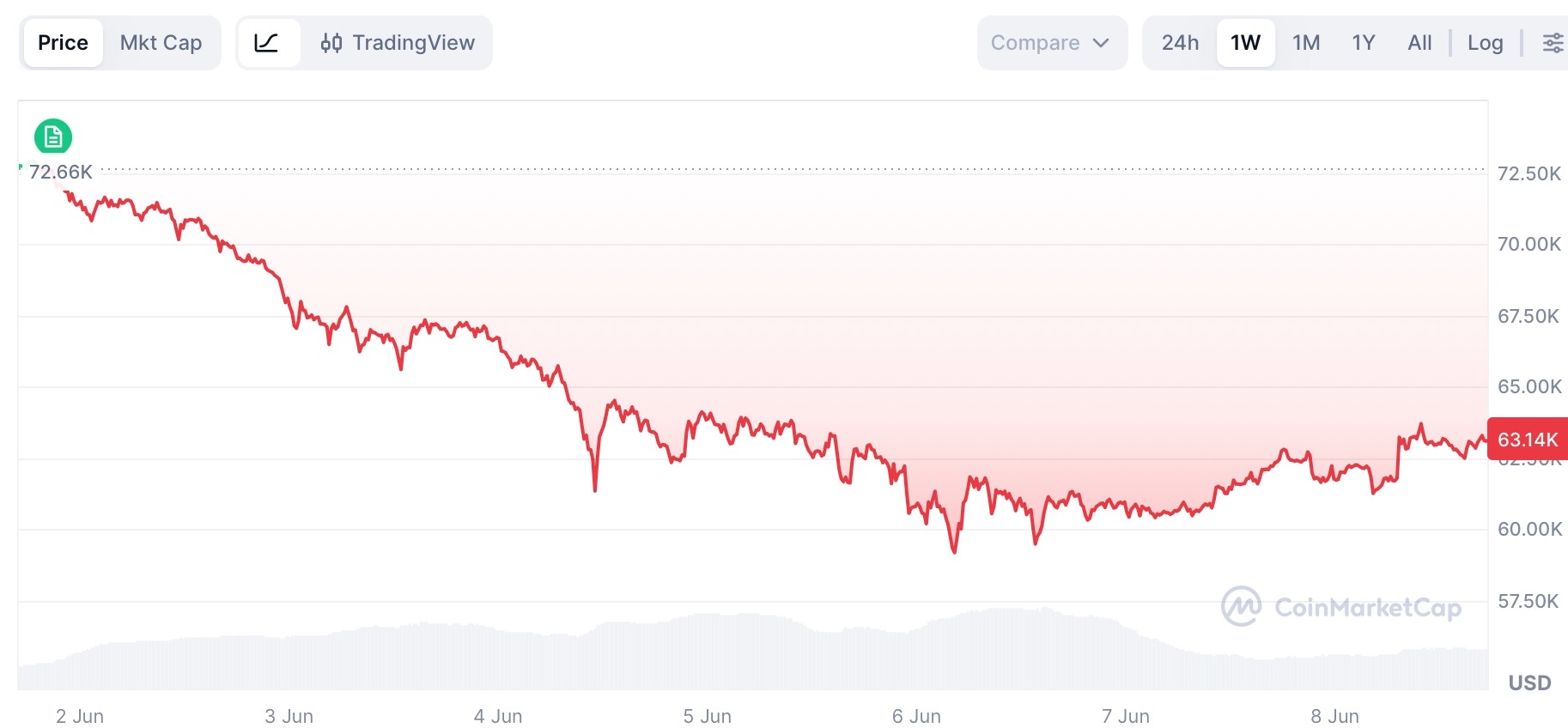
At the time of writing, BTC is trading around $63,000, with a market capitalization of roughly $1.23 trillion and daily trading volume above $30 billion. The price has stabilized slightly, but the broader tone remains cautious.
For much of the past cycle, Bitcoin benefited from a powerful institutional narrative. Spot ETFs opened the door for traditional capital, corporate treasury strategies gained visibility, and BTC was increasingly discussed as a long-term reserve asset rather than just a speculative trade.
That narrative has not disappeared. But in the current market, Bitcoin is competing for capital against a much louder story: AI.
AI chips, data centers, cloud infrastructure, and automation have become the center of global equity market enthusiasm. For portfolio managers, the comparison is straightforward. One side offers a high-growth technology theme with visible corporate spending. The other side offers a volatile macro asset still waiting for fresh catalysts. In that environment, some rebalancing away from BTC is not surprising.
ETF outflows show that institutional demand has cooled
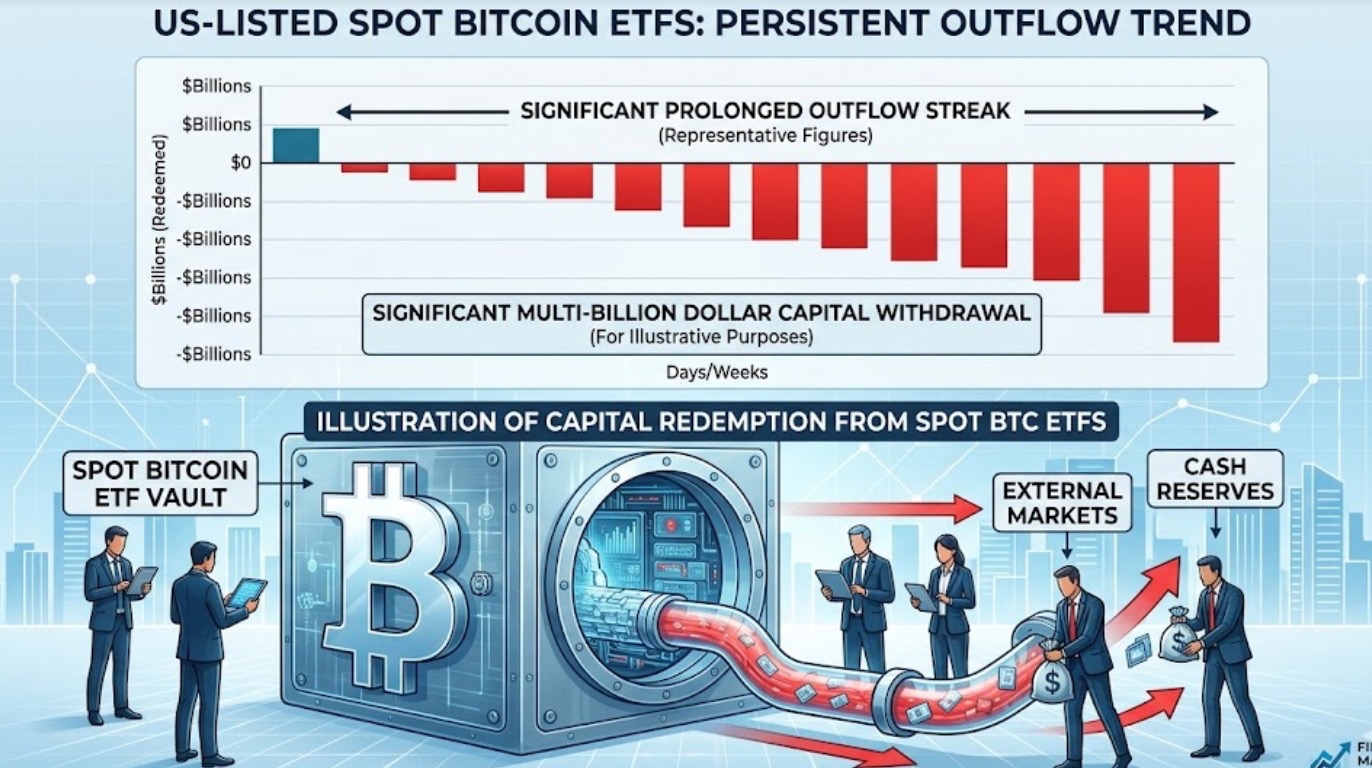
The clearest sign of pressure has come from spot Bitcoin ETFs. Recent reports show that U.S.-listed spot BTC ETFs recorded a 13-day outflow streak, with withdrawals totaling around $4.4 billion during that period.
ETF flows matter because they are one of the cleanest real-time signals of institutional appetite. When inflows are strong, the market tends to read them as confirmation that traditional capital is accumulating. When outflows persist, the message changes quickly. Traders begin to question whether the institutional bid is weakening, and that can amplify downside volatility.
Still, ETF outflows should not automatically be read as a permanent rejection of Bitcoin. They may also reflect a more tactical shift. In a market where AI-related assets are delivering stronger momentum, some investors are choosing to reduce crypto exposure and redeploy capital elsewhere.
That is why Saylor’s “capital rotation” argument has gained attention. It gives the market a way to explain Bitcoin’s weakness without concluding that the asset itself has failed.
AI has become the market’s strongest liquidity magnet
The AI trade is no longer just about a few large technology stocks. It now extends across chips, servers, energy demand, cloud capacity, data centers, and enterprise software. This has turned AI infrastructure into one of the biggest capital allocation themes in the world.
Saylor’s point is that money has not disappeared. It has moved.
For Bitcoin, that distinction matters. If capital is leaving BTC because investors believe the asset no longer has long-term value, that would be a much deeper problem. But if capital is temporarily chasing AI because the near-term returns look more attractive, the pressure may be cyclical rather than structural.
That does not mean Bitcoin will automatically recover once AI cools. Markets rarely move that neatly. But it does suggest that BTC’s current weakness is partly a cross-asset allocation issue. Bitcoin is not only trading on its own fundamentals; it is trading against every other major opportunity competing for institutional dollars.
Right now, AI is winning that competition.
Strategy’s small BTC sale carried a large symbolic weight
Strategy’s recent sale of 32 BTC added another layer of anxiety. On paper, the sale was tiny. The company still holds 843,706 BTC, with an average purchase price of around $75,699. Selling 32 BTC barely changes the size of its position.
But markets do not trade only on numbers. They also trade on stories. Strategy has spent years building a reputation as the most committed corporate Bitcoin holder. For many investors, the company represented a simple message: buy Bitcoin, hold Bitcoin, do not sell Bitcoin. Even a small sale can therefore carry more emotional weight than financial weight.
That is what happened here. The market did not react because 32 BTC created meaningful selling pressure. It reacted because the sale challenged a belief that had become part of Bitcoin’s corporate adoption narrative.
The more practical reading is that Strategy is still heavily committed to Bitcoin, but its treasury model is not completely disconnected from financing needs, dividend obligations, or market conditions. That is not the same as abandoning the BTC thesis. It does, however, remind investors that even the most aggressive Bitcoin strategy has real-world balance sheet constraints.
The debate now is about whether Bitcoin needs a new catalyst
The market is split between two interpretations.
The bullish interpretation is that Bitcoin’s fundamentals are still intact. Its fixed supply has not changed. The network continues to operate. Institutional access through ETFs still exists. The long-term scarcity argument remains in place. From this view, the current decline is mainly a liquidity squeeze caused by capital rotating toward AI.
The cautious interpretation is that Bitcoin is losing relative strength. ETF outflows, weaker price action, and uncertainty around corporate treasury strategies all suggest that BTC may need a fresh catalyst before institutions return in size.
Both views can be true in the short term. Bitcoin’s long-term thesis may remain intact, while its near-term market structure continues to weaken. That is often how risk assets behave during periods of capital rotation. The asset does not need to be “broken” to keep falling. It only needs to be less attractive than the alternatives for a period of time.
Tapbit View: Bitcoin is not trading in isolation
Bitcoin’s latest pullback is a reminder that crypto markets do not move in a vacuum. BTC is influenced by on-chain activity and long-term adoption, but it is also shaped by liquidity, ETF flows, institutional positioning, equity market momentum, and competing investment themes.
AI is currently absorbing a large amount of attention and capital. That has made it harder for Bitcoin to attract fresh inflows, especially while ETF demand remains weak. At the same time, Strategy’s small BTC sale has added psychological pressure by disrupting one of the market’s strongest corporate holding narratives.
For investors, the key is to avoid oversimplifying the move. This is not necessarily proof that Bitcoin’s long-term thesis has failed. It is also not a reason to ignore the risks created by weaker liquidity and shifting institutional preferences.
The next phase will likely depend on whether spot Bitcoin ETF flows stabilize, whether AI’s momentum begins to cool, and whether Bitcoin can regain a stronger institutional bid. Until then, BTC may remain volatile as the market searches for a new balance between long-term conviction and short-term capital rotation.
Traders can follow more market updates on Tapbit, log in, or register to stay connected with global crypto opportunities.
Frequently Asked Questions (FAQ)
Why is Bitcoin under pressure while AI-related assets remain strong?
Bitcoin is facing pressure partly because capital is rotating toward AI-related opportunities. AI infrastructure, including chips, cloud computing, data centers, and enterprise automation, has become one of the strongest investment themes in global markets. As a result, some institutional investors may be reducing exposure to high-volatility assets like BTC and reallocating capital toward sectors with stronger near-term momentum.
Does this mean Bitcoin’s long-term value is weakening?
Not necessarily. A decline in price does not automatically mean Bitcoin’s long-term thesis has failed. Bitcoin’s fixed supply, decentralized network, and institutional access through ETFs remain important parts of its investment case. The current weakness appears more closely tied to liquidity conditions, ETF outflows, and cross-asset capital rotation than to a clear breakdown in Bitcoin’s core fundamentals.
What does Michael Saylor mean by “capital rotation”?
Saylor’s argument is that money is not leaving markets entirely; it is moving from one opportunity to another. In this case, he believes capital is temporarily flowing into AI infrastructure instead of Bitcoin. Under this view, BTC is not being rejected as an asset class, but is competing with AI for institutional capital in the short term.


