

Avalanche entered September with more positive developments than its price had reflected for most of 2026.
AVAX rose from roughly $7.22 on September 1 to $8.07 on September 7, with trading volume also increasing. The network drew attention from a reported South Korean securities platform and a confirmed timeline for the Helicon upgrade.
The rebound has identifiable catalysts, but it doesn't resolve the longer‑standing question: can growth across the ecosystem generate sufficient economic demand for AVAX?
AVAX Has Recovered From Its August Low
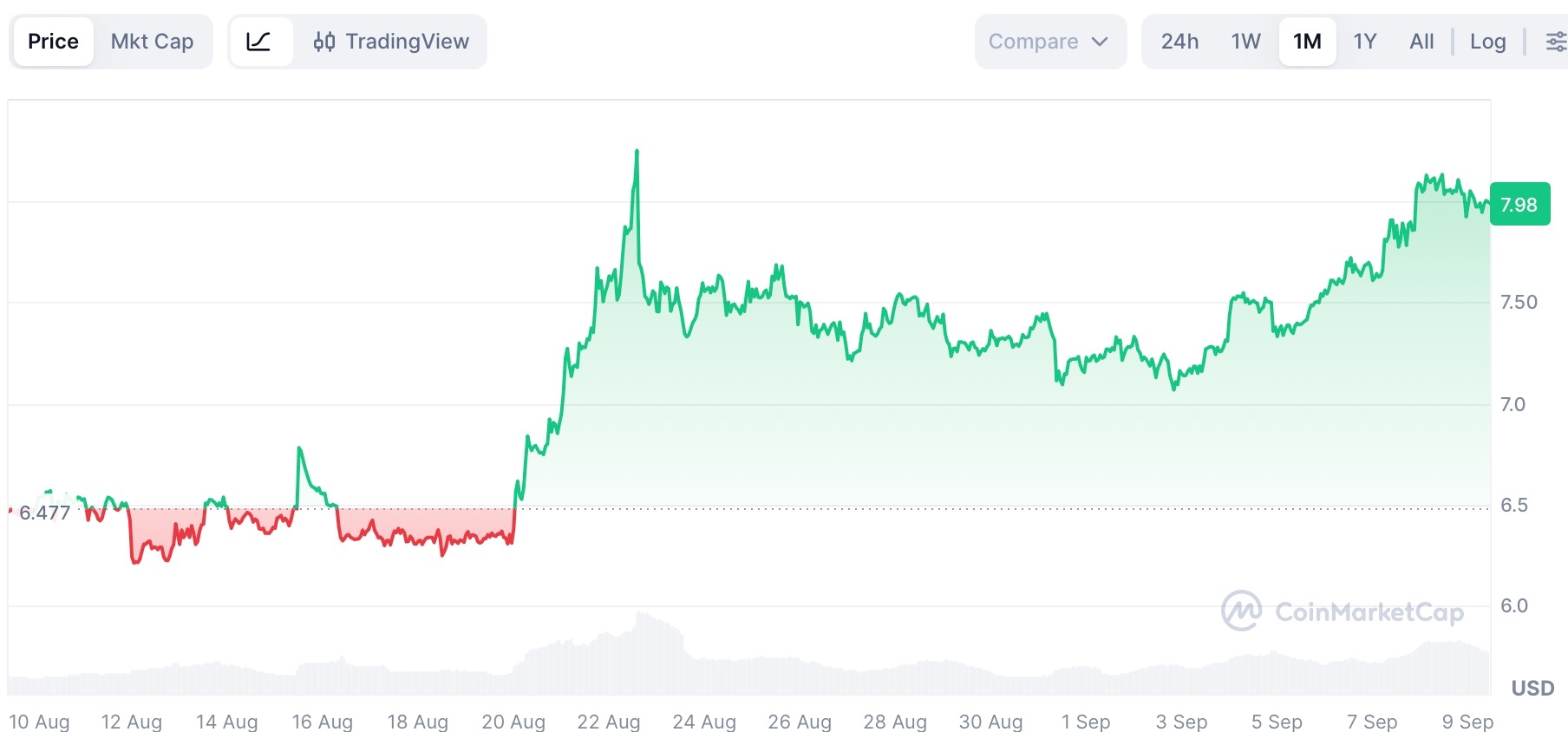
AVAX was trading near $6.36 when concerns about its weak performance intensified in mid-August. By early September, the token had returned above $8.
AVAX closed around $7.19 on September 2 and $8.07 on September 7. Its reported market capitalization reached approximately $3.49 billion on September 8, accompanied by about $405 million in daily trading volume.
This is a meaningful recovery from the August range, but AVAX remains far below both its 2021 peak and its price at the beginning of 2026. The recent move is better described as a rebound than a confirmed long-term reversal.
What makes it more interesting is the timing. The price recovery coincided with new evidence of Avalanche’s role in South Korean tokenization infrastructure and details of an upgrade that could reduce AVAX inflation.
A Korean Securities Platform Has Added Avalanche Support
On September 6, the Seoul Economic Daily reported that Hanwha Investment & Securities had completed a tokenized-securities platform supporting Avalanche and Hyperledger Besu.
The system was developed with FairSquare Lab and is designed to record the issuance and transfer of tokenized securities. The Korea Securities Depository is also preparing infrastructure capable of connecting with Avalanche, Besu and Hyperledger Fabric, according to the report.
This development is relevant because South Korea is preparing to bring tokenized securities into its regulated capital-market framework. Avalanche’s architecture allows financial institutions to operate separate networks while retaining access to public blockchain infrastructure.
The available evidence needs to be described carefully. Hanwha has reportedly built a multi-network platform that supports Avalanche. That does not mean South Korea’s entire capital market is moving onto Avalanche, nor does it prove that securities are already being issued at scale.
No public figures have yet established how many assets will use the platform, how much value it will process or how much AVAX the system will require. The announcement strengthens Avalanche’s institutional narrative, but its economic impact remains to be measured.
Helicon will Arrive on September 22
A more direct change to Avalanche’s economics is scheduled for September 22. The official Helicon upgrade announcement confirms that the upgrade will activate on Avalanche mainnet at 15:00 UTC. Helicon combines changes to C-Chain performance with a significant revision of staking operations.
Validators will be able to renew their stake automatically rather than manually re-entering the validator set when each period ends. The minimum staking duration will fall from two weeks to 48 hours, making shorter commitments more practical for professional operators.
The uptime requirement for receiving rewards will rise from 80% to 90%. Validators falling below the threshold will forfeit the reward for that cycle, placing greater emphasis on reliable infrastructure.
Helicon will also introduce Continuous Execution on C-Chain. Consensus will be able to accept blocks while a separate process executes transactions, reducing the bottleneck created when those activities take place sequentially.
These are technical improvements, but the staking changes may have more immediate relevance for AVAX holders.
Helicon Could Slow AVAX Inflation
Avalanche has a maximum supply of 720 million AVAX, but the circulating supply continues to grow through validator rewards. Transaction fees are burned, yet extremely low C-Chain fees mean that rising transaction counts do not necessarily destroy enough AVAX to offset new issuance.
Helicon changes part of that equation.
The upgrade will gradually reduce the mean staking-reward consumption rate from 10% to 7.5%. Avalanche estimates that the adjustment could lower annual inflation by approximately 0.5 to 1 percentage point.
The change will not make AVAX immediately deflationary. Validator rewards will continue, and the actual result will depend on staking participation, reward duration and network fees.
Still, this is a more direct response to AVAX’s value-capture problem than another increase in transaction throughput. Slower issuance improves the supply side even if fee demand remains modest.
Shorter staking periods could also encourage more institutional participation. Funds and professional investors often face liquidity and redemption requirements that make long lockups difficult. A 48-hour minimum offers greater flexibility, although it may also allow capital to leave staking more quickly during volatile markets.
Avalanche’s RWA Business Is Growing
Real-world asset tokenization remains Avalanche’s strongest institutional use case.
RWA.xyz data for September 8 showed approximately $1.68 billion in distributed RWA value on Avalanche. The platform also reported roughly $11.4 billion in represented value.
Those categories should not be combined without context. Distributed assets are issued and held across blockchain addresses. Represented value can include assets recorded or referenced through blockchain infrastructure without the entire amount circulating freely onchain.
For that reason, describing Avalanche as having more than $13 billion in conventional RWA TVL would be misleading. The $1.68 billion distributed figure offers a more conservative measure of tokenized value directly associated with the network.
Avalanche also hosted approximately $870 million in stablecoins, according to the same dataset. Stablecoin liquidity matters because it supports settlement, trading and lending around tokenized assets.
The opportunity is real, but the link to AVAX remains indirect. An institution can use an Avalanche-based network without buying a large amount of AVAX, particularly after earlier upgrades reduced the cost of operating custom Avalanche L1s.
The Value-Capture Question Remains Open

Avalanche has made its network cheaper and easier to use. That has helped applications, institutions and custom L1 operators, but it has weakened some of the earlier assumptions about AVAX demand.
Low fees mean less AVAX is burned per transaction. Custom L1 validators no longer need to lock 2,000 AVAX as they did under the previous model. Institutional networks may benefit from Avalanche technology without creating large purchases of the token.
Helicon improves this picture by reducing expected inflation and simplifying staking. Korean tokenization activity could also generate settlement and network demand if real securities begin moving through Avalanche-based infrastructure.
Neither development guarantees strong value capture.
For AVAX to benefit over time, Avalanche needs a combination of rising network fees, consistent staking, more capital entering its investment products and applications that require AVAX rather than merely using Avalanche software.
Avalanche Is Improving the Economics, Not Solving Them Overnight
Avalanche’s recent progress is substantial. Its RWA footprint is growing, Korean financial infrastructure is reportedly adding Avalanche support, and Helicon introduces a credible attempt to reduce inflation while improving validator operations.
These developments explain why AVAX has recovered from its August low. They do not yet prove that the token has entered a durable repricing cycle.
Helicon changes how AVAX is issued and staked. The Korean platform could expand how Avalanche is used. The missing evidence is whether those changes produce sustained purchases, locking, fee payments and burns at a scale that matters to the token.
Follow Avalanche and the wider digital-asset market through Tapbit. Users with an existing account can log in here; those opening a new account can use the Tapbit registration page.
Frequently Asked Questions
Why is AVAX rising?
AVAX rebounded in early September alongside news that a Hanwha Investment & Securities platform supports Avalanche and confirmation that the Helicon network upgrade will activate on September 22. Broader crypto-market conditions may also have contributed.
What is the Avalanche Helicon upgrade?
Helicon is a mainnet upgrade introducing Continuous Execution, automatically renewed validator staking, a shorter minimum staking period, a higher validator uptime requirement, a dynamic minimum gas price and a revised staking-reward curve.
When will Helicon activate?
Avalanche has scheduled Helicon to activate on September 22, 2026, at 15:00 UTC. Mainnet validators must upgrade their AvalancheGo software before activation.


