

The Federal Reserve's September interest-rate decision has become one of the most important macro events for Bitcoin traders. After holding rates steady in July, the Fed faces a difficult choice: keep policy unchanged while waiting for more data, or raise rates to contain persistent inflation.
A September hold remains possible, but it is no longer an easy consensus call. The unusually divided July vote, elevated energy prices, and stubborn inflation have made a rate hike a credible alternative. Bitcoin traders should therefore focus on incoming economic data instead of treating either outcome as certain. Traders following the market can also view the BTC/USDT spot market on Tapbit as expectations change.
What Happened at the July FOMC Meeting?
The Federal Reserve kept the federal funds target range unchanged at 3.50%-3.75% at its July meeting, extending the pause for a fifth consecutive meeting. The decision was not unanimous: three officials preferred an immediate 25-basis-point increase, producing a 9-3 vote. That level of dissent showed that inflation concerns were becoming more influential inside the committee.
The July decision therefore carried two messages. The Fed was not ready to tighten policy immediately, but a meaningful group of policymakers believed existing rates were no longer restrictive enough. This split is why the September meeting is attracting more attention than a routine policy hold. The next scheduled meeting is September 15-16, according to the Federal Reserve's monetary policy calendar.
Will the Fed Hold Rates in September?
The honest answer is that the September decision remains too close to call with confidence. Immediately after the July meeting, interest-rate markets assigned greater weight to a possible hike. Those expectations later moderated as investors assessed Fed communication and the possibility that higher bond yields were already tightening financial conditions.
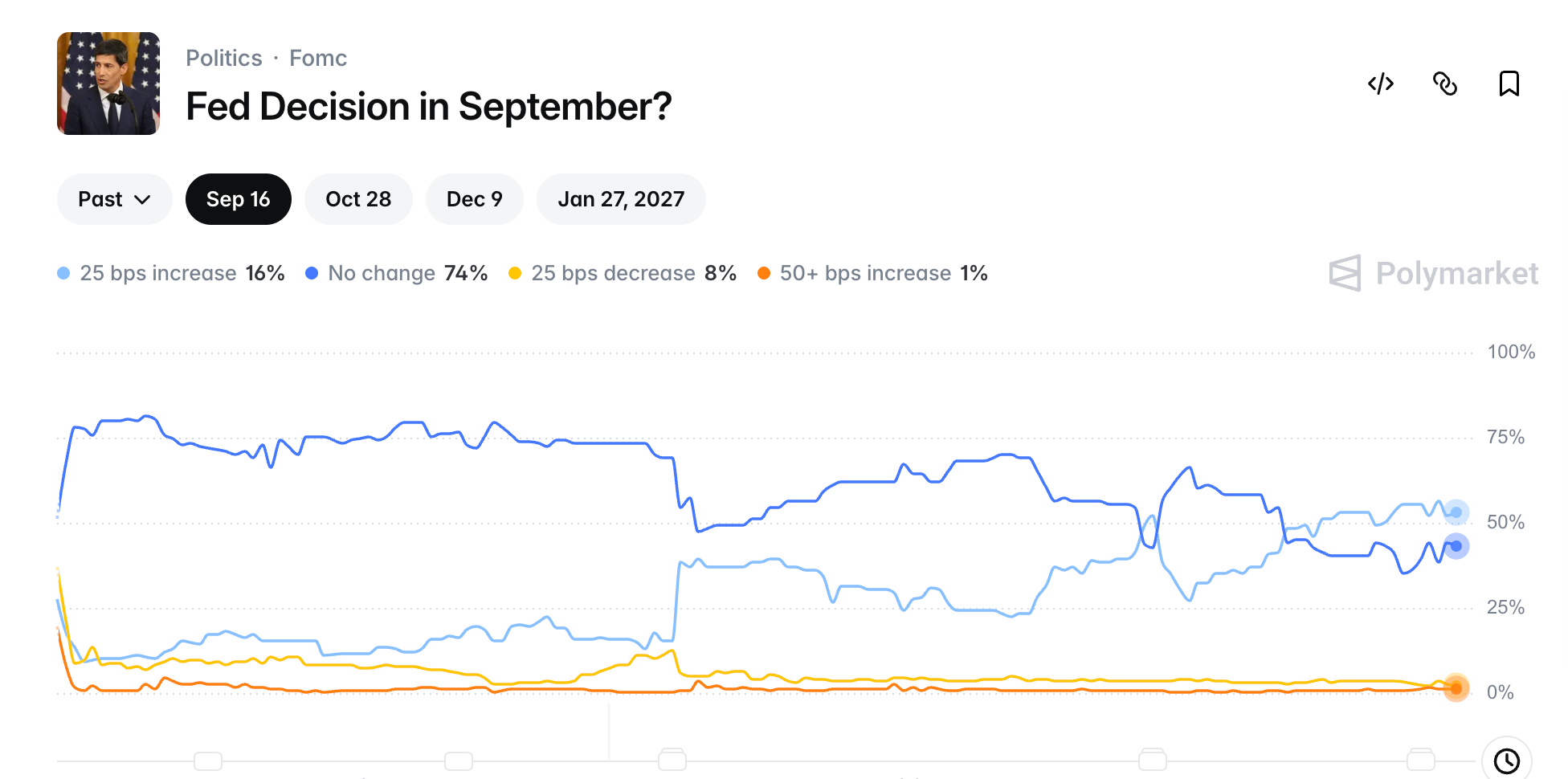
A hold becomes more plausible if inflation stabilizes, employment weakens, consumer demand slows, or Treasury yields remain elevated. A hike becomes more likely if inflation accelerates, oil remains expensive, wage growth stays strong, or consumer spending continues to exceed expectations. The three July dissents show that tighter policy already has meaningful support inside the committee.
Economic Data That Could Decide the September FOMC Outcome
Inflation will remain the central variable. Policymakers are likely to examine headline and core CPI, the Personal Consumption Expenditures index, wage growth, and inflation expectations. Energy prices also matter because higher oil costs can feed into transportation, production, and consumer prices. Persistent strength in crude oil would make a hold harder to justify if underlying inflation is elevated at the same time.
Employment data provides the other side of the debate. A sharp slowdown in payroll growth or a rise in unemployment could discourage further tightening. Strong job creation and wage growth would give the Fed more room to raise rates without immediately threatening economic activity. Treasury yields deserve equal attention: rising two-year and ten-year yields increase borrowing costs across the economy even when the policy rate does not change.
Why FOMC Odds Matter for Bitcoin
Bitcoin trades continuously, but its price is strongly influenced by global liquidity and the expected path of U.S. interest rates. Higher rates increase the return available on cash and government bonds, can strengthen the dollar, and make leveraged positions more expensive. A surprise September hike could therefore pressure Bitcoin, altcoins, technology stocks, and other risk-sensitive assets.
A hold could provide short-term relief, especially if the accompanying statement suggests that policymakers are comfortable waiting. However, a hold alone is not automatically bullish. If the Fed leaves rates unchanged while warning that a future hike is likely, Bitcoin may still struggle.
| FOMC Signal | Possible Bitcoin Reaction |
|---|---|
| Hold with patient guidance | Moderately bullish |
| Hold with a strong inflation warning | Mixed or volatile |
| 25-basis-point hike | Initially bearish |
| Hike with softer future guidance | Sharp decline followed by stabilization |
| Lower inflation before the meeting | Supports BTC risk appetite |
The press conference and updated economic projections may therefore matter as much as the headline decision.
Bitcoin Price Levels and Market Signals to Watch
Bitcoin has recently traded around the mid-$60,000 area while investors digest the July decision. That range reflects uncertainty rather than a decisive bullish or bearish trend. A sustained move above nearby resistance could indicate that traders are positioning for a September hold or improving liquidity conditions. Failure to hold recent support would suggest that macro risk, ETF flows, or leverage reduction is overpowering the rate-hold narrative.
- The U.S. Dollar Index
- Two-year Treasury yields
- Bitcoin ETF inflows and outflows
- Perpetual futures funding rates
- Open interest and liquidation data
- Bitcoin's correlation with the Nasdaq
- September interest-rate probabilities
No single indicator can reliably predict Bitcoin's next move. A stronger signal appears when several indicators point in the same direction. Falling Treasury yields, a weaker dollar, positive ETF flows, and moderate funding rates would create a more constructive environment than a rate-hold probability alone.
Bullish Scenario: The Fed Holds and Inflation Cools
The strongest bullish scenario would involve softer inflation, moderate employment growth, and stable or lower energy prices before September. Under those conditions, the Fed could hold rates and emphasize that current policy remains sufficiently restrictive. Treasury yields might decline, the dollar could weaken, and investors could rotate toward risk assets.
Bitcoin could then attempt to break above its recent range. A healthier rally would require spot buying and ETF demand rather than excessive leverage. If open interest rises much faster than spot volume, the move would remain vulnerable to liquidation-driven reversals.
Bearish Scenario: Inflation Forces a September Hike
The bearish scenario begins with renewed inflation pressure. Higher oil prices, strong wage growth, or unexpectedly resilient consumer demand could strengthen the argument for another rate increase. A September hike would likely push short-term yields higher and pressure speculative assets as leveraged positions unwind.
The longer-term effect would depend on the Fed's guidance. A single hike followed by a prolonged pause may produce less damage than a signal that several increases are possible. Traders should avoid assuming that every hike produces the same market outcome.
Conclusion
The Fed may hold rates in September, but the divided July vote and persistent inflation risks mean that another pause is not guaranteed. The decision will depend heavily on inflation, employment, oil prices, Treasury yields, and financial conditions during August and early September.
For Bitcoin, the most favorable outcome would be a hold accompanied by evidence that inflation is cooling and further tightening is unnecessary. A hawkish hold could create only temporary relief, while a surprise increase would probably generate immediate volatility. FOMC probabilities should be treated as changing market estimates rather than certain predictions, making position sizing and leverage control more important than committing too early to one scenario.
FAQ
When is the September 2026 FOMC meeting?
The Federal Reserve's September meeting is scheduled for September 15-16, 2026.
Did the Fed raise rates in July 2026?
No. The Fed maintained its target range at 3.50%-3.75%, although three officials voted for a 25-basis-point increase.
Is a September rate hold bullish for Bitcoin?
It can be bullish if the hold is accompanied by softer inflation and patient guidance. A hawkish hold may produce a weaker or short-lived reaction.
What could make the Fed raise rates in September?
Higher inflation, elevated oil prices, strong wage growth, resilient consumer demand, and persistent inflation expectations could strengthen the case for a hike.
What should Bitcoin traders monitor before the FOMC meeting?
Key indicators include CPI, PCE inflation, payrolls, unemployment, oil prices, Treasury yields, the U.S. dollar, ETF flows, funding rates, and open interest.
Risk notice: This article is for informational purposes only. FOMC probabilities and market scenarios can change quickly, and cryptocurrency trading involves substantial risk.


