
If you've been searching "what is OP token," here's the one-sentence answer:
OP token is the governance token of Optimism — a Layer 2 network built on top of Ethereum to make crypto transactions faster and cheaper.
That's it. That's the foundation.
Now, what is OP token really about in practice? Two common misconceptions get in the way. First, many beginners assume OP is Optimism's gas fee token — it's not. Second, some treat it like a meme coin with no real function — that's also wrong.
OP has a specific job: it gives holders a voice in how Optimism grows and evolves. Before you check the price, it's worth understanding exactly what that means.
What Does OP Token Mean in Crypto?
OP token means the governance token of the Optimism ecosystem.
Let's break that down into three fast facts:
- OP is an ERC-20 token. It runs on Ethereum, not its own separate blockchain.
- OP is for governance. Holders vote — or delegate votes — on protocol upgrades, funding decisions, and ecosystem direction.
- OP is not a gas token. Transactions on Optimism still use ETH for fees, not OP.
Think of it this way: if Ethereum is the highway, Optimism is the express lane. OP is the voting card that decides who builds the next on-ramp.
That's what "OP token" means in crypto — a governance tool, not a payment method.
What Is Optimism and Why Does It Need OP?
The Problem Optimism Solves
Ethereum is secure and decentralized. But it's also slow and expensive during peak usage. Every transaction competes for limited block space, and fees can spike dramatically.
Optimism fixes this with a technology called optimistic rollups. Instead of processing every transaction directly on Ethereum, Optimism bundles thousands of transactions together and settles them as a single batch on Ethereum's main chain. The result: faster speeds, lower costs — still backed by Ethereum's security.
Why the Token Exists
Optimism isn't just a piece of software. It's a protocol with real economic weight. Someone has to make decisions about how it upgrades, how funds are distributed, and where the ecosystem goes next.
That's where OP comes in. Rather than letting a single company control those decisions, OP token distributes that power to the community. Every OP holder gets a seat at the table.
OP is what turns Optimism from a company product into a community protocol.
What Is OP Token Used For? (3 Real Jobs)
1. Governance Voting
This is OP's primary function. Holders can vote directly on governance proposals — or delegate their voting power to a trusted representative called a delegate.
What gets voted on?
- Protocol upgrades and technical changes
- Treasury fund allocations
- Ecosystem incentive programs
- Key governance parameters
One important note: you must delegate your OP (even to yourself) before your votes count on-chain.
2. Ecosystem Incentives
Optimism allocates 25% of total OP supply to an Ecosystem Fund. These tokens are used to:
- Reward developers building on Optimism
- Support liquidity programs across DeFi apps
- Fund growth initiatives for new protocols
OP acts as fuel for the ecosystem — distributed to people and projects that make Optimism more useful.
3. Retroactive Public Goods Funding (RetroPGF)
This is where Optimism gets genuinely interesting.
Most crypto projects promise future rewards to attract builders. Optimism does the opposite: it rewards past contributions after they've already proven valuable.
The Citizens' House decides which projects deserve funding. Winners receive OP grants — no promises required, just demonstrated impact.
Think of it like a Yelp review system — but for public good contributors, and the reward is real tokens.
Is OP Token Used for Gas Fees? (Common Misconception Cleared Up)
No. OP token is not used for gas fees on Optimism.
This is one of the most common beginner mistakes. You hear "OP is Optimism's token" and naturally assume it powers transactions. It doesn't.
On OP Mainnet, gas fees are paid in ETH — same as Ethereum itself.
Here's why this matters practically: if you buy OP and want to use Optimism-based apps like DeFi protocols or NFT platforms, you still need ETH in your wallet. Without ETH for gas, your OP sits idle — you can hold it and vote with it, but you can't transact.
OP = voting card. ETH = fuel.
Get both if you plan to actively use the Optimism network.
OP Token vs ETH: What's the Difference?
These two tokens are often confused, especially by newcomers to Ethereum Layer 2.
| OP Token | ETH | |
|---|---|---|
| Main role | Governance & ecosystem | Gas fees & base asset |
| Network | Optimism ecosystem | Ethereum + all L2s |
| Pays gas fees? | ❌ Usually no | ✅ Yes, on OP Mainnet |
| Holder benefit | Voting rights, ecosystem exposure | Transaction settlement, staking |
The key takeaway: OP doesn't compete with ETH. They serve different functions in the same stack.
ETH powers the engine. OP votes on who steers.
How Does Optimism Governance Actually Work?
Optimism's governance structure is called the Optimism Collective. It works like a two-chamber system — similar in concept to a parliament.
Token House
- Made up of OP token holders and their delegates
- Votes on protocol upgrades, treasury allocation, sequencer selection, and governance parameters
- Uses token-weighted voting: more OP = more voting power
- This is where your OP has direct influence
Citizens' House
- Made up of reputation-based community members, not token holders
- Uses a one-person-one-vote system, verified by non-transferable NFTs (attestations)
- Responsible for RetroPGF: deciding which public goods projects get funded
- Can veto certain Token House decisions to prevent governance capture
Simple analogy: Token House = shareholder meeting. Citizens' House = independent oversight board.
The two-house design is intentional. It prevents token-rich whales from controlling everything, while keeping OP holders meaningfully involved in economic decisions.
Why Does OP Token Matter for the Superchain?
OP Mainnet Is Just the Beginning
Most people searching "what is OP token" think of a single chain: OP Mainnet. But Optimism's real ambition is much bigger.
Optimism built an open-source framework called the OP Stack. It lets any team deploy their own Ethereum-compatible Layer 2 chain using the same standardized components. The collection of chains built on the OP Stack is called the Superchain.
Who Uses the OP Stack?
You've likely already used OP Stack chains without knowing it:
- Base — Coinbase's Layer 2 (launched August 2023)
- Unichain — Uniswap's own L2, focused on DeFi
- Worldchain — built by the Worldcoin team, designed for verified humans
The OP Stack now powers 50+ production chains. In H2 2025 alone, Superchain activity reached 3.6 billion transactions — up from 2.47 billion in H1. That growth is real.
The 2026 Buyback Program
In February 2026, Optimism governance approved a significant change: 50% of net Superchain transaction fees are now used to buy back OP tokens on the open market.
The repurchased OP is then redistributed through RetroPGF — rewarding ecosystem contributors while creating direct, usage-linked demand for the token.
This shifts OP's narrative. It's no longer purely a governance token. It's becoming a token whose demand grows with network usage.
This doesn't guarantee any price outcome. But it does make OP more interesting to watch if you follow Ethereum Layer 2 development.
How to Trade OP Token on Tapbit
Once you understand what OP does, the next practical question is how to access it.
On Tapbit, you can trade OP in two ways: futures or spot. Each suits a different type of user.
Method 1 — Trade OP Futures on Tapbit
Futures let you trade OP's price movement without directly holding the token. You can go long (betting price rises) or short (betting price falls) — with leverage if you choose.
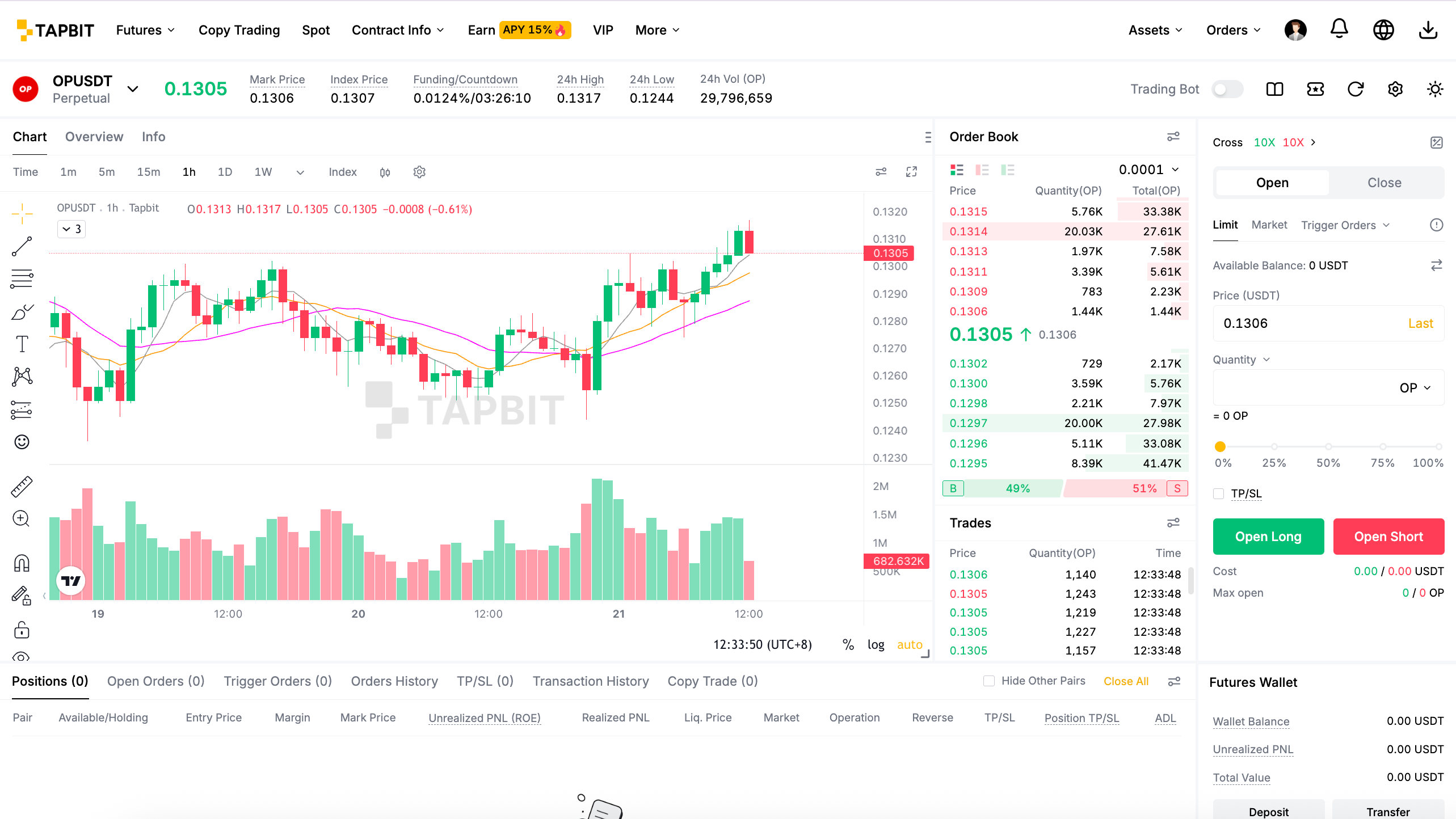
Steps:
- Go to OP futures trading on Tapbit
- Log in or create an account
- Transfer funds to your futures wallet
- Choose your margin mode and leverage level carefully
- Select long or short based on your view
- Check the funding rate, liquidation price, and order book before confirming
Important: Leverage amplifies both gains and losses. Never use more leverage than you understand.
Method 2 — Buy OP Spot on Tapbit
Spot trading means you actually own the OP tokens. It's simpler and more suitable if you want to hold OP long-term or participate in governance.
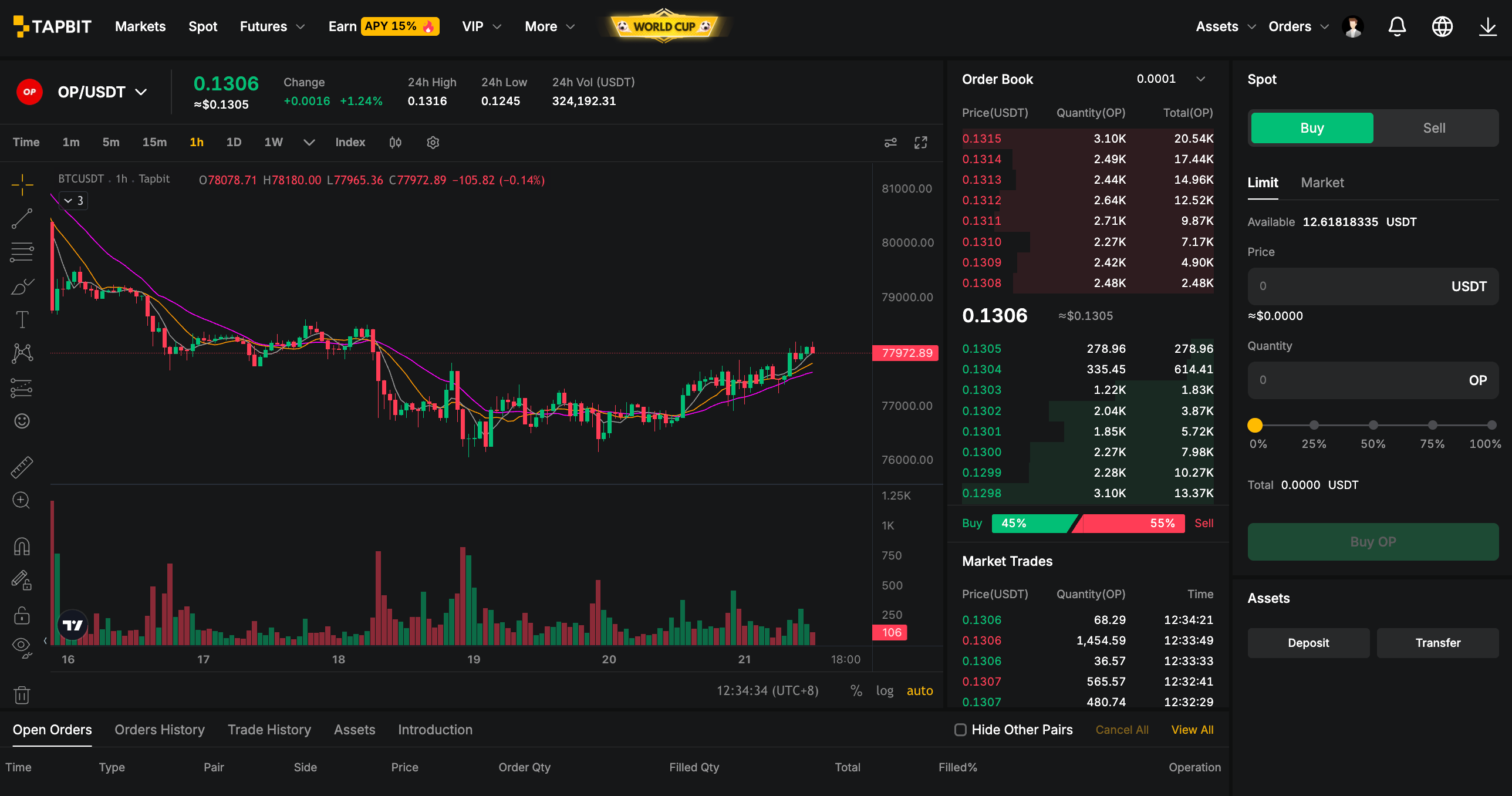
Steps:
- Go to OP spot trading on Tapbit
- Fund your spot account via deposit or transfer
- Search for the OP/USDT pair
- Choose a market order (instant) or limit order (set your price)
- Enter the amount and confirm
You can also check OP price and market data before placing any order.
New to crypto? Start with small position sizes. OP is volatile. Understanding the asset before trading it is always step one. If you're ready to get started, create an account and explore the platform.
Final Thoughts — What Is OP Token for Beginners?
Let's come back to the original question: what is OP token?
Here's what every beginner should remember:
- OP is a governance token — not a gas token, not a meme coin.
- Optimism is a growing Layer 2 ecosystem. OP gives you a vote on its future.
- You still need ETH to pay gas fees when using Optimism apps.
- The Superchain is the bigger picture. OP's value is tied to a network of 50+ chains, not just one.
- The 2026 buyback program links OP demand directly to Superchain transaction volume for the first time.
What is OP token at the end of the day? It's your governance stake in one of Ethereum's most active Layer 2 ecosystems. Whether you hold it for voting, ecosystem exposure, or trade it based on market view — understanding it clearly is always the right place to start.
If you follow Ethereum Layer 2, Superchain development, or crypto governance narratives, OP token is worth understanding before watching its price.
FAQ
Q1: What does OP stand for in OP token?
In crypto, OP stands for Optimism — the Ethereum Layer 2 network behind the token. The full name is the Optimism token, and it's the governance token of the Optimism Collective.
Q2: Is OP token the same as Optimism?
Not exactly. Optimism is the network and the ecosystem. OP is the token connected to its governance and incentives. You can think of Optimism as the platform and OP as your membership card — related, but not the same thing.
Q3: Do I need OP token to use Optimism apps?
No. To use apps on Optimism — like swapping tokens, providing liquidity, or minting NFTs — you need ETH for gas fees. OP is for governance participation, not for paying transaction costs. That said, you can trade OP on exchanges without ever touching the Optimism network directly.
Q4: What is RetroPGF and how does it relate to OP?
RetroPGF stands for Retroactive Public Goods Funding. It's Optimism's program for rewarding builders who've already contributed value to the ecosystem — after the fact, not as a promise. Winners receive OP grants, determined by the Citizens' House. It's one of the most distinctive features of the Optimism model and a major use case for OP distribution.
Q5: What is the OP Stack and why does it matter for OP token?
The OP Stack is the open-source framework Optimism built for launching Ethereum-compatible Layer 2 chains. It powers Base, Unichain, Worldchain, and 50+ other chains — collectively called the Superchain. As the Superchain grows, more transaction fees flow through the ecosystem. Since February 2026, 50% of those fees are used to buy back OP, meaning the token's demand grows with the network's usage.
Q6: Is OP token a good investment?
That depends entirely on your own risk tolerance, market view, and understanding of the Optimism ecosystem. OP is volatile — like all crypto assets — and its price can move significantly in either direction. Understanding what is OP token and how it works is essential before making any decision. This article is educational only and not financial advice. Always do your own research before trading.hello


