
"Earn Solana" is a phrase that appears constantly in crypto, yet rarely comes with a plain explanation. If you hold SOL and want to understand what earning on it actually involves, this guide covers the definition, the main methods available in 2026, and how to compare them.
What Does "Earn Solana" Mean?
"Earn Solana" means using your existing SOL holdings to generate potential rewards over time, rather than keeping them idle in a wallet. In crypto, "earn" typically refers to staking, exchange earn products, liquid staking, or DeFi yield strategies.
A few things worth clarifying before going further:
-
Earn Solana does not mean receiving free SOL
-
Earn Solana does not guarantee fixed income or profit
-
Earn Solana means placing SOL into a mechanism that may produce rewards based on network activity, platform terms, or protocol rules
Rewards vary by method, market conditions, and platform. They are never guaranteed. You can check SOL price on Tapbit at any time to understand how market movements affect the real value of your rewards.
How Do People Earn Solana?
There are five main ways SOL holders generate rewards. Each differs in complexity, flexibility, and typical return.
1. Native Staking
Native staking means delegating SOL to a validator — a node that processes transactions and helps secure the Solana network. In return, delegators receive a share of network inflation rewards. Payouts occur roughly every two to three days, aligned with Solana's epoch cycle (the fixed time period the network uses to calculate and distribute staking rewards).
There is no minimum amount required to delegate. However, users need a self-custody wallet, an understanding of validator selection, and awareness of the unstaking delay — funds are not immediately available after initiating a withdrawal.
2. Liquid Staking
Liquid staking protocols such as Jito (jitoSOL) and BlazeStake (bSOL) allow users to stake SOL while receiving a liquid token in return. That token represents the staked position and can be used in DeFi applications while rewards continue to accumulate in the background.
As of mid-2026, major liquid staking tokens offer approximately 5.5% to 6% APY, with MEV-sharing validators potentially reaching higher. Liquid staking offers more flexibility than native staking but introduces smart contract risk — protocol bugs or exploits can affect the underlying assets.
3. Exchange Earn Products
Many centralized exchanges offer Earn products where users deposit SOL and receive estimated rewards without any validator management or wallet configuration. These products are the most accessible option for beginners. Flexible variants typically allow redemption at any time, while fixed-term options may offer slightly higher rates in exchange for a lock-up period.
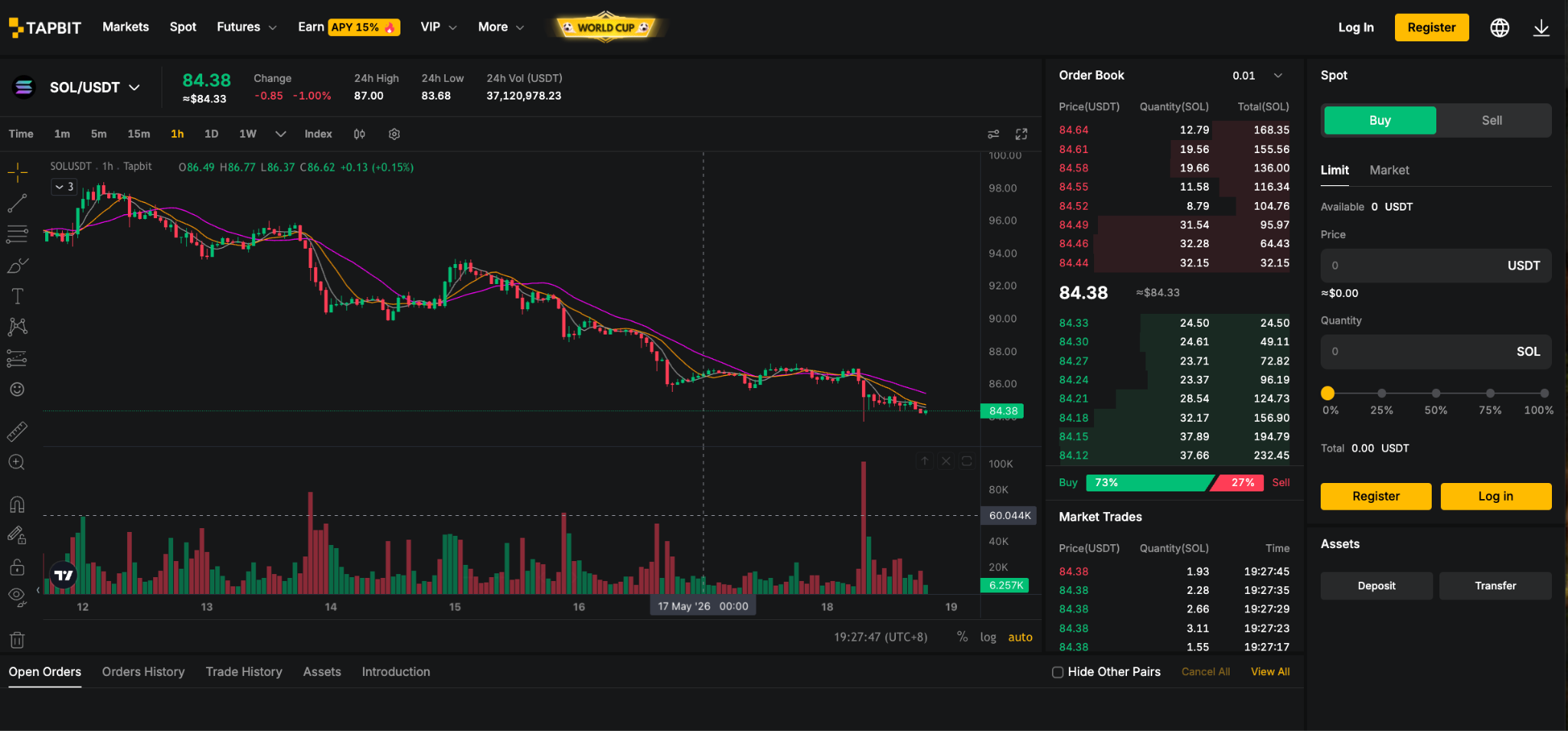
If you want to explore this option, you can buy SOL directly on Tapbit and then move it into an Earn product within the same platform.
4. DeFi Lending and Liquidity Pools
Within the Solana ecosystem, users can supply SOL to lending protocols or provide liquidity in decentralized exchanges to earn yield. Potential returns can exceed staking rates, but the risks are also higher — including smart contract vulnerabilities, impermanent loss, and liquidity constraints.
5. Ecosystem Activities
Some users receive SOL-denominated rewards through airdrops, on-chain task programs, or participation in new Solana projects. Returns here are highly variable and unpredictable. This is generally not considered a reliable passive earn method.
How Much Can You Earn on Solana?
The amount you earn depends on the method, the amount of SOL used, and current market and network conditions.
As of mid-2026, most staking and earn products offer between 5.5% and 7%+ APY. Native staking with low-commission or MEV-enabled validators tends to sit at the higher end. Exchange Earn products are more conservative but require no technical setup.
Example: If you deposit 10 SOL into a flexible Earn product with an estimated 5% APY, the theoretical annual reward is approximately 0.5 SOL — before any fees, APY changes, or market impact.
One distinction worth understanding: APY (Annual Percentage Yield) includes the effect of compounding, while APR (Annual Percentage Rate) does not. When a platform displays an APY figure, it assumes rewards are reinvested, which produces a slightly higher effective return than the raw rate. Always check which figure a platform is quoting before comparing products.
Comparing Ways to Earn SOL
|
Method |
Difficulty |
Flexibility |
Typical APY (Mid-2026) |
Best For |
|
Native Staking |
Medium |
Low (unstaking delay ~1 epoch) |
5.5%–7%+ |
Self-custody wallet users |
|
Liquid Staking (jitoSOL, bSOL) |
Medium–High |
High |
~5.5%–6% |
DeFi-active users |
|
Exchange Earn (e.g. Tapbit) |
Low |
High (Flexible) |
~5% |
Beginners |
|
DeFi Lending / Liquidity Pools |
High |
Medium |
Variable |
Advanced users |
A Simpler Way to Earn SOL: Tapbit Earn
For users who do not want to manage validators, evaluate liquid staking tokens, or monitor DeFi protocols, Tapbit Earn offers a more straightforward entry point.
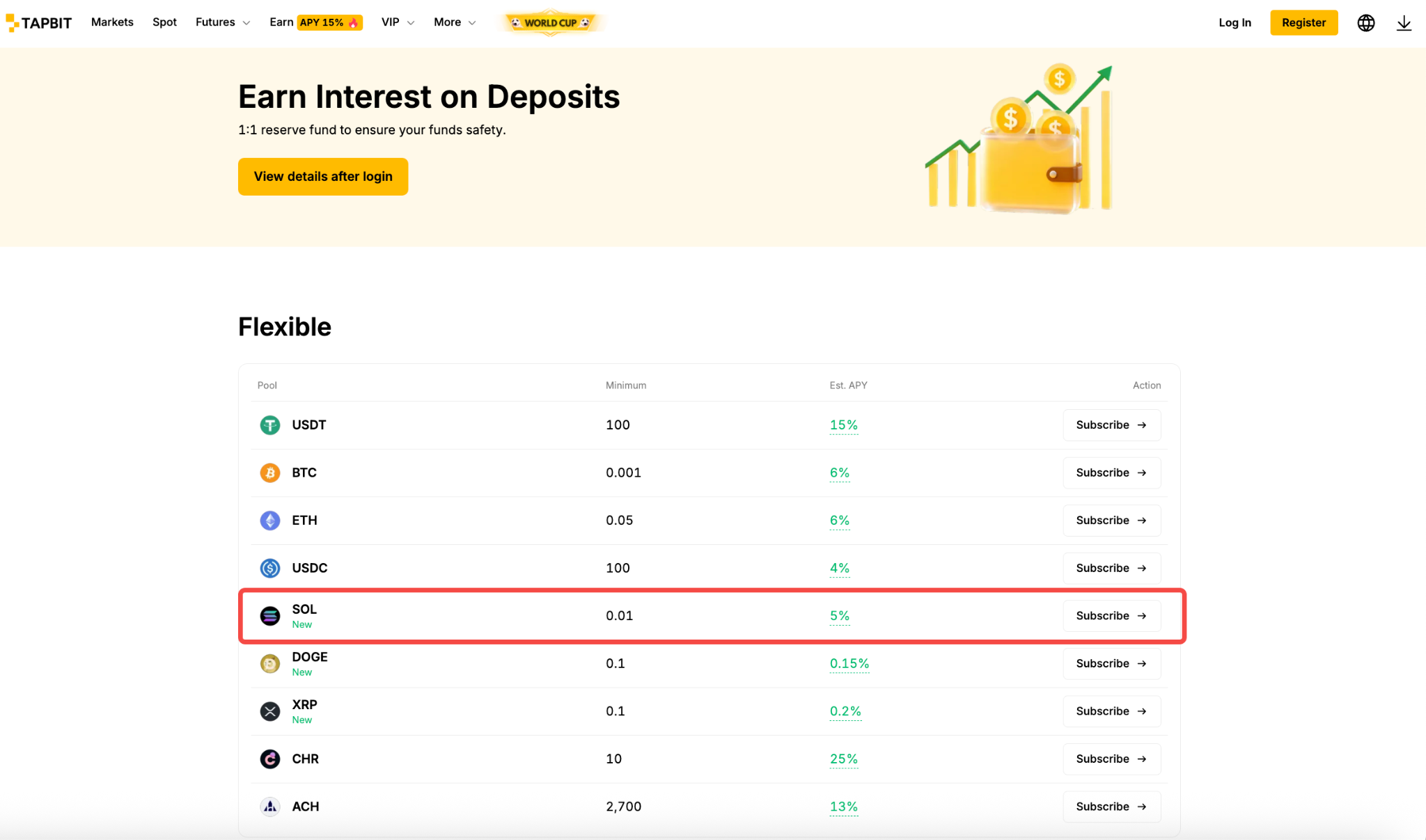
Tapbit has added a SOL Flexible Earn product with the following terms:
-
Asset: SOL
-
Product type: Flexible
-
Minimum subscription: 0.01 SOL
-
Estimated APY: 5%
-
Redemption: Flexible, no lock-up period
In 2026, not every SOL holder wants to navigate on-chain tooling or run validator research. For users who prioritize simplicity and low minimum entry, a flexible exchange Earn product is a practical starting point — even if the APY is more conservative than on-chain alternatives. The advantage is in the low barrier, the flexible structure, and the ability to withdraw without waiting through an epoch.
Tapbit also publishes proof of reserves so users can verify that assets held on the platform are fully backed.
How to Earn SOL on Tapbit in 4 Steps
Ready to get started? Here is the full process:
Step 1 — Create your account
Create an account on Tapbit or log in if you already have one. Verification takes a few minutes.
Step 2 — Add SOL to your account
Deposit existing SOL from an external wallet, or purchase SOL directly on the platform via spot trading.
Step 3 — Open the Earn page and find SOL Flexible
From the top navigation, select Earn. Search for SOL or browse the Flexible category. Review the minimum subscription amount and estimated APY before proceeding.
Step 4 — Subscribe and monitor rewards
Enter the amount of SOL you want to put to work, confirm the subscription, and track your accumulated rewards in the Earn account section. Rewards update regularly and can be redeemed at any time under the Flexible product terms.
For questions at any point, Tapbit's customer support team is available to help.
Risks of Earning Solana
Earning Solana carries risk regardless of the method used. Key risks to understand:
-
APY is estimated, not guaranteed. Rates can decrease as Solana's network inflation decreases over time or as total staked SOL increases.
-
SOL price volatility. A drop in SOL's market price can outweigh any rewards earned in SOL terms.
-
Platform risk. Exchange products depend on the platform's operational integrity. Review terms and reserve disclosures before depositing.
-
Unstaking delays. Native staking requires waiting through at least one epoch before funds become fully liquid.
-
Smart contract risk. Liquid staking and DeFi strategies depend on protocol code that can contain bugs or be exploited.
Before subscribing to any SOL Earn product, read the product terms in full and only commit funds you can afford to risk.
FAQ
What does Earn Solana mean?
Earn Solana means using existing SOL to generate potential rewards through staking, exchange Earn products, liquid staking, or other yield mechanisms. It does not mean receiving free SOL or a guaranteed fixed return.
How do I earn Solana as a beginner?
The simplest method for beginners is an exchange Earn product. On Tapbit, you can subscribe to SOL Flexible Earn with as little as 0.01 SOL, with no validator management required and flexible redemption terms.
What is liquid staking SOL?
Liquid staking lets you stake SOL through a protocol like Jito or BlazeStake and receive a liquid token (such as jitoSOL or bSOL) in return. That token can be used in DeFi while your original SOL continues earning staking rewards. It is more flexible than native staking but carries smart contract risk.
What is an epoch in Solana staking?
An epoch is the fixed time period Solana uses to calculate and distribute staking rewards — approximately two to three days. Newly staked SOL becomes active at the start of the next epoch, and rewards are distributed at the end of each epoch.
How much can I earn on Solana in 2026?
As of mid-2026, most staking and earn products offer between 5.5% and 7%+ APY depending on the method. Exchange Earn products tend to be at the lower end of that range but are the easiest to use. Liquid staking and MEV-enabled native staking can reach higher rates.
Is earning Solana risk-free?
No. SOL price volatility, APY changes, platform risk, unstaking delays, and smart contract vulnerabilities all apply. Review product terms carefully and only use funds you are prepared to risk.


