

Stellar is delivering some of its strongest fundamental news in years, but XLM has yet to turn that progress into a confirmed price breakout.
Stablecoin payment volume has reached a quarterly record, while Tradable plans to bring as much as $1 billion in private credit assets to Stellar. MoneyGram, Figure Markets and Range are also deepening their involvement in the network.
XLM’s price tells a more cautious story. When checked on July 30, 2026, XLM was trading near $0.1716 after falling approximately 7% over seven days. The token had not held above the widely watched $0.19 to $0.20 resistance area. Trading volume was also lower than the previous day.
The result is an unusual setup: Stellar’s network activity is improving, while its native token remains below a major technical barrier.
XLM Has Not Confirmed a Breakout
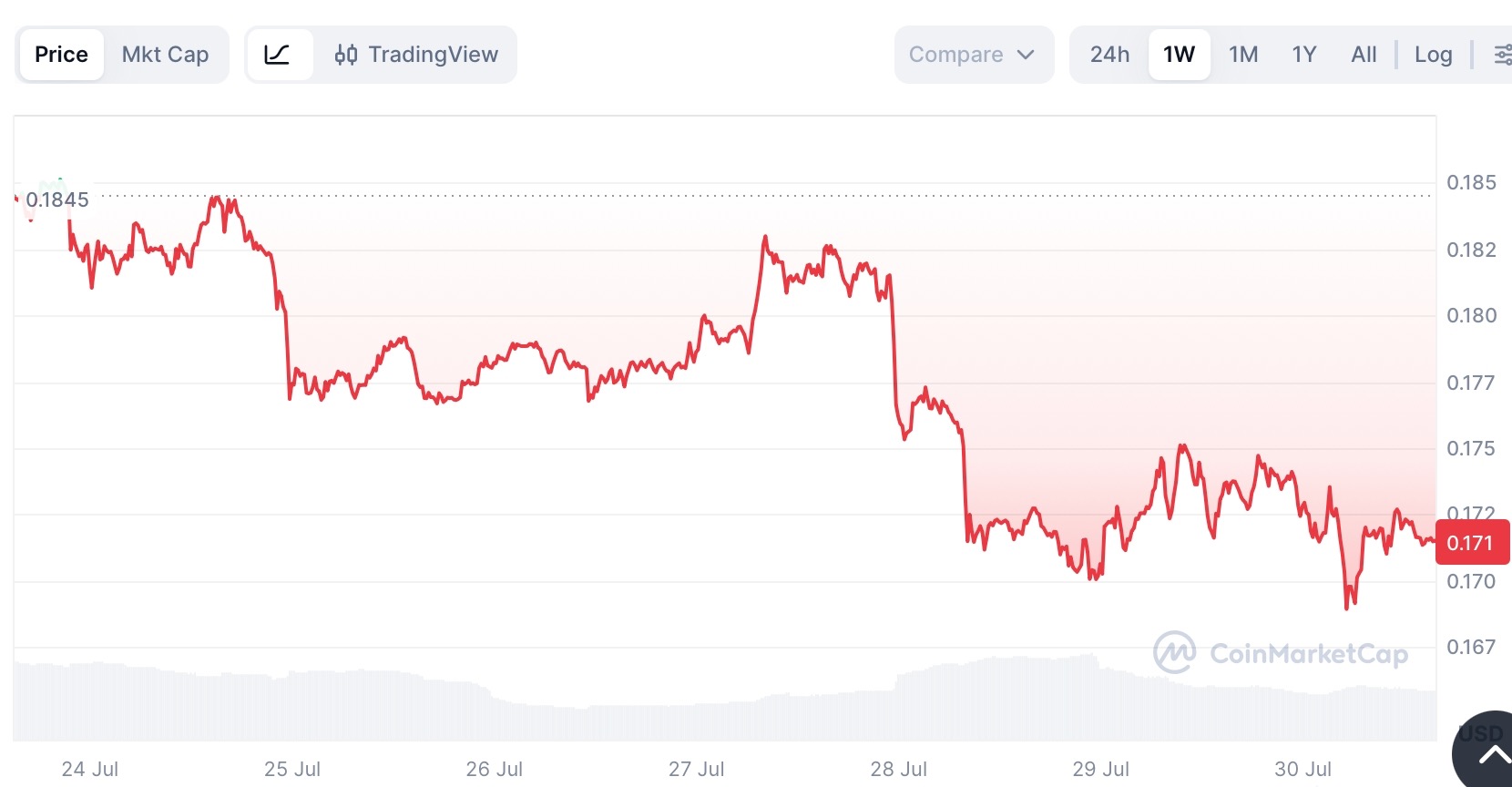
Earlier in July, XLM repeatedly approached the $0.19 to $0.20 area. That encouraged speculation that the token was preparing to break out of a multi-month range.
The breakout did not hold. XLM was trading near $0.1716 on July 30, with a market capitalization of approximately $5.87 billion. Its 24-hour trading volume was close to $100 million and had decreased from the previous day.
This changes the short-term interpretation of the chart. The $0.19 to $0.20 area remains resistance rather than confirmed support. A brief move through that zone would not be enough to establish a new trend. Traders would generally look for a sustained close above resistance, stronger spot volume and follow-through buying.
For now, the price action looks more like a rejected breakout attempt followed by consolidation.
Stellar’s RWA Market Is Growing
The strongest part of the Stellar story is the expansion of tokenized real-world assets.
The Stellar Development Foundation reported that on-chain RWAs crossed $2 billion shortly after the first quarter of 2026, up from $785 million at the end of 2025. That represented approximately 2.5 times growth in a single quarter.
Later market data placed Stellar’s RWA total at approximately $3 billion, although the exact number varies across data providers. Some platforms count only assets distributed directly onchain, while others include represented assets or use different valuation methods. Investors should therefore check the methodology before comparing RWA figures.
The direction, however, is clear. Stellar is becoming a significant network for tokenized funds, private credit and other regulated financial products.
According to the Stellar Q1 2026 report, institutions including U.S. Bank, Amundi, Société Générale, AllUnity and Kenanga advanced activity on or around the network. Franklin Templeton’s BENJI tokenized money market fund also remains one of Stellar’s most established institutional products.
These developments give Stellar a clearer use case than many older Layer 1 networks. Its growth is increasingly connected to regulated finance rather than relying only on speculative token activity.
Tradable Plans to Bring Up to $1 Billion in Private Credit to Stellar
One of the most important recent catalysts arrived on July 15. Tradable announced an integration with Stellar that could bring up to $1 billion in tokenized private credit assets onto the network. The platform focuses on institutional-grade alternative investments and supports compliance, investor onboarding and asset lifecycle management.
The announcement adds another major category to Stellar’s RWA market. Private credit has attracted increasing attention because tokenization may improve settlement, distribution and access to traditionally less liquid assets.
The wording still matters. “Up to $1 billion” describes the potential size of the integration. It does not mean that $1 billion has already been issued, purchased or transferred on Stellar.
The next indicators to watch will be the amount actually tokenized, the number of investors holding the assets and whether the products generate recurring onchain activity. The official announcement supports the long-term RWA narrative, but execution will determine its real market impact.
Stablecoin Payments Reached a Quarterly Record
Stellar’s payment activity provides another part of the fundamental case.
The Stellar Development Foundation reported $5.5 billion in stablecoin payment volume during the first quarter of 2026. That was an all-time quarterly high and represented growth of 72% from a year earlier. Stablecoin payment velocity increased by 75% over the same period.
This matters because Stellar was originally designed for fast, low-cost transfers between different assets and currencies. Stablecoins give that design a practical role in remittances, merchant payments, treasury transfers and financial assistance.
Payment volume alone does not prove lasting adoption. A network can process a large amount of value through a relatively small number of participants. Repeat usage, active addresses and the number of functioning payment corridors provide a more complete picture.
Even so, the figures suggest that Stellar is being used for more than token issuance. Assets are also moving through the network.
MoneyGram, Figure Markets and Range Are Joining as Validators
On July 16, the Stellar Development Foundation announced that MoneyGram, Figure Markets and blockchain security company Range would operate Tier 1 validators.
Tier 1 validators participate directly in Stellar’s consensus process and are expected to maintain high uptime across geographically distributed infrastructure. The three organizations are expected to be fully integrated into Stellar’s quorum configuration by mid-August.
MoneyGram has worked with Stellar since 2021 and uses the network as part of its digital-asset cash access infrastructure. Figure Markets brings experience in regulated capital markets, while Range provides monitoring and compliance services across more than 200 blockchain networks.
Their participation may strengthen Stellar’s operational resilience and institutional credibility. It also shows that these companies are becoming more involved in the network than a conventional marketing partnership would suggest.
However, validator participation is an infrastructure development. It should not be treated as proof that these companies are accumulating XLM or creating immediate token demand.
The UNDP Partnership Is Moving Beyond Pilot Projects
Stellar also expanded its partnership with the United Nations Development Programme in July.
The organizations previously examined blockchain-based payments across 17 countries and conducted live pilots in Haiti, Syria, Kenya, Guatemala and The Gambia. The new phase aims to make digital payments a capability that UNDP country offices can use in regular program delivery.
The results described by UNDP provide practical evidence. In Aleppo, a digital payment pilot reduced estimated distribution costs from around 10% to approximately 2%. A Haiti pilot continued to complete payments during testing even when the cellular network failed.
The agreement runs through 2027 and will focus on governance, safeguards, onboarding and deployment. The UNDP and Stellar announcement is significant because it involves real payment conditions rather than a theoretical blockchain use case.
Still, the partnership primarily demonstrates the utility of the Stellar network. It does not establish a direct relationship between humanitarian payment volume and the market price of XLM.
Protocol 27 Expands Stellar’s Smart Account Capabilities
Stellar’s technical development is another reason the network remains in focus.
Protocol 27, also known as Zipper, introduces improved authentication delegation and address-bound credentials for Soroban smart contracts. These changes can support more flexible smart accounts, including delegated signing, modular multisignature systems and social recovery.
For users, the benefits may eventually appear through wallets that are easier to recover and accounts that can use more precise permissions. For developers, the upgrade simplifies authentication designs that previously required more complicated authorization processes.
Protocol upgrades rarely create sustained token demand by themselves. Their value depends on whether developers use the new capabilities to build wallets, financial products and applications that attract users.
Confidential Tokens Are Promising but Not Production-Ready
Stellar has also introduced a developer preview of Confidential Tokens. The system is designed to hide token balances and transfer amounts while keeping sender and recipient addresses visible. It also includes optional auditor access and compliance controls, making it potentially relevant to payroll, treasury management and institutional settlement.
This approach is intended to balance commercial privacy with regulatory requirements. Financial institutions may not want transaction values to be visible publicly, even when the parties involved are known.
However, Confidential Tokens remain a testnet preview. The contracts and verification components are still undergoing audits and are not intended for production use with real assets.
It would therefore be inaccurate to claim that private token transfers have already launched commercially on Stellar. The feature is better understood as a developing part of the network’s institutional roadmap.
Does Stellar Adoption Create Demand for XLM?

This is the most important question for traders.
The success of the Stellar network does not automatically translate into an equal increase in the value of XLM. Institutions can issue and transfer stablecoins, tokenized funds or private credit products without purchasing large amounts of XLM.
XLM is used to pay transaction fees, meet account reserve requirements and discourage spam. It may also serve as a bridge asset in certain markets. These functions create genuine utility, but Stellar’s transaction fees are deliberately very low.
Low fees make the network attractive for payments. They also mean that a large increase in transaction count may generate only modest direct demand for XLM.
The relationship between network growth and token value therefore depends on more than the total value of RWAs. Traders should also examine how much XLM is held in accounts, used as liquidity, locked in applications or required by new financial products.
This value-capture question helps explain why Stellar can report positive adoption news while XLM remains below resistance.
Conclusion
Stellar has a credible institutional narrative built around tokenized assets, stablecoins and cross-border payments. Recent developments involving Tradable, MoneyGram, Figure Markets, Range and UNDP reinforce that direction.
XLM’s market performance remains less convincing. The token has not established a sustained breakout above $0.19 to $0.20 and was trading closer to $0.17 when checked on July 30.
The gap between network adoption and token price is now the central issue. A confirmed XLM recovery would require more than positive announcements. Traders will be looking for stronger volume, a successful resistance break and clearer evidence that Stellar’s expanding financial ecosystem creates lasting demand for XLM itself.
Existing users can monitor crypto markets through Tapbit and access their accounts from the Tapbit login page. New users can visit the registration page.
Frequently Asked Questions
What is Stellar?
Stellar is an open-source blockchain designed for payments, asset issuance and low-cost settlement. Financial institutions and developers can use it to issue stablecoins, tokenize financial products and transfer assets across borders.
What is XLM?
XLM, also called Lumens, is the native asset of the Stellar network. It is used to pay transaction fees, meet account reserve requirements, discourage spam and provide liquidity in certain markets.
Why is Stellar still attracting attention?
Stellar is gaining attention because of growth in tokenized real-world assets, stablecoin payments and institutional participation. Recent developments include a planned Tradable integration, new Tier 1 validators and an expanded partnership with the United Nations Development Programme.


