
World Collective Oil Reserve, commonly known as WCOR, is a Solana-based token built around an oil-reserve theme. The name may suggest exposure to physical crude oil or a government-managed commodity reserve, but the project’s publicly available information does not support that interpretation.
WCOR appears to be connected to an initiative that organizes and records public information about global oil reserves. It does not currently provide token holders with ownership of oil, redemption rights, income from oil sales, or another legal claim on an underlying commodity.
That distinction is essential. A token can reference a real-world industry without representing a real-world asset.
What Is WCOR?
WCOR is an SPL token issued on Solana. The project describes itself as a public-information framework focused on oil-reserve data rather than a financial product backed by stored crude oil.
The contract address currently presented by the project and selected market trackers is:
WCoRVxGcpiwE6EvtDjXHJq6Kcn4nWT9Ubt1PrJHNAzM
Users should confirm this address independently before connecting a wallet or completing a swap. Token names and tickers are not unique on decentralized networks, and more than one Solana asset has appeared under the WCOR name.
A matching ticker is therefore not enough. The contract address is what identifies the token on-chain.
Is WCOR Backed by Physical Oil?
There is no clear public evidence that WCOR is backed by physical oil.
A commodity-backed token normally has a documented legal structure connecting the token to the underlying asset. WCOR has not publicly demonstrated such an arrangement. The project also states that it is not issued, sponsored or operated by a national government, the International Energy Agency or a strategic petroleum reserve authority.
WCOR should therefore not be described as a government-backed oil token. Its name refers to an oil-reserve narrative, but that narrative does not create legal ownership of crude oil.
Does WCOR Qualify as a Real-World Asset Token?
WCOR is sometimes associated with the real-world asset sector because it uses an oil-related theme. That association can be misleading.
A conventional RWA token represents an enforceable interest in something outside the blockchain. Depending on the product, that interest might involve government bonds, real estate, private credit, commodities or revenue-generating contracts. The legal documentation and custody structure are what connect the token to the real-world asset.
WCOR does not currently appear to give holders an enforceable claim on oil or oil-related revenue. A more accurate description is that it is a Solana token associated with an oil-reserve information project.
Its market price is therefore driven primarily by liquidity, trading activity and market attention. It should not be valued as though each token represents a defined quantity of crude oil.
Where Is WCOR Traded?
WCOR has mainly appeared in Solana-based decentralized exchange pools rather than on large centralized exchanges.
Trading through a DEX requires a compatible Solana wallet, enough SOL to cover network fees and access to an active liquidity pool. Although the swap itself may be simple, the quality of the market can vary considerably.
A displayed price does not guarantee that traders can buy or sell a meaningful amount at that price. When liquidity is thin, a modest order may move the market sharply. Buyers can end up paying more than expected, while sellers may receive far less than the value shown in their wallets.
This is why pool liquidity matters more than the headline market capitalization. Market capitalization is calculated by multiplying the latest token price by the circulating or total supply. It does not show how much capital is available for traders who want to exit.
A token may display a six-figure valuation while having only a small amount of usable liquidity.
Why Duplicate WCOR Tokens Matter
Anyone can create a token on Solana and assign it an existing name, ticker or logo. This makes duplicate and imitation assets a common problem on decentralized exchanges.
WCOR is especially vulnerable to this confusion because several tokens can use the same ticker. An imitation may copy the original branding, website description or social-media content closely enough to appear legitimate.
Users should compare the contract address shown on the project website with the address displayed by Solscan, established market trackers and the DEX pool itself. Official social accounts may provide additional confirmation, but they should not be the only source because accounts can be compromised.
Sponsored search results, unsolicited messages and unofficial Telegram groups deserve extra caution. A website asking for immediate wallet access or a token approval should not be trusted simply because its design looks professional.
Contract Permissions Do Not Tell the Whole Story
Verifying the contract address is necessary, but it does not establish that the token is safe.
On-chain research should also examine mint and freeze permissions, holder concentration and the structure of the active liquidity pool. If mint authority remains active, additional supply may be created. If freeze authority is available, certain token accounts may potentially be restricted. If liquidity is controlled by a small group, it may be removed with little warning.
Holder distribution is equally important. A market dominated by a few wallets can react violently when one of those wallets sells.
Automated token scanners can help identify basic technical issues, but their scores should not be mistaken for full due diligence. Revoked permissions may reduce specific contract risks without confirming the project’s claims, ownership structure or long-term viability.
Price History Does Not Prove Fundamental Value
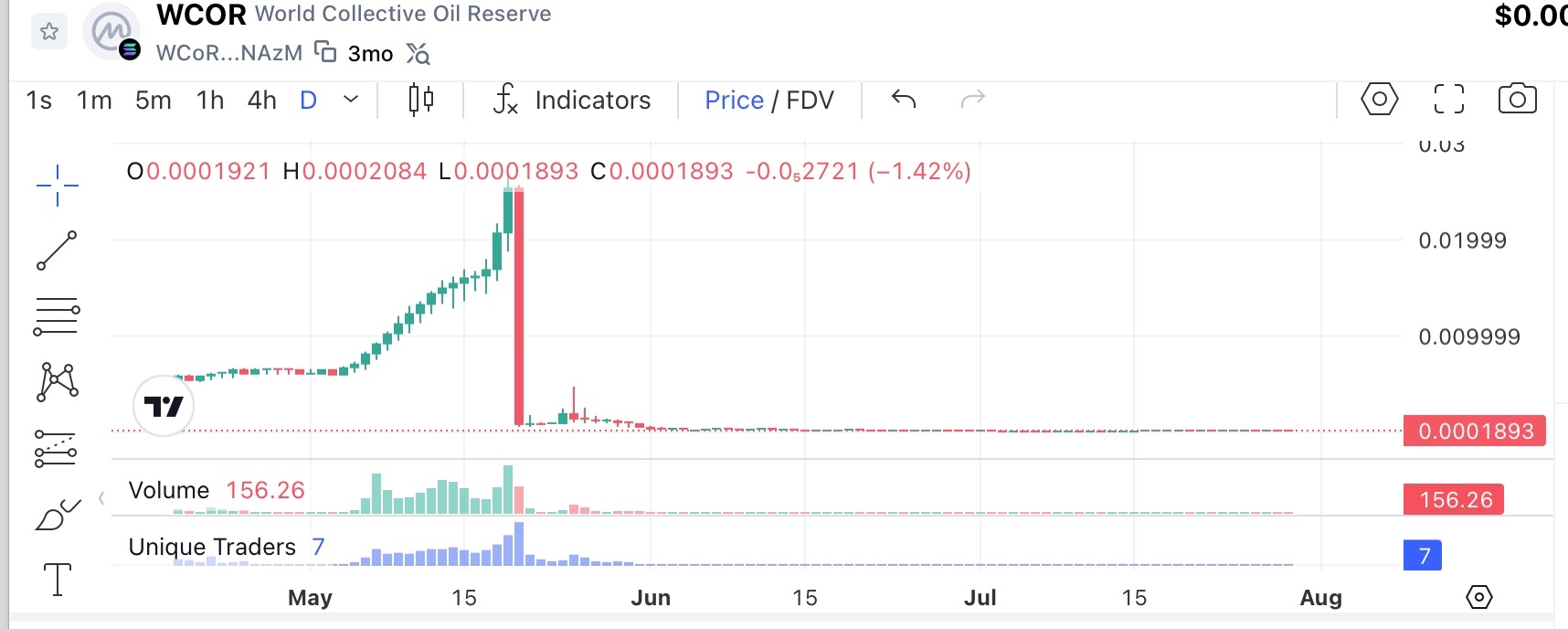
WCOR has experienced substantial price swings since it began trading. For a small token, these moves may reflect changes in liquidity or a limited number of trades rather than a meaningful shift in project value.
A sharp decline from an earlier high does not necessarily make the token undervalued. The previous high may have occurred during a brief period of thin liquidity and concentrated buying. A later rebound can also be speculative rather than evidence of new adoption.
Price percentages are most useful when viewed alongside actual volume, pool depth, active trader numbers and wallet activity. Project development and verifiable announcements matter as well. Without that context, a price chart can give a distorted picture of the market.
Why Could WCOR Attract Attention?
WCOR combines several narratives that regularly attract crypto traders: oil, energy security, commodity tokenization, real-world assets and the Solana ecosystem.
Interest may increase when crude oil prices, strategic petroleum reserves or geopolitical disruptions dominate financial news. The token’s branding makes it easy for traders to associate WCOR with those developments.
That association is not the same as economic exposure.
A rise in crude oil prices does not automatically increase WCOR’s value because token holders do not appear to own the commodity. Oil-related headlines may affect attention and speculation, but there is no documented mechanism tying the token price to barrels of oil.
The Main Risks Around WCOR
The most important risk is misunderstanding what the token represents. WCOR has not shown verified physical-oil backing, government sponsorship or redemption rights. Treating it as an oil investment could lead traders to make decisions based on a relationship that does not exist.
Transparency is another concern. Public information about the team, operating entity, funding and long-term roadmap remains limited. This makes it difficult to evaluate who is responsible for the project or how the token is intended to develop.
The market itself also presents practical risks. Thin liquidity can produce high slippage and make exits difficult during volatile periods. Duplicate tokens increase the chance of buying the wrong asset, while concentrated ownership can give a small number of wallets disproportionate influence.
Trading through decentralized platforms adds a further layer of exposure. Fake interfaces, malicious approvals, wallet-draining links and unstable liquidity pools can cause losses even when a user has identified the intended token correctly.
Final Thoughts
WCOR is a Solana token connected to a project that describes itself as a public-information framework for oil-reserve data. It should not be confused with a tokenized barrel of oil, a government reserve asset or a verified commodity-backed RWA.
The project may continue attracting attention because oil and real-world assets are powerful market narratives. Its actual token value, however, depends on crypto-market demand and available liquidity rather than a documented claim on physical crude oil.
For traders, the central task is to separate the name from the asset. Verify the contract, inspect the market and understand what rights the token does and does not provide before making a decision.
Users can log in to Tapbit to monitor available digital asset markets or register for a Tapbit account.
Frequently Asked Questions
Is WCOR backed by physical oil?
There is no verified public evidence that WCOR holds physical oil or gives token holders the right to redeem tokens for crude oil.
Is WCOR issued by a government?
No. The project states that it is not issued or operated by a government, strategic petroleum reserve authority or international energy organization.
Is WCOR a real-world asset token?
WCOR uses an oil-related narrative, but it does not currently appear to represent an enforceable interest in physical oil. It is more accurately described as a narrative-based Solana token than a verified commodity RWA.


