
What proof of stake actually means
Ethereum proof of stake is the consensus mechanism Ethereum uses to agree on which transactions are valid and in what order they go into the blockchain. Instead of competing to solve a math puzzle (mining), participants lock up — stake — ETH as collateral. That collateral earns them the right to propose and verify new blocks. Honest behavior earns rewards. Dishonest behavior can destroy the collateral. The financial skin-in-the-game replaces the energy expenditure.
Proof of stake vs. proof of work: the key differences
| Proof of Work | Proof of Stake | |
|---|---|---|
| Who secures the chain | Miners with hardware | Validators with staked ETH |
| Resource used | Electricity + machines | Locked capital (ETH) |
| Entry requirement | Mining rigs | 32 ETH (solo) |
| Energy use | Very high | ~99.95% lower (post-Merge) |
| Attack cost | Must own 51% of hashrate | Must own 33%+ of staked ETH |
| Reward type | Block reward + fees | Staking yield + fees |
⚠️ Warning: Proof of stake does not mean transactions are free or instant. Gas fees still depend on network demand, not the consensus mechanism.
The Merge — What Really Changed on September 15, 2022
What The Merge actually did
On September 15, 2022, Ethereum's execution layer (where transactions live) merged with the Beacon Chain (its proof-of-stake coordination layer). From that moment, Ethereum's proof of stake system became the only consensus mechanism. Mining was switched off permanently.
Why Ethereum made the switch
The core reasons were energy reduction and long-term security economics. Proof of work required continuously attracting miners with high rewards. Proof of stake lets Ethereum issue fewer new ETH to maintain security, making the supply model more sustainable. Energy consumption dropped by roughly 99.95%.
What The Merge did not change
Three stubborn misconceptions persist:
- ❌ The Merge did not lower gas fees. Gas prices are set by user demand for block space. The consensus layer change didn't expand block capacity.
- ❌ The Merge did not immediately unlock staked ETH. Withdrawals became possible only after the Shanghai/Capella upgrade in April 2023.
- ❌ The Merge did not make normal transactions dramatically faster. Block times dropped slightly (from ~13 seconds to ~12 seconds), but user-facing speed felt nearly identical.
How Ethereum Proof of Stake Validators Actually Work
What validators do on Ethereum
A validator is software running on a server that:
① Proposes new blocks when randomly selected
② Attests (votes) on blocks proposed by other validators
③ Participates in sync committees that help light clients stay updated
Validators are online around the clock. Missing duties reduces rewards but does not trigger slashing (more on that below).
Why 32 ETH is the minimum
The 32 ETH requirement is a deliberate design choice. It sets the cost of attacking the network at a level that makes attacks economically irrational. Too low and cheap validators could swarm the network; too high and decentralization suffers. Each validator unit is exactly 32 ETH — to run two validators you need 64 ETH, and so on.
What happens if a validator misbehaves: slashing
Slashing is the protocol's punishment for provably malicious behavior — specifically, signing two conflicting blocks at the same height (double voting) or surrounding votes. A slashed validator loses a portion of its 32 ETH stake and is forcibly exited. In severe correlated events (many validators slashed at once), the penalty scales up dramatically.
⚠️ Simply going offline is not a slashing offense. Offline validators lose small amounts of rewards proportionally, but do not lose their principal unless they stay offline for extremely extended periods during specific network conditions.
4 Ways to Stake ETH — Compared
Solo staking, pooled staking, exchange staking, and liquid staking
| Method | Minimum ETH | Control | Main Risk | Best For |
|---|---|---|---|---|
| Solo staking | 32 ETH | Full — you run the node | Slashing, uptime, technical failure | Technical users with 32+ ETH |
| Pooled staking | Varies (often < 1 ETH) | Partial — pool operator | Smart contract bugs, operator risk | Users below 32 ETH threshold |
| Exchange staking | Usually < 1 ETH | None — custodial | Platform/custody risk | Convenience-first users |
| Liquid staking | < 1 ETH | Partial — via LST | LST depeg, smart contract risk | Users wanting tradeable positions |
What liquid staking tokens really are
Liquid staking protocols (like Lido or Rocket Pool) accept your ETH, stake it on your behalf, and issue you a liquid staking token (LST) — for example, stETH or rETH. You can trade or use this token in DeFi while the underlying ETH earns staking rewards in the background.
⚠️ Risk box: Liquid staking is not simply holding ETH plus yield. LSTs are separate tokens with their own market prices. They may depeg from ETH during market stress, protocol incidents, or low liquidity periods. Holding an LST is not the same as holding ETH.
Ethereum Staking Risks — What You Need to Know Before You Start
Staking rewards are not guaranteed
Ethereum staking yield is not a fixed rate. It fluctuates based on the total amount of ETH staked network-wide. More validators → lower per-validator reward. Reward rates are expressed as estimates (APR/APY), not promises.
Slashing risk: when you can lose staked ETH
If you run your own validator with misconfigured software, or use a third-party node operator that makes a critical error, slashing penalties can reduce your principal. Using well-audited pooled or liquid staking protocols reduces — but does not eliminate — this risk.
Liquidity and lockup: your ETH may not be instantly available
Solo staking exits take time (validator exit queue can last days to weeks during high demand). Pooled and liquid staking products have their own redemption queues and terms. You may not be able to access your ETH immediately when you want it.
Custody and platform risk
When you stake through an exchange or earn product, the platform holds your ETH. Platform insolvency, regulatory action, or operational failure can affect your funds. Check each platform's proof of reserves policy before depositing.
⚠️ Risk box: Staking ETH is not a bank deposit, not a guaranteed yield product, and not principal-protected. You can lose part or all of your staked ETH under certain conditions.
How to Explore ETH Earn on Tapbit — A Practical Walkthrough
Tapbit Earn offers flexible ETH products that let users participate in yield opportunities without running their own Ethereum validator. This is fundamentally different from solo staking — you are using a platform product, not operating network infrastructure. Risks include changing APY, platform custody, redemption limits, and updates to product terms.
① Go to Tapbit Earn
Log in and navigate to the Earn section. This is where Tapbit lists its flexible and fixed savings products across multiple assets.
② Find ETH Under Flexible Products
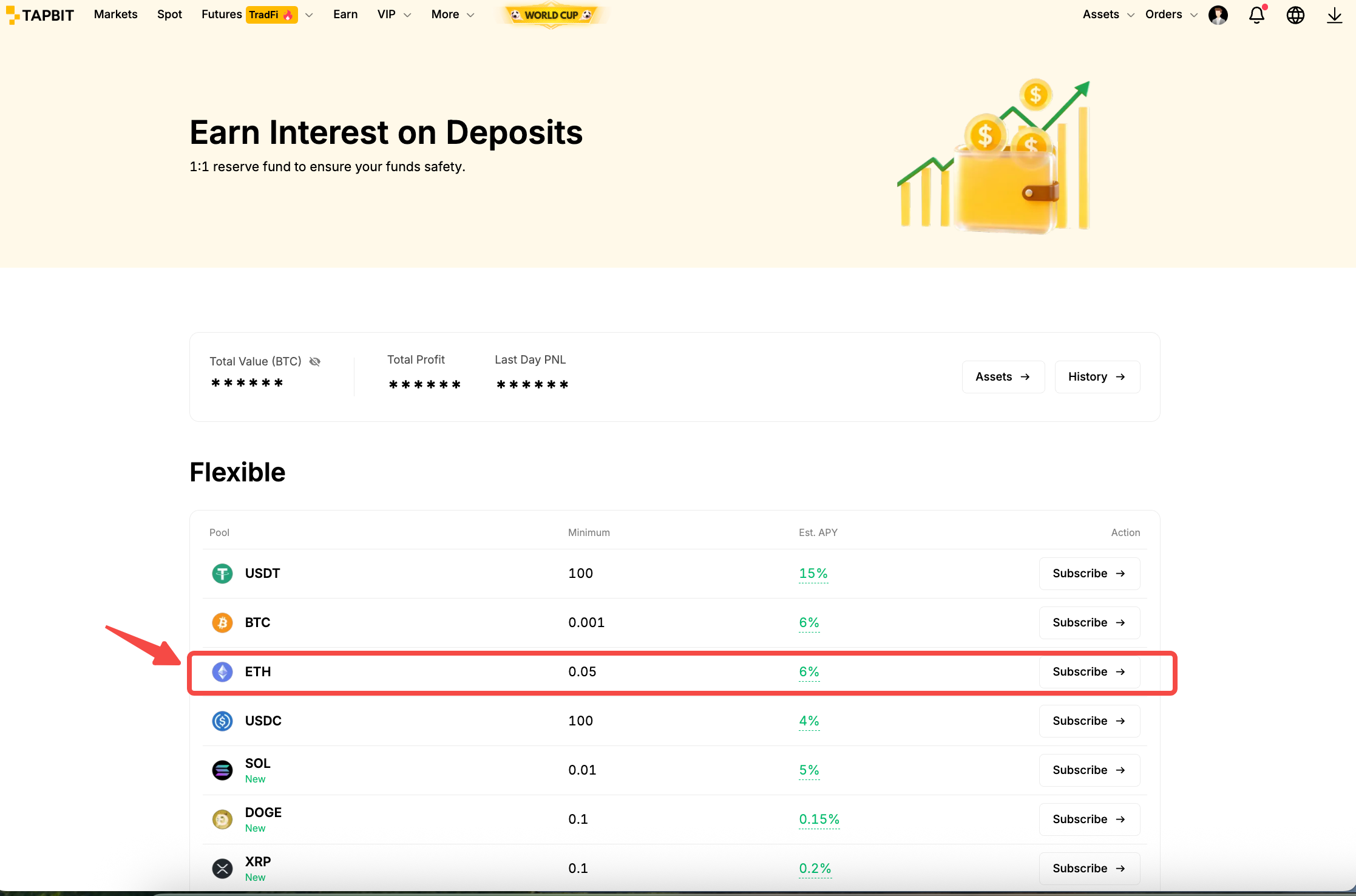
Use the asset filter or search bar to locate ETH flexible products. Flexible products generally allow redemption without a fixed lock period, though redemption processing times and daily limits may apply — check the product page carefully.
③ Review the Terms Before Subscribing
Before clicking Subscribe, note:
- Estimated APY — this is a variable rate, not a guaranteed return.
- Minimum subscription amount — confirm you meet the threshold.
- Redemption terms — understand how quickly you can withdraw and whether limits apply.
- Product rules — Tapbit may update product terms; review the current terms on the product page.
④ Subscribe — Start Small if You Are New
If this is your first time using a crypto earn product, consider starting with a small amount to understand the redemption process before committing larger sums. If you don't have ETH yet, you can buy ETH on Tapbit's spot market, or check the ETH market first to review current pricing. New users can create an account to get started.
Is Ethereum Proof of Stake Right for You? A Simple Checklist
What to understand before staking any ETH
Ethereum proof of stake creates opportunities for ETH holders to earn yield, but every method carries distinct trade-offs. The right choice depends on your technical ability, risk tolerance, and liquidity needs — not just the advertised APY.
When staking may be too complex
Staking may not be suitable if:
- You need your ETH available at short notice (high liquidity need)
- You are not comfortable with the smart contract or platform risks involved
- You do not understand the redemption process of the product you are using
- You are relying on staking rewards as a primary income source
Your pre-staking checklist
Before staking any ETH, confirm each item:
- ✅ I understand the staking method I choose.
- ✅ I know who holds the ETH and how redemption works.
- ✅ I checked fees, lockup terms, and minimum requirements.
- ✅ I understand slashing and liquidity risk.
- ✅ I do not treat staking rewards as fixed income.
FAQ
1. Can I lose my ETH by staking it? Yes. Solo validators can be slashed for double-signing or surrounding votes, losing part of their 32 ETH. Users of pooled or liquid staking products face smart contract risk, platform risk, and — for LST holders — depeg risk. Staking is not principal-protected.
2. Do I need exactly 32 ETH to start staking Ethereum? Only for solo staking. Pooled staking, liquid staking protocols, and exchange earn products accept far smaller amounts — sometimes a fraction of one ETH. Each method carries different risks and trade-offs.
3. Is Ethereum proof of stake the same as Ethereum mining? No. Mining (proof of work) required physical hardware and electricity to solve computational puzzles. Proof of stake replaces that with locked ETH as collateral. Ethereum ended mining permanently with The Merge in September 2022.
4. Did The Merge make Ethereum gas fees cheaper? No. Gas fees are determined by how much demand there is for block space. The Merge changed how Ethereum reaches consensus, not how much capacity each block has. Fee reduction requires layer-2 scaling or changes to block size — not a switch from proof of work to proof of stake.
5. What happens if my validator goes offline? Going offline causes small inactivity penalties proportional to how long you are offline. It is not a slashing event. Your principal is not destroyed for downtime alone. However, extended downtime in rare specific network conditions (inactivity leak) can result in more significant losses.
6. Are liquid staking tokens always worth 1 ETH? No. LSTs like stETH or rETH are separate tokens that trade on open markets. Under normal conditions they trade close to ETH value, but during periods of market stress, low liquidity, or protocol issues, they can and have traded below ETH price. Holding an LST is not equivalent to holding ETH.


