

XRP has traded under notable pressure in USD terms, with price action sliding from recent highs and consolidating around the low dollar range. Over a trailing multi-week window, the token has given back a significant portion of prior gains, reflecting profit-taking and broader consolidation across the digital asset market. Market capitalization remains substantial, keeping XRP among the largest cryptocurrencies by value, while trading volume fluctuates around typical averages, indicating steady but cautious participation from both retail and larger holders.
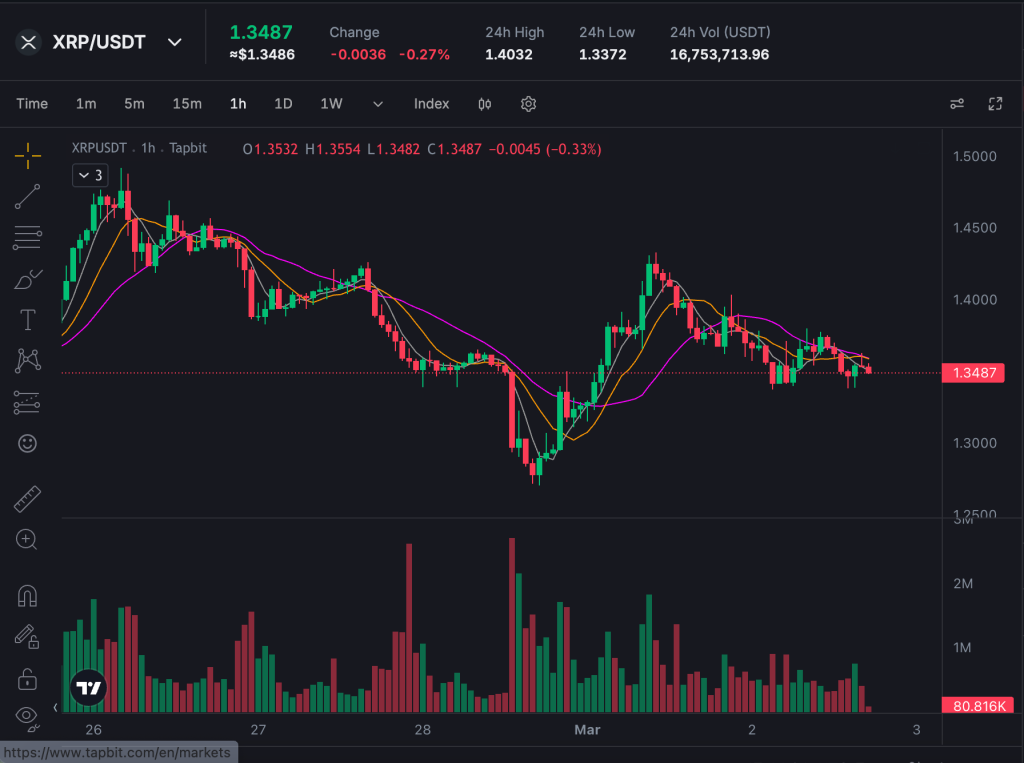
From a trend perspective, XRP trades below key short- and medium-term moving averages, signaling that sellers maintain the upper hand in the prevailing structure. The distance between shorter and longer moving averages points to an established downtrend rather than a short-term dip. Despite this, price still sits above deeply distressed levels seen in past cycles, leaving room for both further downside and sharp mean-reversion rallies if sentiment improves.
XRP Technical Setup
Momentum indicators show a market that is weak, but not yet in extreme panic territory. The Relative Strength Index (RSI) hovers in the high-30s to low-40s, which suggests that selling pressure dominates while early oversold conditions begin to form. This zone often precedes either a continuation leg lower or a relief bounce, depending on whether buyers step in near support.
The Moving Average Convergence Divergence (MACD) indicator sits in negative territory, confirming bearish momentum. However, a modestly positive or flattening histogram hints at early-stage divergence, where downside momentum may be starting to slow. The Average Directional Index (ADX) holds in the low-to-mid 40s, a level that generally confirms a strong and well-defined trend. In practice, this means the existing downtrend deserves respect until price action and volume send a clear reversal signal.
Bollinger Bands add further context. XRP trades near the middle of its band structure, with the lower band clustering around a key support zone and the upper band aligning with an important resistance area. This setup implies room for expansion in either direction: a break toward the lower band would expose prior swing lows and liquidation zones, while a move toward the upper band would require renewed demand and stronger inflows. Stochastic oscillators sit near the middle of their range, reinforcing a neutral near-term bias and underscoring that directional conviction will come from fresh catalysts rather than purely from stretched technicals.
XRP Price Scenarios and Long-Term Outlook
Forecast models for XRP sketch a wide band of possible outcomes, driven largely by institutional adoption, regulatory clarity, and broader market risk appetite. In a bearish short-term scenario, extended selling and risk-off behavior could see price probing the lower end of the recent range, including sub-dollar retests if key supports fail. Such a path would likely coincide with weak volumes, negative money flow, and an absence of meaningful fundamental catalysts.
A more neutral, base-building scenario envisions XRP stabilizing in a broad consolidation corridor, with repeated tests of both support and resistance but no decisive breakout. In this case, the token may oscillate around its short-term moving averages as traders fade extremes and wait for clearer signals from regulation and enterprise adoption. This environment often rewards range-trading strategies and emphasizes tight risk management, especially in the presence of elevated volatility.
On the upside, medium- to long-term projections remain constructive if bank-focused initiatives and enterprise integrations gain real traction. Under a bullish adoption path, models point to the potential for XRP to revisit multi-dollar levels over a multi-year horizon, with gains that could substantially outperform broad market benchmarks. Such outcomes assume that large financial institutions embrace XRP as a settlement or liquidity bridge, regulatory overhang diminishes, and on-chain volumes reflect genuine transactional utility rather than purely speculative flows.
Market Sentiment, Flows, and Liquidation Risk
Trading activity in XRP reflects a market that is engaged but discriminating. Volume often tracks slightly below long-run averages during consolidation phases, signaling that market participants are hesitant to commit aggressively while trend signals remain bearish. When sharp moves occur, volume spikes tend to align with liquidation events around obvious technical levels, amplifying intraday volatility.
Money flow metrics point to a modest tilt toward outflows, with indicators such as the Money Flow Index showing more capital leaving than entering over selected lookback periods. This pattern is consistent with distribution, where larger holders gradually reduce exposure rather than accumulate. On-Balance Volume (OBV) and similar cumulative flow measures trend lower, reinforcing the impression that rallies are being sold into rather than aggressively bought.
Liquidation dynamics center on a handful of critical price zones. A major support area resides just above psychological round numbers, where many leveraged long positions cluster. A decisive break below that zone risks triggering cascading sell orders and forced liquidations, potentially accelerating downside beyond what fundamentals alone would justify. Conversely, resistance bands near prior swing highs and key moving averages will require persistent buying pressure and robust participation to overcome, especially from traders attentive to trading fees and execution quality when scaling positions.
Bank-Focused Initiatives and XRP Utility
A central pillar of the XRP investment thesis is the push to integrate the token into bank and financial institution workflows. A multi-billion-dollar deployment earmarked for building bridges between traditional banks and crypto markets aims to enhance cross-border settlement efficiency, reduce friction, and position XRP as a core component of emerging payment infrastructure. If this strategy succeeds, it directly addresses long-standing criticism that XRP lacks use cases beyond speculative trading.
Historically, major announcements around partnerships, liquidity programs, or infrastructure upgrades have triggered sharp but sometimes short-lived rallies in XRP, with gains in the low double-digit percentages over short windows. The durability of those moves has depended on follow-through: concrete integrations, transaction volumes, and evidence that top-tier financial institutions are using the technology at scale rather than as limited pilots. Market participants are therefore keenly focused on whether new capital deployments translate into measurable adoption rather than headlines alone.
Execution risk remains significant. For XRP to justify aggressive long-term targets, banks and payment providers must perceive clear advantages in cost, speed, and regulatory treatment compared with alternative solutions. Transparent reporting, audits, and credible proof of reserves from platforms supporting XRP trading also play an important role in building confidence. If these elements align, XRP could see sustained demand from institutional users, which in turn would support higher and more stable price levels over time.
Final Thoughts and Key Levels to Watch
XRP sits at an important crossroads, caught between a technically confirmed downtrend and ambitious bank-focused initiatives that aim to expand its real-world utility. Momentum indicators lean bearish but show early signs that selling pressure may be slowing, while trend strength remains elevated enough that traders should respect the downside until price, volume, and structure clearly shift. Support zones near prior lows and key psychological levels form the first line of defense for bulls, whereas resistance at former highs and major moving averages will test the conviction of any rebound.
In the market, sentiment toward XRP is mixed: many long-term holders view bank partnerships and infrastructure spending as catalysts for future growth, while shorter-term traders focus on weak flows and distribution signals. The trading environment therefore favors disciplined risk management, scenario planning, and careful observation of how price reacts around well-defined technical levels. As with all digital assets, conditions can change quickly, and historical forecasts or indicator readings do not guarantee future outcomes.
This analysis is for informational purposes only and does not constitute financial, investment, or trading advice. Digital asset markets are volatile, and participants should conduct independent research and consider consulting a licensed professional before allocating capital.
For traders who want to translate analysis into action, it is important to use platforms with clear pricing structure and strong risk controls. You can create an account to begin your journey with XRP and other digital assets, explore welcome rewards designed for active users, and log in to access your account whenever you are ready to refine your strategy.