



Crypto traders usually think about risk in familiar terms: price, volatility, liquidity, leverage. The latest controversy around Axiom points to a different kind of risk — what a platform can see about its users internally, and what happens if that visibility is misused.
On Feb. 26, on-chain investigator ZachXBT publicly alleged that a senior Axiom employee abused internal tools to look up user-linked wallet information and track trading activity that was not meant to be easily connected to a public identity. In the same investigation, he argued that this kind of access could have been used to gain an edge in memecoin trading.
What makes the allegation different
This is not a typical “wallet sleuth” story where someone pieces together public blockchain data. The reason the allegation has drawn so much attention is that it centers on internal platform access. ZachXBT’s thread says the employee could search users through referral codes, wallet addresses, or account identifiers, then view linked wallet information that ordinary traders would not have.
If true, that would turn a private operational tool into a trading advantage. In memecoin markets, narratives move faster than fundamentals and a few minutes can matte. So the ability to identify “hidden” wallet clusters before a token is publicly pushed can change who gets in early and who becomes exit liquidity later.
Axiom’s response was immediate
Axiom responded publicly on X after the allegations spread. In its statement, the company said it was “shocked and disappointed” to learn that someone on its team had allegedly abused internal customer support tools to look up user wallets. It also said it had removed access to those tools and would continue investigating while holding responsible parties accountable.
That response matters because it does two things at once: it pushes back against the idea that this reflects the company as a whole, but it also acknowledges the seriousness of the issue by confirming that access was revoked rather than dismissed as pure rumor.
Why this resonated so quickly
The story spread fast because it touches a nerve that goes beyond one platform. Crypto users are comfortable with public blockchains, but many still assume that “private wallet behavior” stays meaningfully private unless they reveal it themselves. Allegations like this challenge that assumption.
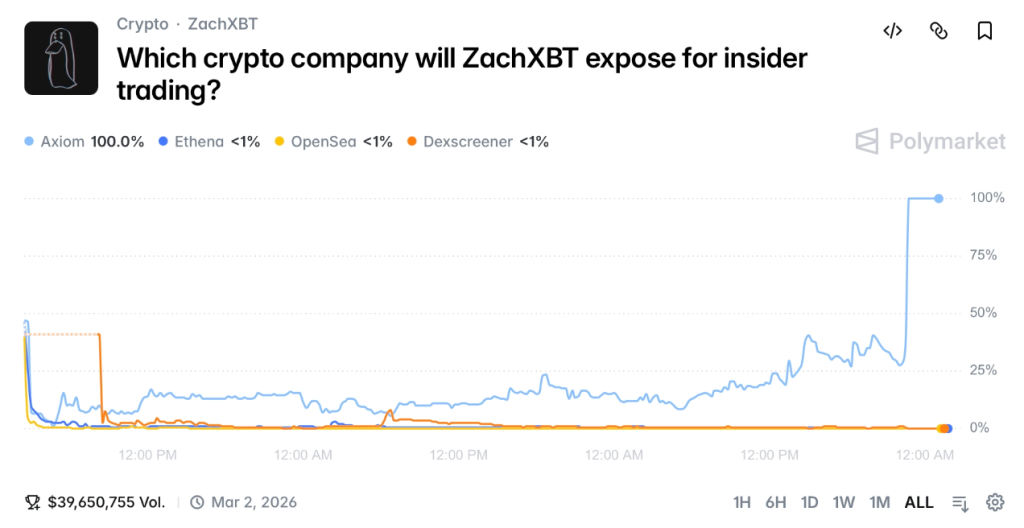
The controversy also spilled directly into prediction markets. Polymarket hosted a contract asking which crypto company ZachXBT would expose for insider trading, and the market moved sharply toward Axiom before resolving in that direction. The public market page showed Axiom as the resolved outcome.
The bigger takeaway for users
Even if the most serious claims are never fully proven, the episode still highlights a structural issue in crypto: the moment a platform can connect support data, referral information, user IDs, and wallet activity, it has a level of visibility that no ordinary on-chain observer has. From that point on, internal controls are no longer a back-office detail. They become part of the product.
That is why this story matters beyond Axiom. It is a reminder that trust in a trading platform is not only about uptime, execution speed, or token listings. It is also about who inside the system can see sensitive behavioral data, how often that access is reviewed, and whether abuse can be detected before it affects users.
What comes next
The next real test is not social media outrage. It is whether Axiom provides a more detailed explanation of what data could be accessed, how long the access existed, and what controls are being changed now. Without that, the story is likely to stay where many crypto scandals do: widely discussed, partially evidenced, and difficult to close cleanly.
For traders, the practical lesson is simple. “On-chain” does not automatically mean “private,” and operational risk does not start only when funds are lost. It can begin much earlier, when sensitive data is visible to more people than users realize.
Following fast-moving markets
In crypto, information moves quickly, and so does sentiment. If you are tracking market developments and managing positions in real time, you can monitor markets on Tapbit. Existing users can access their accounts through the Tapbit login page, while new users can get started on the Tapbit registration page.
Sum Up
The Axiom controversy is not just another memecoin scandal. It has become a test case for how crypto platforms handle internal visibility into user behavior. ZachXBT says an employee used that visibility improperly. Axiom says it removed access and is investigating. What the market will watch next is whether the company can show that the problem was contained — and that the underlying controls are stronger than the allegations suggest.
Disclaimer: This article is for informational and educational purposes only and does not constitute investment advice. Crypto markets are highly volatile, and small-cap tokens can move sharply in both directions.