




Strategy is back in the market with another headline-sized Bitcoin buy, and this time the reaction is not just about BTC. Traders are also watching MSTR itself, because the company has increasingly become its own kind of market instrument: part software business, part Bitcoin treasury, part equity-funded proxy trade.
According to Strategy’s latest announcement, the company acquired 17,994 BTC for roughly $1.28 billion at an average price of about $70,946 per coin. That brings total holdings to 738,731 BTC acquired for about $56.04 billion in aggregate, or roughly $75,862 per Bitcoin on average. The purchase was also disclosed in the company’s latest 8-K filing, which shows the buying was funded through a mix of common stock and preferred share sales under its at-the-market programs.
Why this purchase matters now
On paper, this is another familiar Michael Saylor move. In practice, it landed at a moment when both Bitcoin and macro risk sentiment are still moving fast. Bitcoin was trading around $69,903 at the latest read, after moving between $66,964 and $70,503 intraday. MSTR, meanwhile, traded at $138.95, with an intraday range of $131.19 to $140.06. That matters because MSTR is no longer trading like a normal software stock. It tends to move as a higher-beta expression of Bitcoin, but with an added layer of corporate financing and market-structure risk.
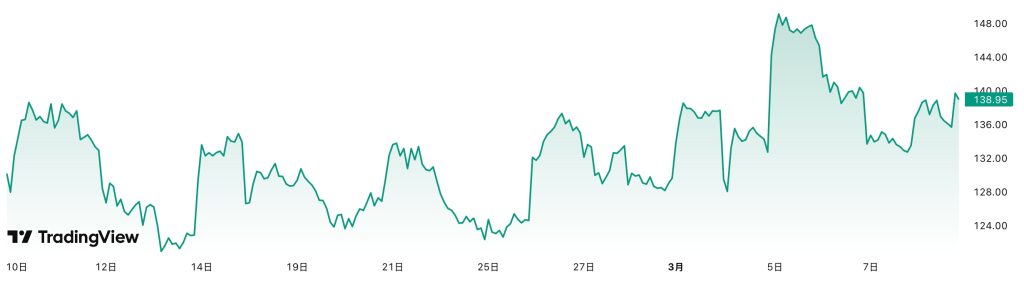
That is exactly why this latest buy is getting attention beyond the usual “Strategy bought more BTC” headline. The market is trying to price two things at once: Bitcoin exposure, and the sustainability of Strategy’s capital-markets machine.
The stock is part of the story now
For a while, the bull case around MSTR was simple: if Bitcoin goes up and Strategy keeps accumulating, the equity can outperform spot BTC because it offers leverage, liquidity, and equity-market access. That argument is still alive. On X, many bullish accounts framed the latest buy as more proof that Strategy remains the biggest and most aggressive corporate Bitcoin accumulator in the market.
But the conversation has become more layered than that. The debate now is not only about whether Strategy can keep buying. It is about whether those purchases continue to improve the company’s Bitcoin exposure on a per-share basis, especially when the buys are funded by fresh issuance.
What X is arguing about
The discussion on X after the filing broke has been loud, but it is not one-sided.
On the bullish side, Michael Saylor himself confirmed the purchase in a post stating that Strategy had acquired 17,994 BTC for roughly $1.28 billion, bringing total holdings to 738,731 BTC. That post quickly became the anchor link for the market’s initial reaction. The same numbers were also amplified by on-chain and market-tracking accounts such as Lookonchain, which helped push the “Strategy keeps absorbing supply” angle across crypto timelines.
A second camp on X focused less on the headline purchase and more on the capital structure behind it. Some traders argued that if MSTR can continue issuing securities at a premium to its underlying Bitcoin exposure, the model can still work as a form of accretive treasury expansion under the right conditions. That line of thinking shows up in posts from MSTR-focused market commentators and strategy accounts, including discussions around BTC yield and dilution mechanics.
Then there is the skeptical side. Critics argue that the “dilution increases Bitcoin per share” narrative only works under fairly specific assumptions, and that the trade becomes much more fragile if MSTR’s premium compresses or equity-market demand weakens.
Put simply, X is not debating whether Strategy bought more Bitcoin. That part is settled. The real argument is whether Strategy is still the market’s most effective public Bitcoin vehicle, or whether investors are underpricing how dependent that model is on continued financing flexibility.
Why traders should care
For short-term traders, the takeaway is simple: MSTR can still trade like a momentum-heavy Bitcoin instrument, especially when Strategy announces another large buy into a firm BTC tape. But it is not a one-variable trade. The stock carries additional risk around issuance, premium compression, volatility, and the market’s willingness to keep funding the strategy.
For longer-term crypto investors, the bigger point is supply. Strategy now holds 738,731 BTC. That is a meaningful chunk of the asset’s eventual supply, and every new purchase reinforces the same broader narrative: more Bitcoin is moving onto long-duration balance sheets rather than staying in fast-moving circulation.
That is one reason the market continues to care about these filings. Every buy is more than a treasury update. It is a read on whether public capital markets are still willing to fund large-scale Bitcoin accumulation.
The bigger market read
The latest move does not settle the MSTR debate. It sharpens it.
Bulls will say Strategy is still proving that an aggressive corporate Bitcoin treasury can create a powerful equity story. Bears will say the structure depends too heavily on favorable financing conditions and investor belief in the premium. Both sides have a point, and that is exactly why every new 8-K from Strategy now moves more than just sentiment around Bitcoin.
For now, the market is still giving Saylor room to keep pressing the trade. As long as Bitcoin stays resilient and MSTR remains liquid and well-followed, that debate is not going away.
If you want to follow Bitcoin market moves in real time, you can explore the Tapbit homepage, sign in through the Tapbit login page, or create an account on the Tapbit registration page.