




Bitcoin price action has been leaning softer as geopolitical tension around key shipping routes keeps global markets in a risk-off mood. When routes such as the Strait of Hormuz face disruption, energy-supply risk and freight costs rise, and that tends to push capital toward classic havens like gold and major government bonds. Bitcoin price performance often lags those assets in this kind of environment, with traders treating it more as a high-beta risk asset than as digital gold. For HK investors, the takeaway is clear: volatility can stay elevated while price action is headline-driven, so risk control matters more than chasing every bounce.
Hormuz Shock Pivots Global Flows
Reports that military forces have effectively constrained traffic in the Strait of Hormuz push shipowners and traders to reroute vessels, raising both energy-supply uncertainty and shipping costs. That jump in perceived geopolitical risk nudges portfolios toward defensive assets and away from higher-beta exposure. For HK investors who hold sectors sensitive to oil-linked input costs, such as transport, manufacturing, and airlines, this backdrop can squeeze margins and weigh on equity performance.
When fear rises, flows typically rotate first into gold and high-quality sovereign debt. That pattern has shown up across multiple episodes of Middle East tension, with safe-haven demand crowding out appetite for crypto risk. In those phases, bitcoin price swings tend to widen while directional conviction weakens, as traders fade rallies rather than chase upside. For anyone holding coins on centralized platforms, it is also worth checking whether the venue publishes independent proof of reserves so you can monitor asset security as macro stress builds.
Signals on the Bitcoin Price Chart
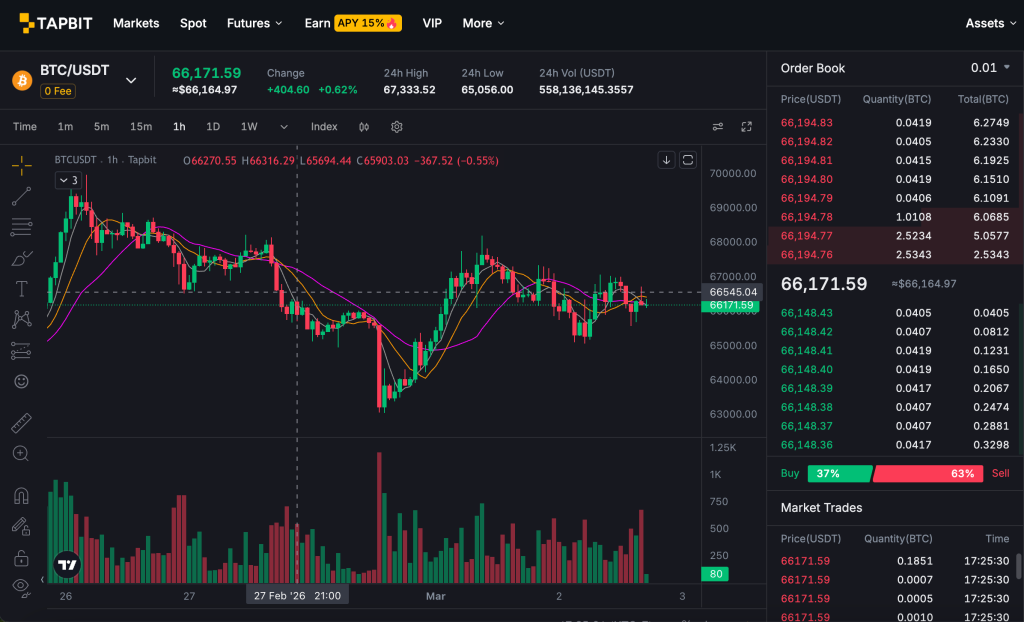
On the chart, bitcoin price has struggled to reclaim key moving averages. Spot levels sit below both the 50-day and 200-day averages, and the wide gap between price and those longer-term trend markers keeps sentiment cautious. A relative strength index in the mid-30s to low-40s region signals weak momentum without a clear oversold flush, while a negative MACD line shows the prevailing downtrend. A slightly improving MACD histogram can hint that downside pressure is easing, but confirmation is still lacking.
Trend-strength gauges such as ADX remain elevated, pointing to a strong trend that, for now, still tilts lower. Average True Range has expanded, underlining wide intraday swings that can punish traders who ignore sizing and leverage. Volatility bands paint a similar picture: Bollinger and Keltner midlines cluster in the upper part of the recent range, with upper bands sitting above the market and lower bands several thousand dollars below. With bitcoin price trading under those midlines, buyers need a firm reclaim to improve the tape.
Volume and flow metrics add another layer. Turnover has picked up compared with calmer periods, yet on-balance volume has been skewed to the downside, pointing to distribution rather than accumulation. Money Flow Index readings around the low-40s suggest that dip-buying is present but hardly aggressive. If bitcoin price fails to sustain bounces on rising volume, rallies risk fading into lower highs. Watching whether money flow improves on up days will help confirm whether a durable base is forming or whether the path of least resistance remains lower.
Playbook for HK Investors in a Risk-Off Tape
Respect levels in this tape. For many traders, the key resistance zone sits in the upper US$60,000s, where recent highs line up with the midlines of major volatility bands. A nearby cluster of offers often emerges just below the psychological US$70,000 area. On the downside, initial support tends to show up around the mid-US$60,000s, with more significant support closer to the low-US$60,000s where lower Bollinger and Keltner bands converge. Use these zones to frame entries, exits, and stop placement rather than trading on impulse.
Execution discipline matters. Use limit orders to curb slippage when spreads widen, and keep position sizes smaller than usual while geopolitical risk is elevated. Build expected trading fees into your position-sizing math, so costs do not quietly erode your edge. If you trade meaningful notional, it can be worth evaluating whether a VIP tier with differentiated maker and taker rates helps keep your overall pricing structure competitive.
Given the strength of safe-haven flows, consider running a defensive sleeve alongside your crypto exposure. Some HK investors pair bitcoin with gold, high-quality bond exposure, or cash-like instruments to smooth drawdowns when risk-off episodes hit. If bitcoin price weakens on fresh geopolitical headlines, a balanced mix can reduce portfolio volatility without forcing you entirely out of the market. Reassess allocations regularly while shipping and energy risks remain in focus, and avoid letting any single headline drive oversized bets.
Crypto trades 24/7, but depth and liquidity often improve when Europe and the US are active. For HK traders, that generally lines up with the late afternoon through late night window, roughly 4 pm to 1 am HKT, when spreads tend to be tighter and order books deeper. Spreads can widen in Asia mornings when headline risk is high and offshore desks are thinly staffed. If liquidity looks shallow, stagger entries and exits over multiple clips to avoid adverse fills and sudden gaps in bitcoin price.
Outlook and Bitcoin Price Scenarios
Our composite view on bitcoin price in this backdrop is neutral to cautious, effectively a Hold stance. Model projections over the next several months sketch a wide cone of possible outcomes, from deeper pullbacks toward prior cycle support to potential retests of earlier highs if macro conditions stabilize. Treat these figures as guideposts, not promises; the combination of geopolitics and leverage makes crypto paths especially noisy.
On the upside, a sustained break above resistance in the upper US$60,000s would open room toward the low-US$70,000s, then into the mid-US$70,000s near the upper volatility bands. A stronger bid would likely require RSI lifting back above the 50 area, a bullish MACD signal-line cross, and some easing in safe-haven demand. If market participants start rotating out of gold and government bonds and back into equities and higher-beta assets, bitcoin price could recover faster than many peers.
On the downside, losing support in the mid-US$60,000s would expose the low-US$60,000s at the lower end of recent ranges. With ATR elevated, intraday drops can be sharp, especially around unexpected headlines on shipping lanes or energy infrastructure. Persistent negative OBV, an RSI that fails to lift, and weak bounces on light volume would all confirm that pressure remains in place. If geopolitical risk intensifies or funding conditions tighten, bitcoin price may need to retest lower supports before more patient capital steps in.
Final Thoughts on Bitcoin Price and Risk Management
Geopolitics has steered global flows back toward classic havens, and that leaves bitcoin price trailing despite its long-term narrative. The market sits below key moving averages, momentum is soft, and realized volatility is high, which together argue for respect rather than bravado. For HK investors, the roadmap is straightforward: trade the levels, size smaller, and lean on limit orders when spreads widen. Track whether price can reclaim and hold the midline of major volatility bands with improving volume; above resistance in the upper US$60,000s, upside opens toward the US$70,000 area and beyond. Below the mid-US$60,000s, risk grows for a test closer to the low-US$60,000s. Keep a defensive sleeve while the Strait of Hormuz story and broader geopolitical narrative evolve, and be ready to reassess quickly as headlines shift flows.
FAQs on Bitcoin Price and Geopolitics
How does tension in the Strait of Hormuz affect the bitcoin price?
The Strait of Hormuz is a critical chokepoint for global oil shipments, so disruption there raises both energy and freight risk. That combination tends to push investors toward assets such as gold and government bonds, which are perceived as safer when supply chains look fragile. In those phases, demand for crypto risk often fades, leaving bitcoin price more volatile and prone to downside spikes until shipping and energy headlines calm down.
Is bitcoin acting as a safe haven in this environment?
In periods of acute tension around the Strait of Hormuz and similar flashpoints, safe-haven flows have generally favored gold and sovereign bonds over crypto. Bitcoin price has behaved more like a risk asset, showing drawdowns when fear rises and recovering when broader risk sentiment improves. Over longer cycles, its role can evolve with adoption, liquidity, and macro policy, but flow data in stress episodes still shows investors prioritizing traditional havens first.
What levels matter most for the bitcoin price in this setup?
The key levels many traders watch are clustered around the recent range. On the upside, resistance in the upper US$60,000s and then the US$70,000 area serves as a trigger zone; a firm close above those levels, on rising volume, would improve the technical picture. On the downside, the mid-US$60,000s act as initial support, with stronger support nearer the low-US$60,000s where lower volatility bands sit. Use these areas to plan entries, exits, and stop-loss placement rather than focusing on every intraday fluctuation.
How should HK traders manage execution risk in this kind of tape?
For HK traders, it pays to focus on the Europe–US overlap, roughly 4 pm to 1 am HKT, when global liquidity is deepest and spreads are tighter. Use limit orders instead of market orders, keep trade sizes modest, and consider scaling in or out over several tickets rather than all at once. If volatility spikes on new geopolitical headlines, stepping back and letting spreads normalize is often better than forcing fills into thin books. The goal is to participate in bitcoin price moves without letting execution risk overwhelm your intended strategy.
FAQs
How does the Strait of Hormuz affect Bitcoin price today?
The Strait of Hormuz is a key route for global oil. Disruption raises energy and freight risk, which pushes investors to safe havens like gold and Treasuries. That leaves less demand for crypto risk. Bitcoin price today reflects this shift, with wider swings and weak momentum until shipping and energy headlines calm down.
Is Bitcoin acting as a safe haven right now?
Not today. Safe-haven flows favor gold and government bonds. Bitcoin price today is tracking risk assets instead, showing drawdowns when fear rises. Over time, its role can change with liquidity, adoption, and macro trends, but current flows show investors prioritizing traditional havens while geopolitical risk remains high.
What levels matter most for Bitcoin price today?
Watch resistance at $68,866 and the Bollinger midline near $68,452. Support sits at $66,500, then $61,045. A firm move above $68,866 with rising volume would improve the outlook. A drop below $66,500 risks a slide toward the lower band. Use these levels to frame entries, exits, and stop placement.
How should HK traders manage execution risk today?
Focus on the Europe-US overlap from roughly 4 pm to 1 am HKT for better depth. Use limit orders, smaller sizes, and staged entries to curb slippage. If volatility spikes, step back and let spreads normalize. Keep plans flexible, since Bitcoin price today can react quickly to fresh geopolitical headlines.
Disclaimer
This material is provided solely for research and informational purposes and does not constitute investment, trading, or financial advice. It does not take into account your specific objectives, financial situation, or needs, and you should consult an independent professional advisor before making any investment decisions.
If you decide that this environment offers opportunities to express a view on the bitcoin price, make sure you trade through venues and structures that fit your risk tolerance and strategy. You can create an account and explore available welcome rewards designed for active traders before committing capital.