




Crypto didn’t rally this week in isolation. One of the quieter catalysts may have come from Seoul. South Korea’s equity market suffered a brutal, record-setting selloff, and when that kind of local risk trade snaps, money doesn’t always go straight to cash. Sometimes it looks for the next liquid outlet.
On Wednesday, the tech-heavy KOSPI plunged about 12% — its worst day on record — after a steep drop the prior session. The won weakened sharply as volatility spiked, with trading curbs triggered amid the chaos. The shock was tied to a geopolitical-driven energy scare that hit Asia particularly hard.
A local shock can spill into a global market
South Korea is unusually important for crypto flows because retail participation is high across both markets. When equities gap lower, margin gets cut, and positions are forced to reset, traders still want something that trades continuously — and crypto is open when stock markets are not.
That doesn’t mean bitcoin is a “safe haven.” It means bitcoin can act like the nearest 24/7 risk venue when a crowded local trade breaks and people re-position fast.
What the tape looked like
Bitcoin climbed back into the low-$70,000s during the same window. CoinMarketCap’s live page showed BTC around the ¥11.3 million range (JPY) at the time of retrieval, reflecting a move back above the key $70K area.
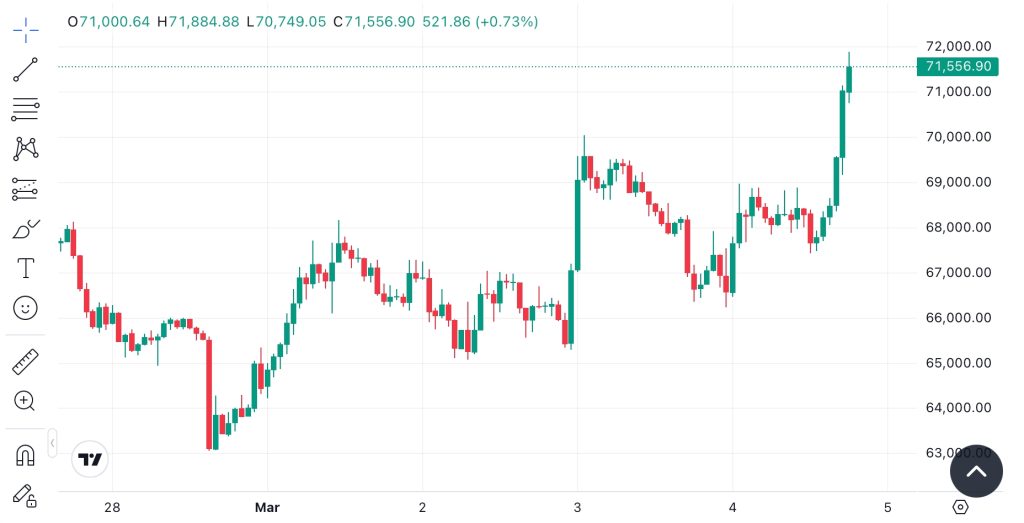
The timing is what traders noticed: Korea’s two-day drawdown was violent, and crypto caught a bid as the equity panic peaked. That’s not proof of causality, but it is a pattern markets recognize — stress in one risk pocket can redirect activity rather than eliminate it.
Why this matters for the next move
The most useful question now isn’t “did Korea cause the crypto rally?” It’s whether the rally can survive once the shock fades.
If Korean equities stabilize and volatility cools, rotation-driven bids can lose urgency. If the macro shock remains (energy prices, currency pressure, geopolitical uncertainty), risk behavior can stay jumpy — and crypto can keep inheriting the flow whenever traditional markets seize up.
Trade the market as it is, not as it “should” be
Crypto often moves on flows and positioning more than neat narratives. When a big market dislocates, the second-order effects show up quickly in the only venues still trading.
If you’re tracking fast shifts in risk sentiment and managing positions in real time, you can monitor markets on Tapbit. Existing users can access their accounts via Tapbit Login, and new users can get started here: Tapbit Register.
Bottom line
Korea’s stock rout was large enough to reset local risk appetite in a hurry. When that happens, crypto doesn’t need a new story to rally — it just needs to be the easiest place to trade next. Whether this week’s move turns into something durable will depend on what happens after the panic: stabilization, or another leg of pressure.
Disclaimer: This article is for informational and educational purposes only and does not constitute investment advice. Markets can move sharply during geopolitical events, and both commodities and crypto assets carry risk.