

Strategy Bitcoin News: What Happened?
Strategy Bitcoin coverage is no longer only about how many coins the company buys. Investors are now watching Strategy's broader capital framework, including preferred stock, cash reserves, buyback plans, and the conditions under which the company could sell Bitcoin.
Strategy, formerly known as MicroStrategy, built its identity around Bitcoin treasury exposure. That made MicroStrategy Bitcoin holdings a recurring market topic. In 2026, the focus has become more complex: how does a Bitcoin-heavy company manage capital when BTC is volatile, preferred dividends must be serviced, and public investors want protection against downside pressure?
The timing is important. For years, Strategy was mainly discussed as an aggressive Bitcoin accumulator. The story was easy to understand: raise capital, buy BTC, hold for the long term. The newer discussion is more institutional and more nuanced. Investors are now asking whether Strategy can preserve the upside of Bitcoin exposure while also managing public-market instruments that require cash discipline.
That shift makes the story relevant beyond one company. Strategy has become a case study in what happens when a public corporation turns Bitcoin into a central treasury asset. Its capital decisions are watched by equity investors, credit investors, preferred-stock holders, crypto traders, and Bitcoin bulls who see the company as a high-conviction signal.
Strategy BTC Holdings and Why They Matter
Strategy has reported 847,363 BTC in recent company-linked market coverage, keeping it at the center of institutional Bitcoin discussion. That number matters because the company is not a crypto fund, yet its stock and financing instruments often trade like a leveraged Bitcoin proxy.
The market watches Strategy BTC holdings for three reasons:
- Supply signal: A large treasury holder can shape expectations around institutional demand.
- Sentiment signal: Strategy buying is often read as confidence in long-term Bitcoin.
- Risk signal: Any potential sale would attract attention because of the company's large position.
For Bitcoin context, Tapbit Learn's why bitcoin is dropping guide explains how large flows and sentiment can affect BTC price action.
The size of the holding also changes how investors think about Strategy's stock. In a normal software or analytics company, investors focus mainly on revenue growth, margins, cash flow, and product strategy. In Strategy's case, the Bitcoin balance sheet can dominate the valuation conversation. If BTC rises sharply, investors may price Strategy as a leveraged Bitcoin vehicle. If BTC falls, the same leverage can create sharper downside anxiety.
That is why Strategy Bitcoin coverage often overlaps with macro crypto coverage. The company is not Bitcoin itself, but it can amplify Bitcoin sentiment in public markets. It gives traditional investors a way to express a view on BTC through a listed equity structure, while also exposing them to corporate-finance risks that do not exist when holding spot Bitcoin directly.
The Capital Framework Investors Are Watching
The latest Strategy debate centers on capital management. Recent reporting has highlighted a $2 billion buyback authorization, a larger $2.55 billion dollar reserve, and a BTC monetization framework designed to support preferred-equity obligations when necessary.
| Focus Area | Why It Matters |
|---|---|
| Bitcoin holdings | Core treasury asset and investor narrative |
| Dollar reserve | Helps service obligations without forced BTC sales |
| Buyback plan | Can support preferred equity market confidence |
| BTC monetization policy | Defines when Bitcoin might be sold |
This does not mean Strategy is abandoning Bitcoin. It means investors are asking how a Bitcoin treasury company balances conviction with financial flexibility.
The dollar reserve is especially important because it changes the market's interpretation of risk. If a company with large BTC holdings has enough liquidity to meet near-term obligations, investors may worry less about forced selling. If liquidity looks tight, even a small mention of BTC monetization can become a major market event. The reserve is therefore not just an accounting item; it is a confidence tool.
The buyback element also matters because Strategy's capital stack includes securities that may trade under pressure when investors worry about dividends, convertibility, or balance-sheet stress. A buyback authorization can signal that management wants to support market confidence. But investors still need to watch whether the authorization is actually used, under what conditions, and how it interacts with Bitcoin prices.
When Could Strategy Sell Bitcoin?
The key phrase investors are watching is Bitcoin monetization. In simple terms, this means Strategy may sell a portion of BTC under certain capital-management conditions, such as supporting dividend obligations, protecting preferred equity, or maintaining its reserve framework.
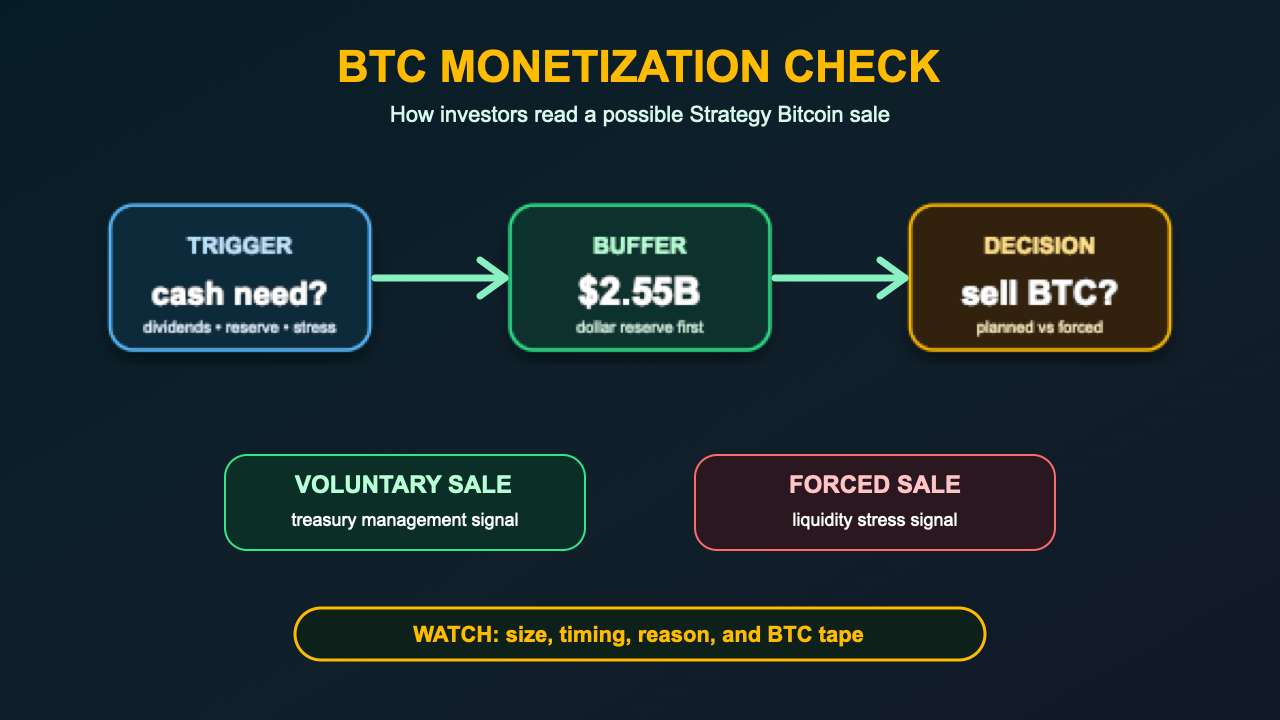
That distinction is important. A planned framework is different from panic selling. Still, any Strategy Bitcoin sale would likely become a major headline because the company has become a symbol of corporate Bitcoin accumulation.
Traders can view market data to compare BTC movement with broader crypto conditions. New users can also create an account before following live market updates.
The most important distinction is voluntary monetization versus forced liquidation. Voluntary monetization means the company chooses to sell BTC within a planned framework. Forced liquidation implies pressure from debt, liquidity constraints, or market stress. The first can be read as treasury management. The second would likely be read as a risk event.
Investors should therefore avoid reading every mention of Bitcoin sales the same way. A small sale used to fund an obligation may have a different meaning from a broad change in long-term BTC conviction. The market reaction will depend on size, timing, stated reason, and whether the sale happens during a strong or weak BTC tape.
Why MicroStrategy Bitcoin Exposure Still Moves Crypto Sentiment
Even after the name change to Strategy, many investors still search microstrategy bitcoin because the old name is strongly associated with BTC accumulation. That search behavior matters for SEO and market psychology.
Strategy is watched as a bridge between public equity markets and crypto. When the company raises capital to buy Bitcoin, BTC bulls often treat it as institutional validation. When the company discusses reserves, buybacks, or possible BTC sales, traders watch for signs of stress.
For a broader look at BTC's market role, Tapbit Learn's Bitcoin dominance guide explains why Bitcoin still drives crypto cycles.
The search phrase microstrategy bitcoin also reveals how sticky financial narratives can be. Even after a corporate rename, investors continue using the older brand because it became shorthand for a very specific trade: listed-company exposure to Bitcoin. That has SEO value, but it also has market meaning. When a phrase becomes shorthand, headlines can move faster than detailed filings.
This is why Strategy news should be read carefully. A headline about buybacks, reserves, or BTC monetization may sound bearish at first, but the details matter. Does the company plan to sell Bitcoin immediately? Is it building a liquidity buffer? Is it protecting preferred shareholders? Is it trying to reduce volatility in its own capital instruments? Each answer leads to a different market interpretation.
What to Watch Next
The next Strategy Bitcoin headlines will likely focus on three things: the size of BTC holdings, the use of dollar reserves, and whether the buyback plan stabilizes preferred-equity sentiment. Investors should also watch Bitcoin's own trend. A stable BTC market gives Strategy more flexibility; a sharp BTC drawdown makes the capital framework more important.
Strategy Bitcoin news is therefore both a company story and a crypto-market story. The company remains a major Bitcoin proxy, while microstrategy bitcoin remains the search phrase many investors still use to understand that exposure.
A practical watchlist should include BTC spot price, Strategy's latest BTC disclosure, preferred-equity pricing, any announced use of the buyback program, and changes in the dollar reserve. Together, these signals show whether the market views the framework as a stabilizer or as evidence of tighter financial conditions.
The deeper takeaway is that Strategy is testing a new model of corporate finance: a public company with Bitcoin as a strategic treasury asset and capital-market instruments built around that thesis. That makes Strategy Bitcoin a recurring news story, not a one-day headline.
FAQ
What is Strategy Bitcoin?
Strategy Bitcoin refers to Strategy's large corporate Bitcoin treasury strategy and the market discussion around its BTC holdings.
Is Strategy the same as MicroStrategy?
Yes. Strategy is the renamed company formerly known as MicroStrategy.
How many Bitcoin does Strategy hold?
Recent market coverage has cited 847,363 BTC, but investors should always check the latest company disclosure because holdings can change.
Could Strategy sell Bitcoin?
Yes, under certain capital-management conditions. That does not necessarily mean the company is ending its Bitcoin strategy.
Why does Strategy affect Bitcoin sentiment?
Strategy is one of the most visible public-company Bitcoin holders, so its financing, buying, or selling decisions can influence institutional BTC sentiment.


