
Sensex Nifty Stock Market Today: What Changed?
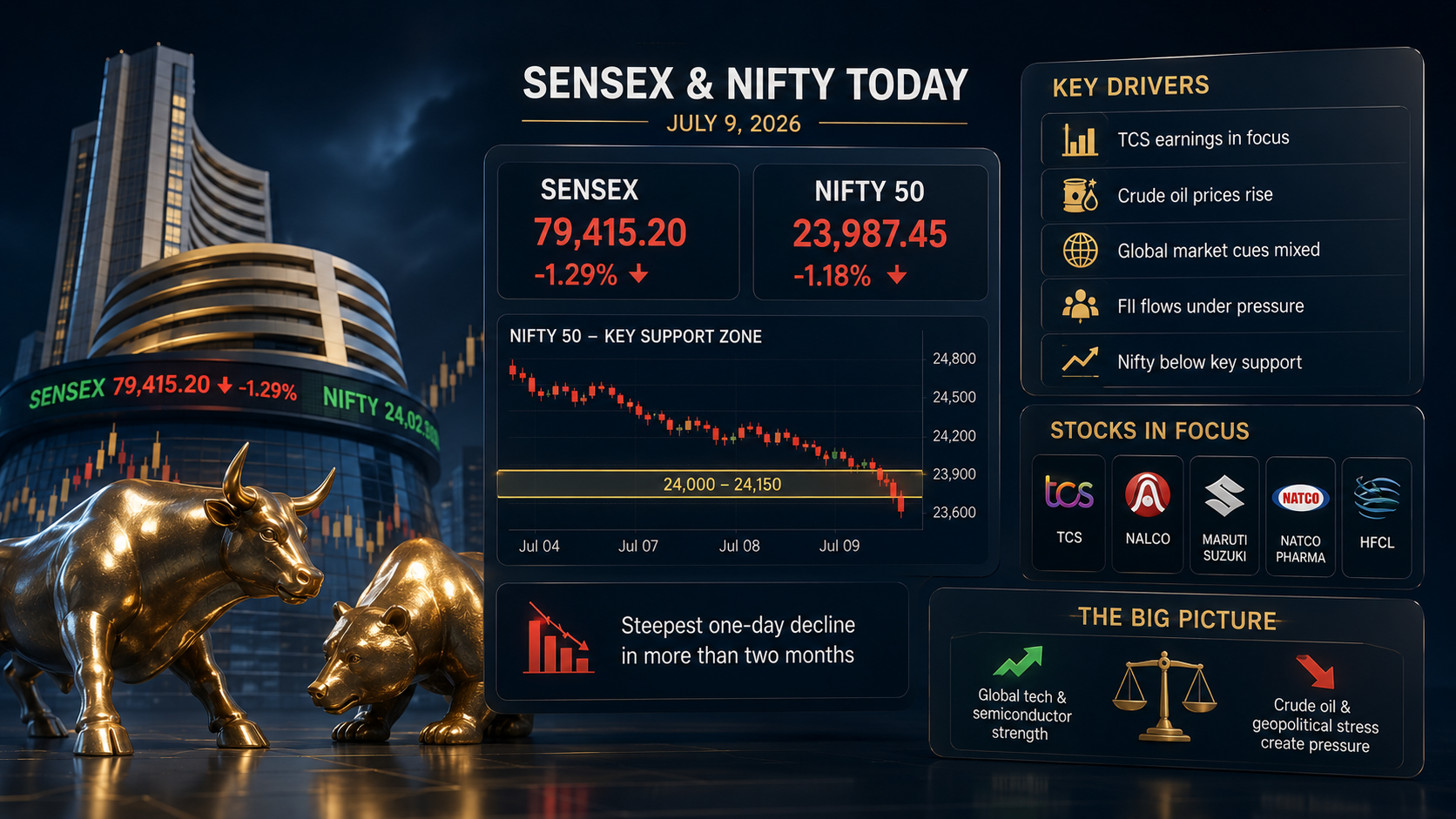
Sensex Nifty stock market today coverage is not only about whether Indian benchmarks opened higher or lower. It is about why the market is reacting the way it is. On July 9, 2026, Indian equities entered the session after a sharp risk-off move, with investors focused on TCS earnings, crude oil prices, global cues, foreign investor flows, and whether Nifty can recover key technical levels.
Economic Times reported that Indian benchmarks had just posted their steepest one-day decline in more than two months, with Nifty breaking below the important 24,000-24,150 support area. That matters because once an index loses a widely watched support zone, short-term traders often shift from “buy dips” to “wait for confirmation.” Stocks in focus included TCS, Nalco, Maruti Suzuki, Natco Pharma, and HFCL, making the session a mix of index-level macro pressure and company-specific catalysts.
The main market message is this: Indian equities are being pulled between two forces. On one side, global tech and semiconductor strength offers some support for risk assets. On the other side, crude oil and geopolitical stress create inflation pressure, currency pressure, and caution toward import-sensitive sectors.
Why Oil Prices Matter So Much for Sensex and Nifty
Oil is one of the fastest ways global stress reaches Indian equities. India imports a large share of its crude oil needs, so a jump in oil prices can affect inflation expectations, the current account balance, corporate margins, and the rupee. When oil rises quickly, investors often become more selective.
This is why Sensex Nifty stock market today analysis needs to include crude oil even if the article is about equities. A higher oil price can pressure airlines, paint companies, chemicals, logistics, and other energy-sensitive sectors. It can also complicate the Reserve Bank of India’s inflation outlook. If inflation pressure returns, the market may become less willing to price aggressive rate cuts.
The link between crude oil and equities is also psychological. Rising oil during a geopolitical shock tells investors that the problem is not isolated. It may affect shipping, insurance costs, bond yields, the dollar, and global risk appetite. That is why an oil-driven sell-off can hit more than energy importers. It can change the way investors value the entire market.
For a broader cross-market comparison, readers can review crypto vs stocks, which explains why crypto, equities, and macro assets can react differently to the same headline.
TCS, Earnings Season and the IT Sector Signal
TCS is important because it is not just one company. It is a read-through for India’s IT services sector, export demand, margin pressure, hiring outlook, and global enterprise spending. When TCS reports, investors look beyond revenue and profit. They listen for commentary on deal wins, discretionary tech spending, North American demand, and currency effects.
If TCS guidance is resilient, IT stocks may help stabilize the index even when oil is rising. If management sounds cautious, pressure can spread across other technology and outsourcing names. This is why TCS sits at the center of the current Sensex and Nifty conversation.
There is also a global technology connection. Nvidia’s rebound shows that investors still want exposure to AI and semiconductors, but that does not automatically mean all tech stocks will rise. India’s IT services sector is more tied to enterprise spending and outsourcing cycles, while Nvidia is tied to AI infrastructure, GPU demand, and semiconductor supply. Both are “tech,” but the drivers are different.
That difference matters for traders. A strong Nvidia session can lift Nasdaq sentiment, yet Indian IT stocks still need their own earnings confirmation. The market is asking two separate questions: Is global AI demand still strong? And are Indian IT exporters seeing enough client spending to justify higher valuations?
Sensex, Nifty and Crypto: What Traders Can Learn From the Same Macro Map
Sensex and Nifty do not move like Bitcoin, but they share several macro drivers with crypto. Oil shocks, bond yields, U.S. dollar strength, and risk appetite can affect both markets. When oil rises and yields move higher, investors often reduce exposure to speculative assets. That can weigh on altcoins even if one part of the equity market, such as AI chips, is rebounding.
This is why Sensex Nifty stock market today can help crypto traders understand broader risk conditions. If Indian equities are under pressure because oil and geopolitics are tightening financial conditions, crypto traders should ask whether the same forces could limit upside in BTC, ETH, or altcoins.
The opposite is also true. If oil stabilizes, the dollar cools, and global equities recover, crypto may find a better environment. But confirmation matters. One green candle in Nvidia or Nasdaq is not enough if emerging-market equities, commodities, and bond yields are still flashing caution.
For crypto market context, the crypto fear and greed index can help frame whether traders are acting from panic, relief, or renewed risk appetite.
How to Track Nvidia-Linked TradFi Products on Tapbit
For readers watching the overlap between AI stocks, global equities, and crypto-linked trading access, Tapbit offers market pages for stock-linked derivatives such as Nvidia derivatives. This does not mean trading the Indian Sensex or Nifty directly. It is a way to monitor a U.S. AI stock-linked product that often influences global tech sentiment.
Tapbit’s TradFi Special #4 event is also live before July 13, 2026. Registered users can check the TradFi event page for current reward rules, eligible activity, and timing. Event rewards are available only to successfully registered users, and qualifying trading data must come from users’ own funds.

A simple way to use Tapbit’s Nvidia-linked market:
- Open the Nvidia derivative market page and confirm the product details.
- Check the latest price, 24H change, volume, and chart direction.
- Compare the move with QQQ, SPY, chip stocks, and broader risk sentiment.
- If trading a derivative, set margin, order type, and TP/SL before opening a position.
Stock-linked derivatives are not direct ownership of Nvidia shares. They do not provide shareholder rights, voting rights, or dividends. They are better understood as tradable market exposure.
New users can create an account, compare trading fees, and review proof of reserves before using any product.
What to Watch Next for Sensex and Nifty
The next phase for Sensex and Nifty depends on whether the market can rebuild confidence after the support break. Three signals matter most.
First, watch whether Nifty can reclaim the 24,000-24,150 zone. A recovery above that area would reduce immediate technical pressure. A failure to reclaim it may keep traders defensive.
Second, watch crude oil. If oil continues rising, India’s inflation and currency sensitivity may remain a headwind. If oil cools, import-sensitive sectors may get relief.
Third, watch earnings commentary. TCS and other early reporters can either calm fears about demand or confirm that companies are facing slower growth and margin pressure.
The bottom line: Sensex Nifty stock market today is a cross-market story. It is about Indian earnings, oil, foreign flows, global tech, and the risk mood that connects equities with crypto. The market does not need every signal to turn bullish at once, but it does need oil to stop worsening, earnings to avoid disappointment, and Nifty to rebuild support before the recovery looks durable.
FAQ
Why did Sensex and Nifty fall recently?
The recent pressure came from crude oil strength, weak global cues, renewed geopolitical risk, foreign investor selling, and profit booking after earlier gains.
Why is TCS important for the Indian stock market?
TCS is a major IT bellwether. Its earnings and guidance can influence sentiment toward the broader Indian technology services sector.
Does Nvidia affect Sensex and Nifty?
Not directly, but Nvidia can influence global tech sentiment. Strong AI chip demand may support Nasdaq and risk appetite, which can affect overseas flows into Indian equities.
Can I trade Sensex or Nifty directly on Tapbit?
This article does not imply direct Sensex or Nifty trading on Tapbit. It discusses related stock-linked products such as Nvidia derivatives.
What should traders watch next?
Watch Nifty’s support recovery, crude oil direction, TCS guidance, foreign investor flows, and global bond yields.


