
ARB more than doubled during the first week of September 2026, following months of underperformance — from roughly $0.08 at the end of August to nearly $0.20.
The market wasn't rediscovering Ethereum scaling. It was reacting to Robinhood Chain, built on Arbitrum technology, which was generating millions in daily fees and sharing a portion of net revenue with the Arbitrum ecosystem.
That provides a credible catalyst for the move. But it does not automatically put any of that revenue into ARB holders' wallets.
Why Is ARB Coin Rising?
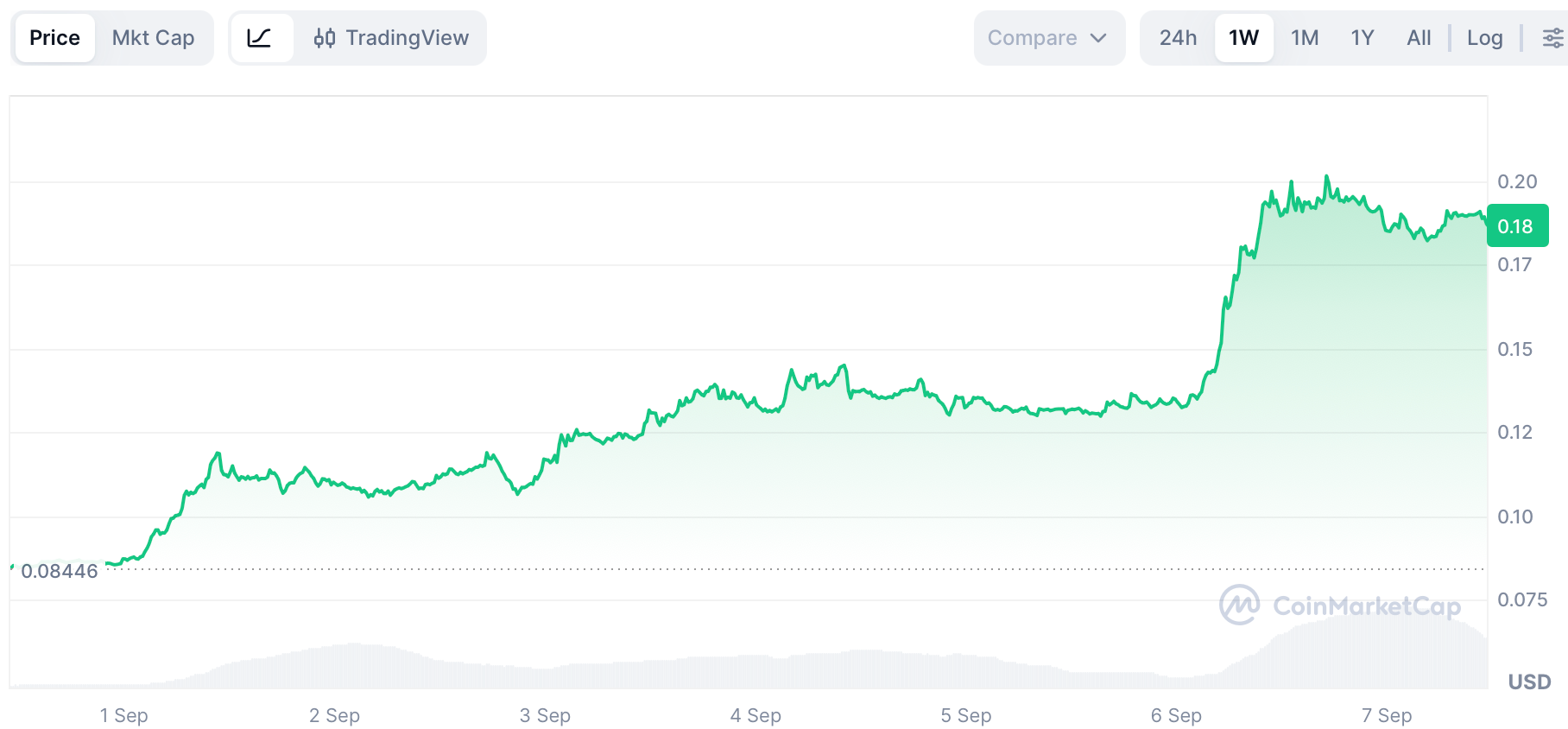
ARB was trading near $0.19 on September 7, with a circulating market capitalization of approximately $1.25 billion. Its seven-day gain reached about 123%, while daily trading volume exceeded $600 million.
The move began shortly before the Arbitrum Foundation published its first-half 2026 report. The report showed that ArbitrumDAO earned $6.19 million during the period from transaction fees, Timeboost auctions, licensing fees and treasury management.
Robinhood Chain supplied the more immediate reason for traders to pay attention. Its activity accelerated sharply in late August and early September, turning Arbitrum’s technology licensing model into a visible source of DAO revenue.
ARB still trades more than 90% below its $2.39 historical high. The rally is substantial, but it comes from a deeply depressed base.
The Robinhood Chain Connection
Robinhood launched its public chain mainnet on July 1, 2026. The network is an Ethereum Layer 2 built with the Arbitrum Platform, using ETH for transaction fees and Ethereum for settlement.
Its main products include tokenized stocks, lending markets and decentralized trading. Robinhood says its new Stock Tokens are available to eligible users in more than 120 countries, although availability varies by jurisdiction.
The connection to Arbitrum goes beyond software branding. Under the Arbitrum Expansion Program, Robinhood Chain returns 10% of its protocol net revenue to the Arbitrum ecosystem. Eight percentage points go to the ArbitrumDAO treasury, while two go to the Arbitrum Developer Guild.
This arrangement creates a repeatable business model: companies can launch dedicated chains with Arbitrum technology, and a share of their net protocol revenue flows back to the ecosystem.
Robinhood Chain’s Numbers Explain the Rally
The early growth has been unusually fast. DefiLlama currently shows approximately $909 million in DeFi TVL, $965 million in stablecoins and $251 million in active real-world assets on Robinhood Chain.
The network processed about $1.37 billion in decentralized exchange volume over the latest 24-hour period and $10.42 billion over seven days. Daily chain fees reached approximately $2.9 million, with $2.61 million recorded as chain revenue.
These figures can change quickly, but they make the new ARB narrative easy to understand. Robinhood Chain is no longer only a future institutional adoption story. It is producing measurable activity, and its licensing agreement sends part of the resulting net revenue to the Arbitrum ecosystem.
The quality of that activity still matters. Much of the recent volume appears connected to decentralized trading and speculative tokens rather than tokenized stocks. A burst of memecoin activity can produce large fees without establishing durable demand.
The useful test is whether Robinhood Chain retains liquidity and fee-paying users after the current trading cycle cools.
ArbitrumDAO Now Has Several Sources of Income
Arbitrum’s financial model is broader than Robinhood Chain. The Arbitrum Foundation’s H1 2026 update reported $6.19 million in total DAO income and gross margins above 97% across protocol revenue streams. The DAO also held approximately $125 million in non-ARB treasury assets at the end of June.
Its income came from Arbitrum One transaction fees, Timeboost, licensing payments from independent Arbitrum chains and returns on treasury assets.
The same report said the wider ecosystem had processed 2.7 billion lifetime transactions, including 478 million during the first half of 2026. Average monthly stablecoin transfers exceeded $70 billion, while derivatives open interest increased 434%.
Those numbers come from the Arbitrum Foundation and should be read as project reporting rather than an independent audit. They nevertheless provide more substance than a partnership announcement alone.
Arbitrum One Still Carries Significant Activity
Robinhood Chain is driving the latest headlines, but Arbitrum One remains the core network.
DefiLlama currently records approximately $1.42 billion in DeFi TVL, $3.6 billion in stablecoins and $823 million in active RWA value on Arbitrum. Daily activity includes around 1.47 million transactions and 80,000 active addresses, while perpetual trading volume is close to $735 million.
L2Beat uses a broader value-secured methodology and places Arbitrum One near $11.6 billion, behind Base but well ahead of most other Ethereum Layer 2 networks.
The two figures are not contradictory. DeFi TVL measures assets deposited in decentralized applications, while total value secured includes a wider group of bridged and issued assets.
Arbitrum remains one of Ethereum’s largest execution environments. Robinhood Chain adds a new dimension by showing that Arbitrum’s software can generate licensing revenue outside Arbitrum One.
ARB Is Not Used to Pay Gas Anymore

The relationship between network activity and ARB demand is easy to overstate.
ARB is primarily a governance token. Arbitrum One users pay transaction fees in ETH, not ARB. Robinhood Chain also uses ETH as its native gas asset.
ARB holders can vote on protocol upgrades, treasury spending and other DAO decisions. They do not automatically receive dividends from Arbitrum One fees or Robinhood Chain licensing revenue.
The DAO may use its income to fund development, grants, liquidity programs or other initiatives that support the ecosystem. Those decisions could benefit ARB indirectly. They are not the same as a contractual claim on revenue.
That distinction is central to the current valuation debate. Arbitrum is demonstrating that its technology can make money. The connection between that income and the economic rights of an ARB token remains dependent on governance.
The Elara Upgrade Supports the Institutional Strategy
Arbitrum activated its ArbOS Elara upgrade on August 20. The release added protocol-level compliance filtering, customizable priority fees and an alternative data API for dedicated chains. It also improved base-fee management on Arbitrum One.
These features are aimed at companies that need more control than a standard public blockchain provides. Financial institutions may require address restrictions, predictable transaction costs and configurable data services before placing regulated products onchain.
Elara therefore fits the same strategy as Robinhood Chain: use Arbitrum as configurable infrastructure for businesses rather than treating every project as another public DeFi application.
Arbitrum has also announced work toward ZK settlement, but that development should still be treated as a roadmap item rather than a fully deployed network feature.
What Could Interrupt the ARB Rally?
The most obvious risk is that Robinhood Chain’s fee surge proves temporary. Its recent activity has been driven partly by speculative trading, which can move elsewhere when incentives or market attention change.
ARB also lacks direct token-level revenue distribution. DAO income strengthens the treasury, but holders must rely on governance decisions to translate that income into stronger ARB demand.
Supply remains another pressure. More than three billion ARB have yet to enter circulation, and scheduled releases will continue after September.
Competition has not disappeared either. Base currently holds more total value secured and processes more activity than Arbitrum One by several measures. Optimism and other rollup providers are also competing for companies that want to launch dedicated chains.
Finally, a 123% weekly move can attract leveraged positions and short-term capital. Even a sound catalyst does not prevent a sharp correction after such rapid price appreciation.
Arbitrum Has Found Revenue. ARB Still Needs Value Capture
The Robinhood Chain launch has changed how the market looks at Arbitrum. It shows that the ecosystem can earn licensing revenue when outside companies adopt its technology, while the DAO’s first-half report confirms that Arbitrum already has several income streams.
What remains unresolved is the ARB token’s role in that model.
ARB provides governance over an increasingly valuable treasury and infrastructure ecosystem. It does not currently provide a direct claim on network income. The rally can continue if traders believe governance rights and treasury growth deserve a higher valuation, but that is different from owning a token with automatic revenue distribution.
The next evidence will come from Robinhood Chain’s fee retention, ArbitrumDAO treasury decisions and ARB’s ability to absorb the September unlock.
Tapbit users can monitor broader crypto-market movements and explore available markets through Tapbit. Existing users can sign in, while those new to the platform can register here.
Frequently Asked Questions
Why is ARB coin rising?
ARB’s rally has been driven mainly by rapid growth on Robinhood Chain, which uses Arbitrum technology and shares 10% of its protocol net revenue with the Arbitrum ecosystem. Arbitrum’s H1 2026 financial report also disclosed $6.19 million in DAO income.
What is Robinhood Chain?
Robinhood Chain is an Ethereum Layer 2 built with the Arbitrum Platform. It supports tokenized assets, decentralized trading and lending applications while using ETH for gas.
Does Robinhood Chain revenue go to ARB holders?
Not directly. Eight percent of Robinhood Chain’s protocol net revenue goes to the ArbitrumDAO treasury, while 2% goes to the Arbitrum Developer Guild. ARB holders govern the DAO but do not automatically receive the revenue as dividends.


