Most utility tokens live and die by a single question: does anyone actually use the thing? For TLC 2.0, the utility token within the Trillioner ecosystem, that question is more relevant than ever as the project enters a more mature phase of development in 2026.
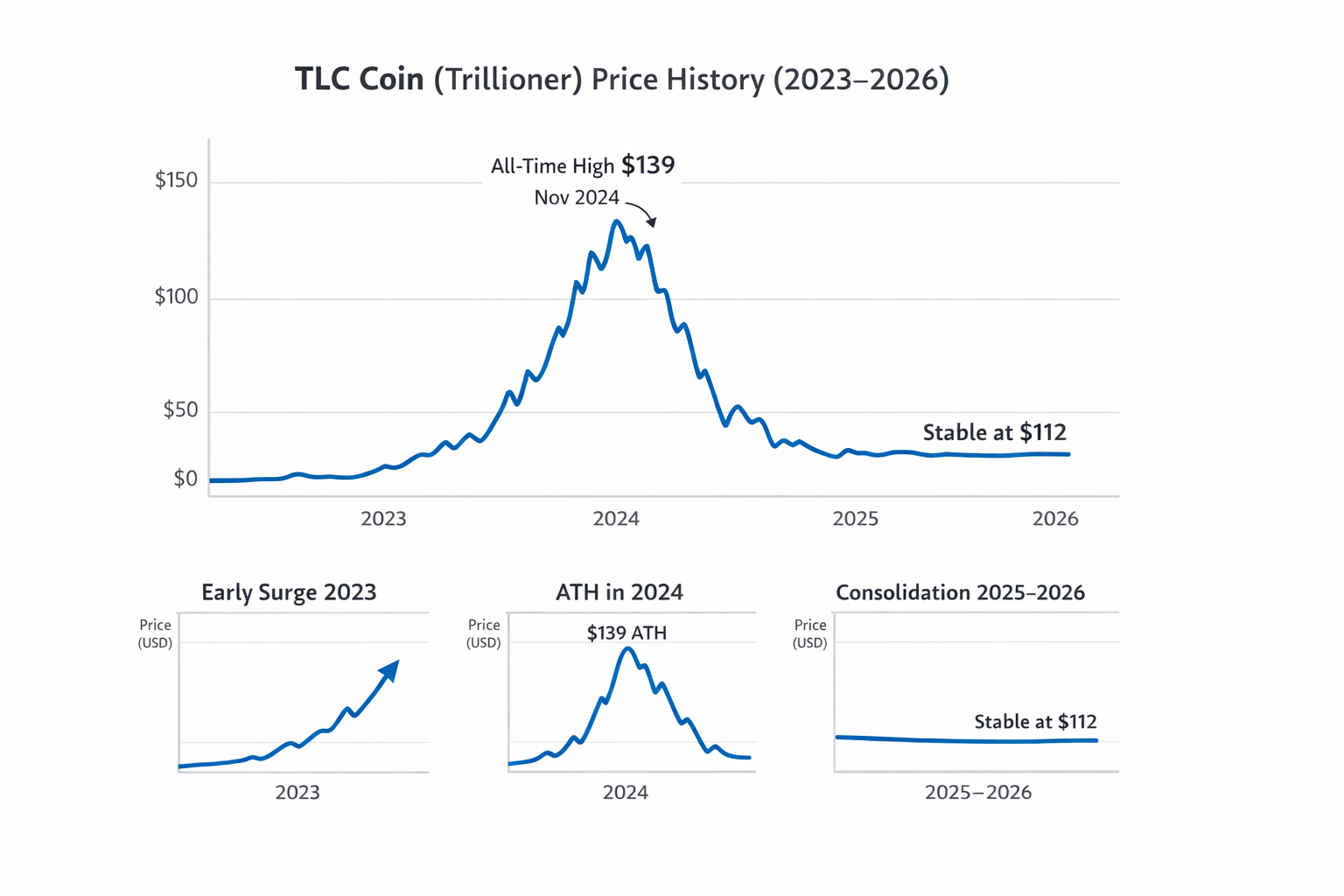
TLC hit an all-time high of $139.59 in November 2024, before pulling back sharply — trading as low as $21.19 by mid-2025. That's a drawdown of more than 80% from peak to trough. Understanding what's behind that kind of volatility — and what could drive the next move in either direction — requires looking past the chart and into the structure of the project itself.
What Is TLC 2.0 and Why Does It Exist Alongside TLC Coin?
Trillioner is a crypto project that aims to bridge traditional finance and the crypto world, offering financial services for both businesses and individual users — including crypto banking, payment processing, staking, and a VISA debit card, all developed under the umbrella of QFX Trade Limited, a forex prime broker operating across 65+ countries with over 600,000 active users.
The original TLC Coin was built to serve everything at once: payments, staking, governance, and ecosystem participation. As the platform grew, that created a structural tension. A single token used for both governance and everyday transactions tends to experience higher volatility — because if holding TLC might be more valuable tomorrow, users have less incentive to spend it today.
TLC 2.0 was introduced to resolve that tension. It handles the utility side — NFT purchases, metaverse payments, DeSci platform access, and high-frequency transactions — while the original TLC Coin retains governance and staking functions. This dual-token model is specifically designed to enhance liquidity and stability compared to traditional single-token systems. In practice, it creates two distinct instruments for two distinct types of participants.
TLC 2.0 vs. TLC Coin: How the Prices Diverge
The price difference between TLC 2.0 and the original TLC Coin follows directly from their different roles in the ecosystem.
TLC 2.0 trades at a lower absolute price by design. As the transactional token, it needs to be accessible enough for routine activity: paying for a digital service, minting an NFT, or interacting with a DeSci application shouldn't require committing significant capital per transaction. Lower unit price enables smaller-denomination activity without forcing users to deal with impractical fractional amounts.
TLC Coin carries a premium that reflects its scarcity and governance weight. A meaningful share of its supply is locked in staking at any given time, which constrains circulating supply and tends to support higher price levels. Holding TLC Coin isn't primarily about spending — it's about participation in protocol decisions and long-term positioning within the Trillioner DAO.
The behavioral difference shows up clearly in trading patterns. TLC 2.0 sees higher daily transaction volume, driven by retail users and active platform participants. TLC Coin moves more slowly, with larger average transaction sizes and a holder base more concentrated among long-term participants. When broader market sentiment shifts, TLC 2.0 tends to react faster — both up and down.
|
Dimension |
TLC 2.0 |
TLC Coin |
|
Primary Role |
Transactional token |
Governance & value storage token |
|
Price Level |
Lower (by design for usability) |
Higher (reflecting scarcity & utility) |
|
Use Cases |
Payments, NFT minting, DeSci interactions |
Governance participation, staking, long-term holding |
|
Supply Dynamics |
More liquid, higher circulation |
Reduced circulating supply due to staking |
|
Trading Activity |
High frequency, retail-driven |
Lower frequency, larger transactions |
|
User Profile |
Active users, frequent participants |
Long-term holders, DAO participants |
What Actually Drives TLC 2.0's Price
Ecosystem Activity Is the Core Variable
Unlike assets that trade purely on narrative, TLC 2.0 has a direct relationship with platform usage. When more users are minting NFTs, accessing DeSci applications, or making metaverse payments, demand for TLC 2.0 increases organically. When activity slows, transaction demand follows — and price tends to reflect that.
The project's roadmap includes a crypto banking payment app, VISA debit card integration, staking rewards, the Trillioner DAO, and access to traditional brokerage markets including forex and stocks. Each of these represents a potential source of recurring transaction demand. New partnerships that bring real users into these products are among the most meaningful catalysts to monitor — because sustained usage is what separates a utility token from a purely speculative one.
Bitcoin Cycles and Broader Market Conditions
TLC 2.0 doesn't trade in isolation. During bull phases, capital rotates from major assets into smaller utility tokens as traders seek higher-beta exposure. During corrections, smaller-cap tokens typically experience amplified drawdowns — TLC's 80%+ decline from its ATH is consistent with this pattern across mid-tier ecosystem tokens.
The relationship with Bitcoin is asymmetric: TLC 2.0 can outperform BTC significantly during risk-on periods, but also underperform sharply when market sentiment turns. Traders who don't account for this correlation tend to be surprised by the speed of both moves.
Supply Mechanics and Staking Dynamics
Trillioner has a maximum supply of 1 billion tokens. How much of that supply is actively circulating — versus locked in staking or held by long-term participants — directly affects price sensitivity to trading volume. When a large share of supply is staked, even modest increases in buy pressure can produce outsized price moves. The same mechanic works in reverse when stakers exit en masse, as happened during the mid-2025 correction.
Liquidity and Exchange Availability
TLC has an all-time low of $14.00, recorded in May 2023 — which was also a period of thin exchange coverage. Liquidity concentration in a small number of venues creates a structural vulnerability: a sudden shift in exchange availability, or a sharp drop in maker activity on a key pair, can widen spreads dramatically and make clean exits difficult. This is a risk factor that doesn't appear on most price charts but shows up clearly in order book depth during volatile periods.
Price Context: Where TLC 2.0 Stands in 2026
Price forecasts for TLC should be read as scenario ranges, not targets. The spread between different analytical models is wide enough that any single figure is unreliable as a planning assumption.
CoinCodex's algorithmic model puts TLC in a range of $112 to $530 across 2026 and into 2027, with the spread reflecting genuine uncertainty about ecosystem adoption rather than a precise projection. A more conservative analysis estimates TLC trading around $111 by end of 2026 under neutral conditions, with a long-term upper scenario reaching $884 by 2030 — though the same model flags the near-term outlook as slightly bearish based on current technical indicators.
The gap between those scenarios comes down to one thing: whether the Trillioner ecosystem generates enough real usage to create sustained organic demand for TLC 2.0. If the banking app, VISA card integration, and DeSci partnerships reach meaningful adoption, the utility case strengthens. If those products stall, TLC 2.0 reverts to trading on speculation alone — and speculation is a much weaker foundation for price support.
View Market
Explore token trends
How to Track and Trade TLC 2.0
For a token with TLC 2.0's liquidity profile, platform choice matters more than it does with major assets. Thin order books can mean wide spreads between buy and sell prices, which cuts into returns on any trade that isn't held long enough to absorb the entry cost.
Tapbit offers spot and derivatives trading across a broad range of assets with on-chain verifiable proof of reserves — giving traders a consistent environment to track live prices and execute orders without counterparty uncertainty. For traders who actively rebalance positions, having access to clean exportable trade histories matters for record-keeping as much as execution quality does.
For on-chain verification,BscScan is the standard tool for confirming TLC 2.0's contract address and monitoring wallet activity directly. Always cross-reference against official Trillioner channels before interacting with any contract — counterfeit tokens using similar names and symbols are common in smaller-cap ecosystems.
For deeper background on evaluating ecosystem tokens before trading, check out What Is Tokenomics? and How to Research a Crypto Token on Tapbit Academy (internal links).
Risks That Belong in the Calculation
Liquidity concentration. TLC 2.0's daily volume is spread across a small number of venues. Exchange delistings — which have affected mid-tier tokens repeatedly in 2024 and 2025 — can create immediate price gaps with limited ability to exit at quoted prices.
Smart contract and security exposure. Before committing significant capital to any ecosystem token, reviewing the latest available audit from a reputable security firm like CertiK is a baseline step. Audits reflect the state of a contract at a specific point in time and may not cover subsequent updates, so checking the date of the most recent report matters.
Ecosystem dependency. TLC 2.0's value is directly tied to Trillioner's platform activity. If the metaverse banking features, DeSci integrations, or the VISA card program fail to reach meaningful adoption, the organic demand case weakens — and without that, price support depends entirely on speculative positioning.
Single-project concentration risk. A platform backed by a single parent company carries execution risk that diversified protocol ecosystems typically spread across multiple teams and stakeholders. Strong existing user base from QFX's forex operations provides a real foundation, but the crypto vertical remains early-stage relative to that parent business.
FAQ
What is the difference between TLC 2.0 and the original TLC Coin?
TLC 2.0 is the utility token for everyday ecosystem activity: payments, NFTs, DeSci platform access, and metaverse transactions. The original TLC Coin is the governance and staking layer — holding it gives you voting rights within the Trillioner DAO and access to staking rewards, but it has lower daily liquidity and a more concentrated holder base. They serve distinct functions and trade at different price levels, with TLC Coin typically carrying a premium that reflects tighter circulating supply.
What determines TLC 2.0's price?
The primary driver is on-chain usage within the Trillioner ecosystem. Secondary factors include Bitcoin market cycles, circulating supply dynamics from staking activity, new platform partnerships, and broader sentiment around DeFi and utility tokens. Exchange listing status and order book depth also have an outsized effect on price stability for a token at this market cap range.
Can TLC 2.0 be used for real-world payments?
The Trillioner ecosystem includes a crypto banking payment app and a VISA debit card, which extend TLC's usability beyond purely on-chain transactions. Acceptance depends on individual service providers and local regulations. TLC 2.0 is not legal tender in any jurisdiction.


