
US-listed XRP investment products have attracted hundreds of millions of dollars, Ripple’s RLUSD stablecoin has continued to expand, and the XRP Ledger is processing more than one million transactions per day.
Yet XRP’s price has struggled to turn those developments into sustained momentum.
At the time of writing on August 2, 2026, XRP was trading near $1.08, with a market capitalization of approximately $67.6 billion. The token remained down substantially from its 2025 peak and had delivered a weaker year-to-date performance than Bitcoin.
Why is XRP underperforming even as institutional access and Ripple’s stablecoin business expand? The answer lies in the difference between positive headlines and actual demand for the XRP token.
XRP’s Underperformance Has Not Been Consistent
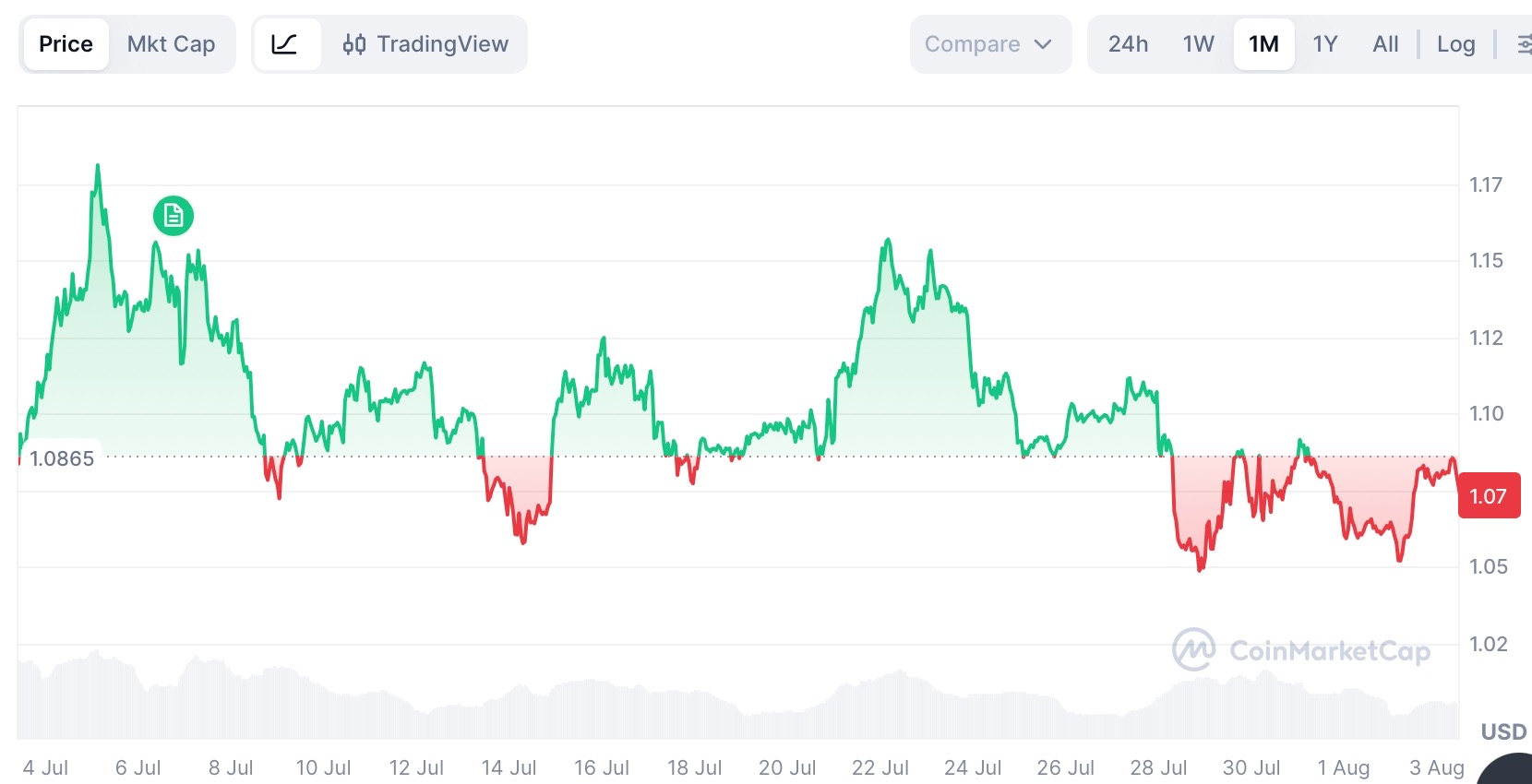
XRP has been weak in 2026, but the timing matters. During the first quarter, XRP fell by approximately 29%. That was worse than Bitcoin’s 24% decline but better than Ethereum and Solana, which dropped by around 32% and 34%, respectively.
Most of XRP’s relative weakness against ETH and SOL therefore developed after the first quarter. This is important because it suggests that XRP has not simply been ignored throughout the entire year. Instead, buying interest weakened as the market waited for new catalysts to produce measurable demand.
Short-term performance also tells a more balanced story. Based on CoinGecko market data, XRP declined by roughly 1.6% over the seven days leading into August 2, compared with a drop of approximately 2.8% for the broader crypto market.
XRP is under pressure, but its weakness is not uniform across every period.
XRP ETF Demand Is Real, but Not Yet Decisive
One explanation commonly offered for XRP’s performance is that institutional investors prefer Bitcoin and Ethereum. That is partly true: BTC and ETH products remain much larger and more liquid.
However, it would be inaccurate to say that institutional demand for XRP is absent.
Recent public disclosures showed approximately $313 million in assets at the Bitwise XRP ETF, $255 million at Franklin’s XRPZ, and $118 million at the 21Shares XRP ETF. REX-Osprey’s XRPR also reported roughly $42 million in direct and indirect XRP exposure.
Because these figures were reported on different dates, they should not be treated as a synchronized market total. Even so, the four products together represented close to $730 million in XRP exposure.
That is meaningful demand. It is simply not large enough yet to dominate XRP’s price.
ETF inflows must compete with profit-taking, token distributions, existing holder supply and broader market risk appetite. Institutional access can make XRP easier to buy, but access alone does not guarantee sustained inflows or rising prices.
Ripple’s Growth Is Not Automatically XRP Growth
Ripple, XRP and the XRP Ledger are closely connected, but they are not interchangeable. Ripple is a private financial technology company. XRP is a tradable digital asset. XRPL is the blockchain network on which XRP operates. A positive development for one part of this ecosystem does not always create direct economic value for the other two.
This distinction has become especially important as Ripple expands RLUSD.
According to Ripple’s stablecoin transparency page, RLUSD had approximately $1.59 billion in circulation as of July 30, backed by around $1.70 billion in reserve assets. Ripple has also introduced Ripple Mint, an institutional platform for minting, redeeming and managing RLUSD.
These are significant developments for Ripple’s stablecoin business. They may support payment, settlement and tokenized asset use cases across the wider ecosystem.
But RLUSD is available across multiple networks. A company can use or transfer the stablecoin without necessarily purchasing a large amount of XRP. Unless RLUSD growth creates measurable XRP demand through liquidity, collateral, settlement or transaction activity, the effect on XRP’s market price may remain limited.
This is the missing link behind many XRP price forecasts: commercial adoption must eventually translate into demand for the token itself.
XRPL Is Active, but DeFi Liquidity Remains Modest
The XRP Ledger is not an inactive network. Recent DefiLlama data showed approximately 1.2 million daily transactions, nearly 24,500 active addresses and close to $980 million in stablecoin market capitalization.
Those figures point to continued use of XRPL for payments, transfers and asset settlement.
Its decentralized finance market remains much smaller. XRPL had approximately $33 million in DeFi total value locked and around $1.8 million in daily decentralized exchange volume at the time of review.
This does not mean XRPL has no utility. It means that network activity has not yet produced the depth of liquidity, application revenue and capital concentration found in larger smart-contract ecosystems.
For XRP holders, the question is whether XRPL can convert transaction activity into a broader economy that creates recurring demand for XRP.
Why the $1.10 Area Matters
XRP’s price near $1.08 has placed the $1.10 area back in focus. This level should not be treated as a permanent barrier. Technical levels change as liquidity and market conditions evolve. However, repeated difficulty holding above the same price area can show that sellers remain active.
A brief move above $1.10 would not be enough to confirm a change in trend. Traders would likely look for stronger volume, a sustained close above the level and follow-through during subsequent sessions.
XRP’s reaction around this area may offer a clearer signal than a temporary intraday spike.
Readers tracking XRP and other major digital assets can follow the latest market activity through Tapbit. Existing users can access their accounts through the Tapbit login page, while new users can register here.
What Could Change the XRP Outlook?
A stronger XRP recovery would probably require more than one catalyst.
Persistent inflows into XRP investment products could reduce available market supply and improve sentiment. Higher XRPL liquidity could strengthen the token’s role within its own ecosystem. Ripple’s payment and stablecoin partnerships could also matter if they begin generating identifiable demand for XRP.
Price confirmation would still be necessary. A sustained move above resistance, supported by trading volume and improving market conditions, would provide stronger evidence that demand is taking control.
Until then, Ripple announcements and RLUSD milestones should be evaluated on their direct relevance to XRP rather than treated as automatic price catalysts.
Conclusion
XRP is not underperforming because nothing is happening around it. The more difficult issue is that many of its strongest developments have not yet translated into consistent demand for the token.
Institutional XRP products have attracted real capital. RLUSD has grown into a sizable stablecoin, while XRPL continues to process substantial transaction activity. At the same time, DeFi liquidity remains modest, Bitcoin still attracts a much larger share of institutional capital, and XRP has struggled to hold above the $1.10 area.
The next phase will depend on whether XRP can close the gap between ecosystem progress and token demand. Until that happens, strong Ripple headlines may continue to coexist with uncertain XRP price performance.
Cryptocurrency trading involves substantial risk. Market prices can change rapidly, and historical performance does not guarantee future results. This article is for informational purposes only and does not constitute investment advice.
Frequently Asked Questions
Why is XRP underperforming despite positive Ripple news?
Many Ripple developments do not create direct demand for XRP. Ripple can expand its payment services or RLUSD stablecoin business without requiring users to purchase and hold significant amounts of XRP. Broader market conditions and selling pressure can therefore outweigh positive company announcements.
Is institutional demand for XRP declining?
Not necessarily. US-listed XRP investment products have accumulated hundreds of millions of dollars in assets. However, their combined size remains much smaller than that of major Bitcoin and Ethereum products. Institutional demand exists, but it has not been strong enough to produce sustained upward momentum.
How do XRP ETFs affect the XRP price?
XRP investment products make the asset more accessible to investors using traditional brokerage accounts. Persistent net inflows may support demand, but launching an ETF does not guarantee price appreciation. Outflows, token selling and weakness across the crypto market can offset ETF purchases.


