Why Pump.fun's Deal With Kimchi Ended Up Looking Just Like a Scam
 Tapbit Wire
Original author: BlockBeats
October 20, 2026, early morning. A wallet with a lifespan of only three hours minted a coin on pump.fun. Its name was Kimchi.
In the first transaction, it spent 87 SOL, about $9,073, to buy 793 million tokens — 79.3% of the total supply.
At the 40th second, three addresses began buying.
Less than a minute after the token launched, pump.fun's official account posted three images. No caption; the images showed billboards on New York streets: PILL YOUR FRIENDS, be the next kimchi.
At the 57th second, 750 million tokens were transferred to another address. Pump.fun's own profile page labels that address as "Kimchi."
At the 19th minute, pump.fun co-founder Alon quote-posted those three images.
"Kimchi is the first person to truly bridge the gap between crypto and pop culture, the first example of turning a trader into a celebrity. The next wave of users won't come from Crypto Twitter, they'll come from the general public. We're honored to have him help us set our creative direction."
Kimchi's X account also added pump.fun to its bio — the collaboration could hardly be clearer.
So pump.fun had signed Kimchi, with the title "creative partner."
And that official ad appeared less than a minute after this coin was minted. This coin's creator fees were set to flow entirely to the address labeled Kimchi. That setting cannot be changed afterward.
An hour later, the coin's market cap reached $35 million to $40 million. Kimchi held 75.32% — it was a gift to him.
Why sign an influencer
The story that made Kimchi famous: he made $40 million on TRUMP coin.
His timeline is a row of luxury cars and luxury watches — the standard kit of a top influencer.
Pump.fun badly needed influencer traffic, because Fomo is strong.
Fomo launched in May 2025, raised $94 million, and was valued at over $550 million. It builds a trading terminal, but what it sells isn't a tool, it's people: leaderboards push the top earners into the spotlight, and a feed pushes every one of their orders. It doesn't sell coins; it sells idols.
From September 2 to 16, Fomo's revenue was higher on 13 of those days; in that half month, it took 60% of the two platforms' combined revenue.
Pump.fun's response was to throw money at the problem. A leaked agreement from August: a $20,000 signing bonus, $30,000 a month, on the conditions that the funds be migrated over, a new wallet, X binding, a public statement that this wallet is the only wallet, and permanent deletion of the Fomo account.
On August 7, its app was redesigned. Open the homepage and what you see is no longer a waterfall of new coins, but traders' feeds.
It was remodeling itself in its rival's image.
Over the past 30 days, pump.fun's launchpad revenue was $45.4 million, Fomo's was $19 million, and its October share climbed from 50% in September back to 75%. The cost: $900,000 a day spent buying back and burning its own token, $490.7 million cumulative.
Signing Kimchi was also an easy move to understand — Pump.fun still needs traffic.
If the story ended here, it would be normal. But the outrageous part comes later.
The retweeted QR code
In the early hours of October 22, another new coin appeared. Its name was project kimchi.
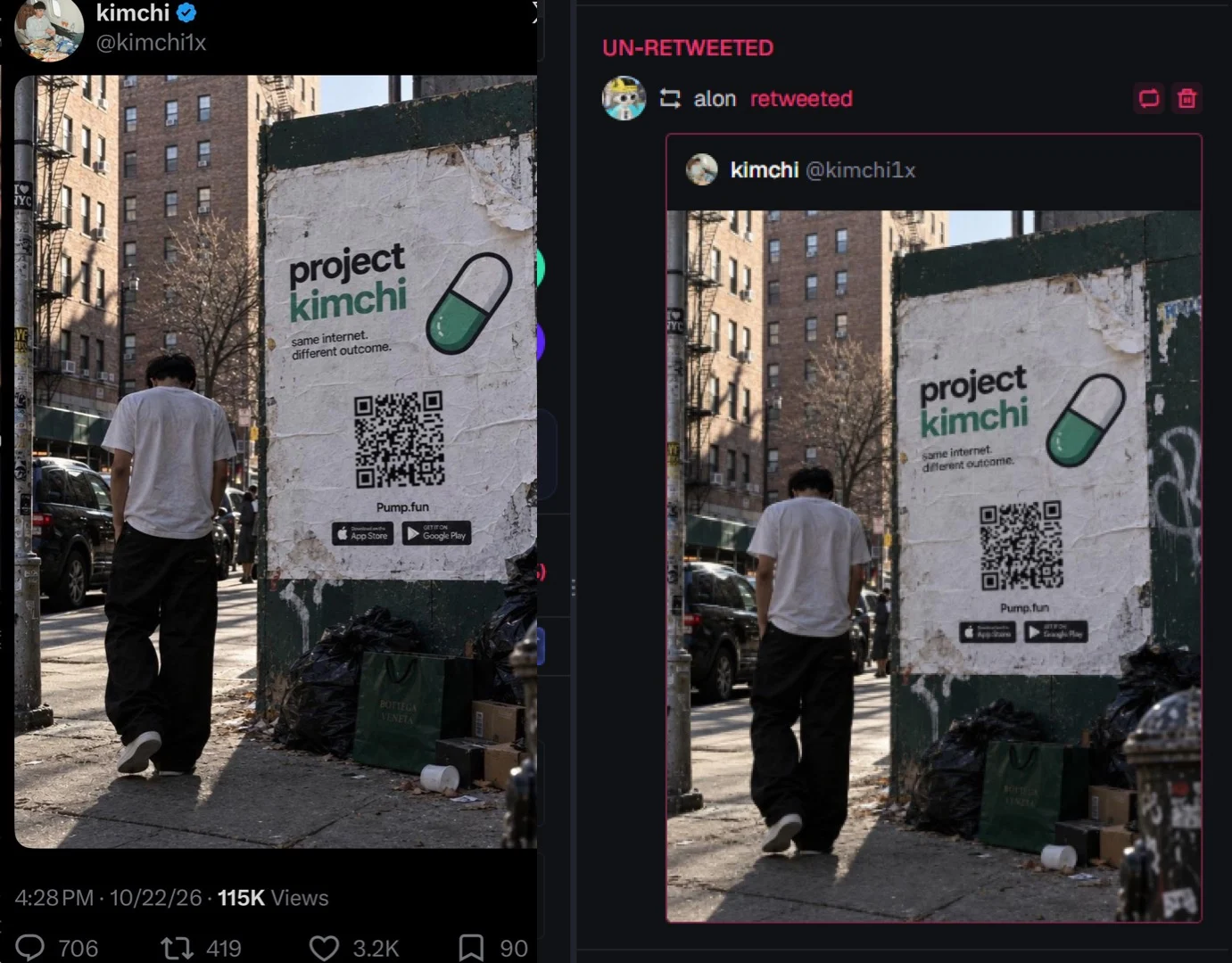
A few hours later, Kimchi posted an image. A poster on a New York street, reading "project kimchi" and "same internet, different outcome.", with a giant QR code in the middle, and below it the Pump.fun logo along with App Store and Google Play download badges.
Alon reposted it. The founder's repost pushed the new coin's market cap to $10 million to $15 million.
Then Kimchi deleted the post and removed that @pumpfun from his bio. Alon deleted the post he had just reposted.
The new coin went from over $10 million to under $300,000 — a 98% drop.
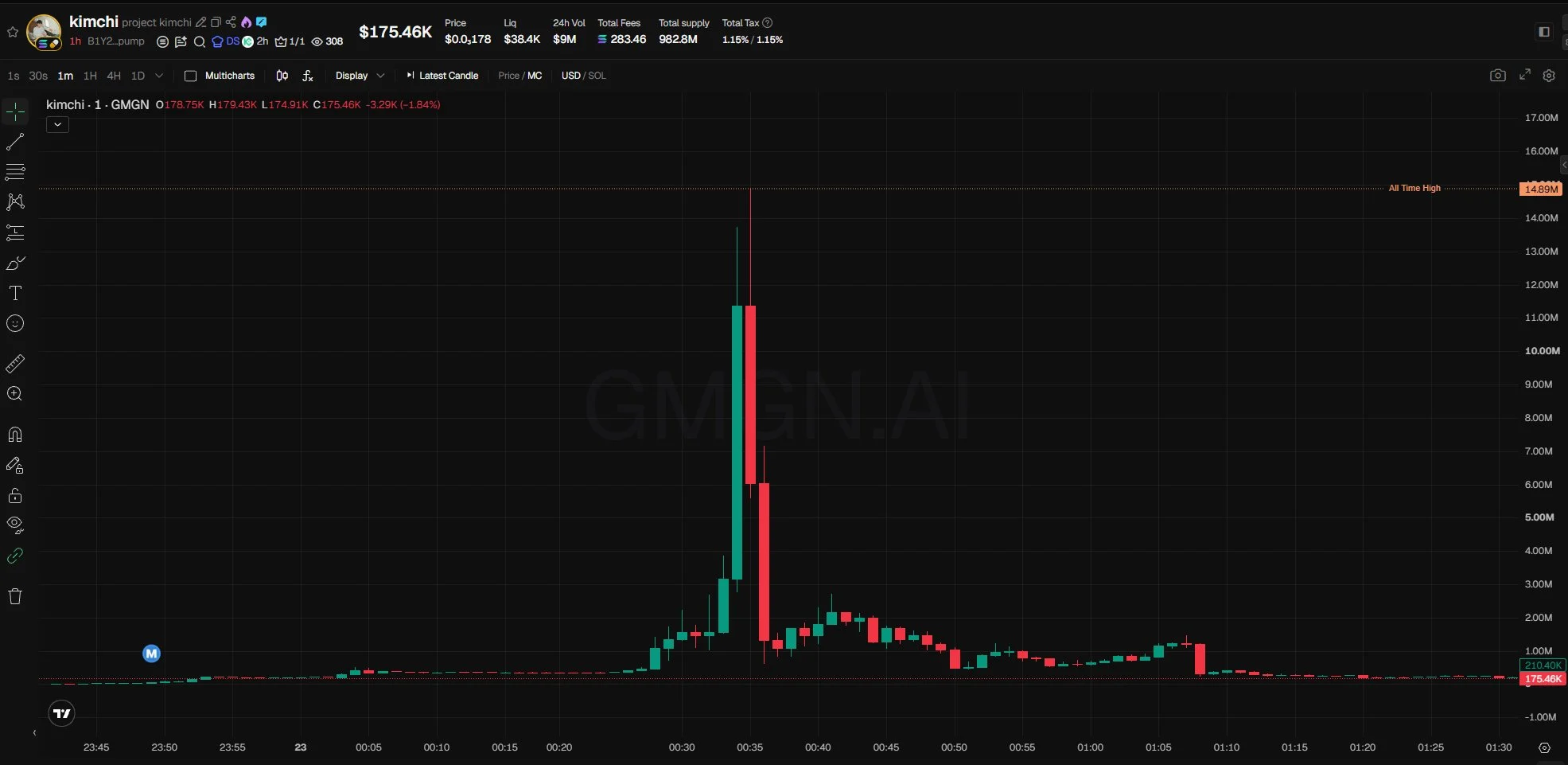
And the "official" coin from October 20 didn't escape either. After the repost incident it fell 49%, leaving a market cap of $12.71 million — down 70% from its peak.
A partnership was on its way to becoming a scam.
In this scam, some people did make money. Remember the three addresses that bought before the ad appeared on October 20?
Nine minutes, $100,000 in profit.
And of course, the address officially labeled as Kimchi himself. 75.32% of the KIMCHI supply, over $7 million on paper. Plus creator income, now over 900 SOL, roughly $100,000, and a sum of unclear origin on top: on-chain analysts found that within three hours he received 1.35 billion PUMP from Binance and OKX hot wallets, worth about $6.25 million to $6.43 million.
In three days, his paper gains topped $10 million.
The platform, Pump.fun, made money too, of course — $1.61 million in revenue on October 20.
The ones who lost were all retail investors.