Wall Street Morning Brief: $100B+ Optical Communications Deal Gets Hammered; Tech Stocks Deflate AI Bubble Ahead of Midterms
 Tapbit Wire


Every Monday to Friday morning, we focus on macro, US equities, AI, precious metals, crude oil and other areas, using data to review the market and trends to seize the initiative. Produced by Tapbit news.
Dow Alone Gains as Chips and Software Drag Down Nasdaq
US stocks diverged overnight. The Nasdaq Composite fell 1.07%, the S&P 500 fell 0.51%, the Nasdaq 100 fell 1.39%, and the Russell 2000 fell 0.21%; the Dow Jones Industrial Average bucked the trend with a 0.41% gain. The Philadelphia Semiconductor Index tumbled 3.37%, and the VIX fear gauge rose 8.91% to 21.14. All three major indexes rose together early in the session, but as news of Marvell's acquisition of Lumentum reverberated, concerns about AI capex again outweighed optimism over US-Iran diplomatic easing, and tech stocks reversed lower.
Moreover, last week's wounds in the market have not healed. According to The Wall Street Journal, the Nasdaq fell about 10% from its high last week, approaching technical correction territory; Intel plunged 29% in a single day, and Alphabet lost about $500 billion in market value after its earnings report. Hassett, director of the White House National Economic Council, sought to reassure investors, calling AI "an extremely well-funded ecosystem" completely different from the financial crisis. Fundstrat co-founder Tom Lee said on CNBC that the AI stock selloff has bottomed, and that AI demand remains supply-constrained rather than reflecting overcapacity, though he acknowledged he does not know how much more downside remains.
The US midterm elections are being held today and may be the biggest source of uncertainty for the market. As of October 31 local time, a record 50 million people had voted early. Trump said that if Democrats win, he will become "Mr. Veto"; if Democrats retake Congress, he is willing to grant pre-emptive pardons to Musk and his close associates.
Long-end US Treasury yields retreated. The 10-year Treasury yield fell 2.1 basis points to 4.912%, the 30-year fell 2.2 basis points to 5.287%, and the 2-year edged up 0.4 basis points to 4.598%. The decline in yields lifted rate-sensitive Rocket Companies by 7.58%. The dollar index was flat at 101.80. WTI crude settled at $96.75 a barrel, up 0.30%; Brent settled at $104.80 a barrel, up 0.03%. COMEX gold settled at $3,965.50 an ounce, down 0.10%; after gold plunged intraday on Friday, it recovered above $3,900 in early Monday trading. Silver settled at $50.46, down 0.84%, after briefly falling below the $50 mark intraday; copper fell 0.56%.
Marvell's Hundred-Billion-Dollar Takeover of Lumentum Triggers Broad AI Selloff
The biggest single event overnight was Marvell Technology's announcement of an all-stock acquisition of Lumentum, with an enterprise value of about $115 billion. Lumentum shareholders will receive 4.5 Marvell shares for each share, equivalent to about $1,132 per share, a premium of about 23.9% to the October 28 close that was unaffected by rumors. After completion, Marvell and Lumentum shareholders will own about 67% and 33% of the combined company, respectively. The parties expect more than $1 billion in annual cost savings, and the deal is expected to close in the first half of 2028. But the market did not buy it: Lumentum initially rose premarket, then turned lower and closed down 18.59%, while Marvell fell 12.72%. The all-stock structure tied Lumentum's stock to Marvell's; when Marvell fell, Lumentum fell even more. Ciena, Astera Labs and Cerebras fell more than 11%, and the Philadelphia Semiconductor Index dropped more than 3% on the day.
Meanwhile, capex at US tech giants continues to expand. Oracle borrowed another $10 billion for AI spending, and its stock fell 8.76%. Anthropic's revised S-1 shows third-quarter revenue of about $17 billion and a net loss of $23.29 billion; signed purchase commitments and lease agreements totaled about $895.4 billion, almost all directed at compute and infrastructure; the third-quarter operating loss was caused by $5 billion in short-term compute investment. According to The Wall Street Journal, after last week's tech rout, institutional investors participating in its IPO have cut valuation expectations to $1.5 trillion to $1.6 trillion, below the nearly $2 trillion previously discussed. Anthropic plans to launch its roadshow as early as next week, targeting a listing in the week before Thanksgiving.
Overall, the fundamental data for AI supply-chain companies is not bad. Palantir reported after hours that third-quarter revenue rose 96% year over year and raised its full-year guidance; Fabrinet, Lattice and Advanced Energy rose nearly 10% after hours, with Fabrinet's beat driven by data center demand. Morgan Stanley expects global data center IT capacity to rise from about 136 GW at the end of 2026 to 316 GW in 2030, a compound annual growth rate of 23%. The problem right now is not demand, but financing and the return cycle.
Specific Company Actions and Stock Moves:
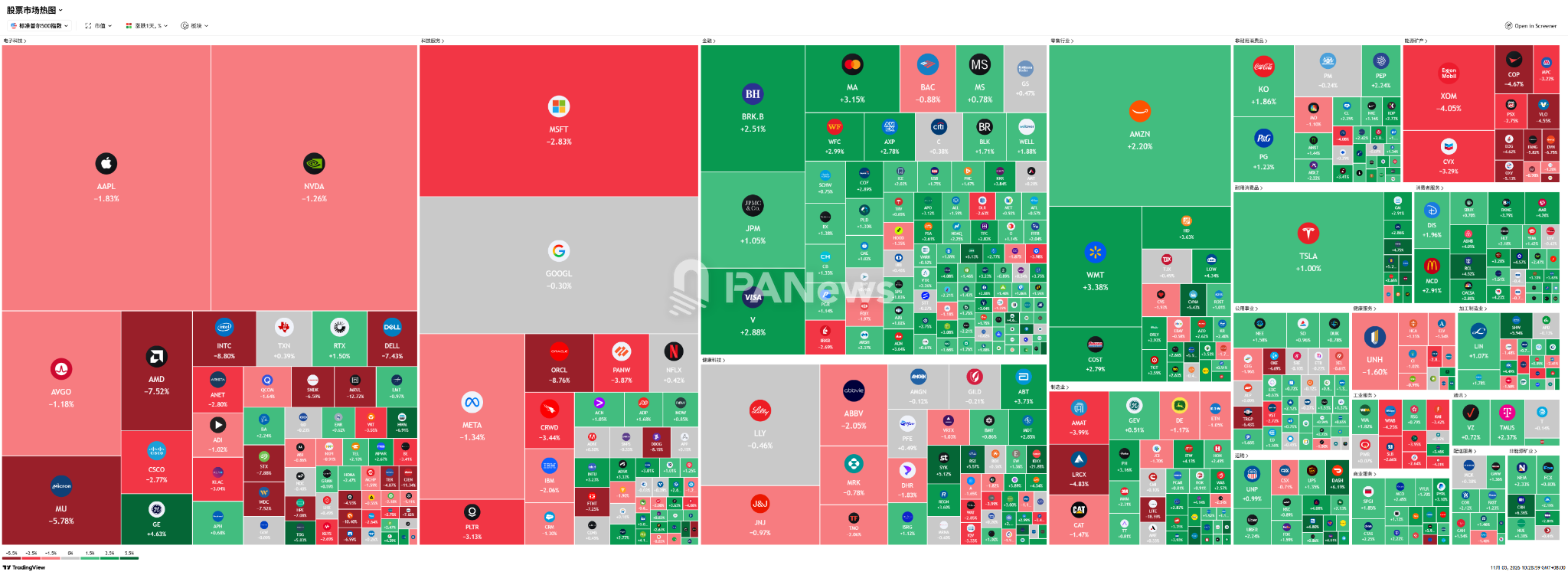
IDEXX +21.85%: Third-quarter results beat expectations and the company raised its full-year outlook; the stock jumped more than 20% in a single day.
Lumentum -18.59%, Marvell Technology -12.72%: Marvell announced an all-stock acquisition of Lumentum at an enterprise value of $115 billion, with each Lumentum share exchanged for 4.5 Marvell shares. Investors voted with their feet, sending both acquirer and target sharply lower.
Nextpower +14.87%: Jefferies named it a Franchise Pick over GE Vernova.
AI networking and compute chain fall in sympathy: Cerebras -11.74% (UBS cut its price target to $250 from $330, maintaining a Buy rating), Ciena -11.34%, Astera Labs -11.22% (reports today after the bell), CoreWeave -8.60%.
AST SpaceMobile -11.33%: According to The Washington Post, SpaceX is in talks to acquire Boost Mobile or use its network; the news directly pressured ASTS.
Software stocks weaken: Okta -11.22%, JFrog -9.83%, SailPoint -8.88%. Okta's upcoming inclusion in the S&P 500 failed to stem the selloff.
Crypto stocks broadly lower: Galaxy Digital -8.81%, IREN -8.06%, Bitdeer -8.05%, Riot Platforms -7.57%, CleanSpark -6.78%, MARA -5.02%, Coinbase -3.98%; Strategy edged up 0.19%, and after increasing its bitcoin holdings last week, its total holdings reached 849,327 coins. Wintermute believes that the dip-buying funds after the Binance incident came mainly from leveraged perpetual contracts, with a lack of spot buying and new capital, and the market still looks weak in the near term.
Intel -8.80%: It extended its post-earnings decline, after plunging 29% in a single day last week.
Oracle -8.76%: The company borrowed another $10 billion for AI spending, and debt expansion weighed on the stock.
Rivian +8.47%: UBS upgraded it to Buy, saying initial R2 demand is solid and the R2 ramp supports a path to positive vehicle gross margin.
Mag 7
Amazon +2.20%: Phillip Securities upgraded it to Buy with a $330 price target; expectations for a strong AWS continue to attract capital.
Tesla +1.00%: Its market cap held near $1.60 trillion, and it drew defensive buying in the blue-chip rotation.
Google -0.30%: The shadow of the roughly $500 billion market-cap loss after its previous earnings report remains, and investors are largely on the sidelines.
Meta -1.34%: Anxiety over tech giants' capex continues to weigh; the market has repeatedly questioned the timeline for AI investment to translate into profit.
Nvidia -1.26%: Chip stocks pulled back broadly, dragged by the 3.37% plunge in the Philadelphia Semiconductor Index; investors turned cautious ahead of its November 17 earnings report.
Apple -1.83%: It reported fourth-quarter results after the bell: revenue of $114.5 billion, up 12% year over year and a record for the September quarter; earnings per share of $2.10, up 14%, both above expectations, but the stock extended its decline by 2.81% after hours. According to reports, the timing for improvement in iPhone Duo supply constraints is "difficult to predict," and AI costs are weighing on holiday-season sales.
Microsoft -2.83%: It led the Mag 7 lower; at elevated valuations, AI capex's erosion of free cash flow continues to trouble the market, and the marginal benefit of Azure's high growth is diminishing.
After-Hours/Overnight Movers
Fabrinet +10.42% after hours: It closed down 3.85% in the regular session. Fiscal first-quarter revenue and earnings both beat expectations, and Barron's said the results were driven by data center demand, with growth reaching 51%; the company also issued second-quarter guidance and expanded its share repurchase program.
Advanced Energy +9.74% after hours: Third-quarter revenue and earnings both beat expectations, operating margin doubled, and the company issued fourth-quarter guidance.
Lattice Semiconductor +8.93% after hours: Third-quarter revenue hit a record, up 118% year over year; earnings and revenue both beat expectations, and inventory levels improved.
Apple -2.81% after hours: This was the first earnings report under new CEO John Ternus. Fiscal fourth-quarter revenue was $114.5 billion, up 12% year over year and a record for the September quarter; diluted earnings per share were $2.10, up 14%, including a roughly $0.05 contribution from tariff refunds; gross margin was 47.9%; fiscal 2026 full-year revenue was $479 billion. iPhone revenue set a September-quarter record, and services revenue hit an all-time high. But according to AFP, AI-related costs weighed on holiday-quarter sales expectations; Apple also said it is "difficult to predict" when iPhone Duo supply constraints will improve.
Palantir reports after hours: Third-quarter revenue was $2.313 billion, up 96% year over year; US commercial revenue was $984 million, up 148%, exceeding government revenue for the first time; US government revenue was $953 million, up 96%; GAAP net income was $1.128 billion. The company expects fourth-quarter revenue of $2.649 billion to $2.653 billion and raised full-year revenue guidance to $8.530 billion to $8.534 billion, with US commercial revenue growth of at least 143% for the full year.