The Inside Story of the Falling-Out Between Two AI Titans, More Dramatic Than a Palace Intrigue
 Tapbit Wire
By: Bitpush
The details of Silicon Valley's most expensive "breakup" have finally been laid bare.
Recently, The Atlantic published the first excerpt from The AGI Chronicles, the new book by Kevin Roose, a well-known American bestselling author and podcast host. For the book, Roose interviewed more than 150 insiders at OpenAI, Anthropic, and Google DeepMind, and drew on a large volume of undisclosed company documents and internal memos to piece together this most sensational falling-out in Silicon Valley history.
If all you know is that Dario Amodei left OpenAI with a group of people at the end of 2020 to found Anthropic, that's only the tip of the iceberg. What's truly jaw-dropping is the "palace intrigue" that unfolded before he left.
The "Countries Plan": A Wild Proposal to Auction Off AGI
Amodei once had high hopes for OpenAI. In 2016, he left Google to join this young nonprofit research institution. According to Roose's account, he was a key figure in steering OpenAI toward the large language model path, and the team he led took part in developing GPT-2 and GPT-3.
As the research progressed, Amodei became increasingly convinced that larger-scale models could lead to AGI—artificial general intelligence. But at the same time, his confidence in the company's leadership kept eroding.
One of the earliest things that stuck in his craw happened in 2017.
At the time, Musk's financial support for OpenAI was beginning to waver, and the lab urgently needed to find a new way forward. Co-founder Greg Brockman and chief scientist Ilya Sutskever proposed an internal plan that later came to be called the "countries plan."
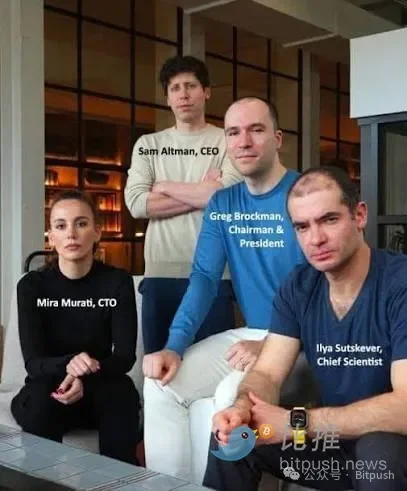
The plan started out respectable enough, envisioning an international coalition in which everyone would jointly manage the risks of AGI and share in the benefits.
But by the time Brockman and Sutskever formally presented it to employees at an internal meeting, it had gone completely off the rails: it had turned into a fundraising campaign to "auction off" the future rights to use AGI technology to various governments, with the countries mentioned including the United States, China, and Russia.
The two men's logic went like this: AGI involves national security, so sooner or later governments would seize it from whichever company built it. Since it would have to be handed over anyway, they might as well sell it for a good price while the company was short on cash.
One person familiar with the presentation complained: "It sounded like a bunch of tech people pitching a crazy startup, and at the end they just said—let the government foot the bill."
Dario Amodei was OpenAI's vice president of research at the time. After hearing it, he fired off an email to Brockman, Sutskever, and other executives, in rather blunt terms. In the email, he wrote that the plan "would exacerbate rather than reduce an arms race," could "lead to human rights atrocities," and would let them do "unspeakable things" to their own people—and that it "would undermine OpenAI's moral legitimacy."
In plain terms: you want to sell humanity's most powerful technology to them? Have you lost your minds?
Fortunately, Microsoft's subsequent large investment saved the day, and the plan never materialized. OpenAI's response was that the company "briefly considered whether to turn OpenAI into an international cooperative endeavor," but "did not consider selling AGI to China or Russia."
The plan ultimately never came to pass, but Amodei did not forget that management had seriously discussed an idea he found so repugnant.
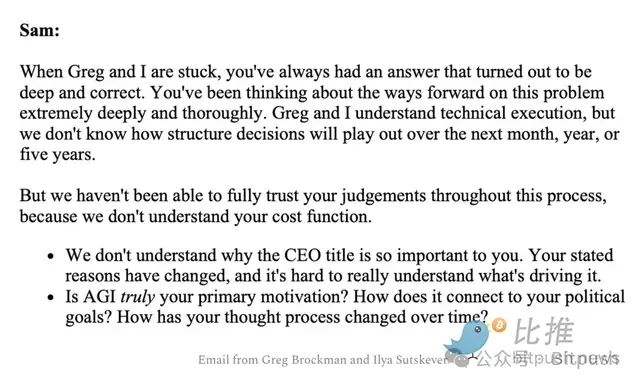
From Microsoft to Kanye, the Cracks in Trust Deepen
After that, a series of seemingly smaller matters kept deepening his distrust.
During GPT-3's private beta, Amodei asked Altman for the list of customers approved to use the model. Altman gave him one list, but Amodei claimed he later discovered another, longer list. He began to suspect that the information he was shown had been filtered.
And a dispute over the Microsoft investment deepened his misgivings.
OpenAI's public charter contains a rather unusual provision: if a value-aligned, safety-conscious project comes close to achieving AGI first, OpenAI will stop competing with it and instead assist it. This means that, under certain circumstances, the company's mission should take priority over winning the race.
According to Roose's new book, when negotiating a $1 billion investment with Microsoft, Amodei wanted to ensure that Microsoft would accept the OpenAI acquisition deal that might be used to carry out this commitment. Altman told him Microsoft would not accept the relevant terms.
Amodei did not believe it was that simple. He suspected that Altman, eager to close the deal quickly, might have given up on pushing for it—or never even raised the demand—while shifting the blame onto Microsoft.
In Amodei's eyes, the problem was becoming harder and harder to resolve through business discussions: he had begun to doubt whether the Altman sitting across from him was willing to give him a full account of the negotiations.
By 2020, Kanye West—the rapper who would later publicly express admiration for Hitler—unexpectedly appeared on this growing list of grievances.
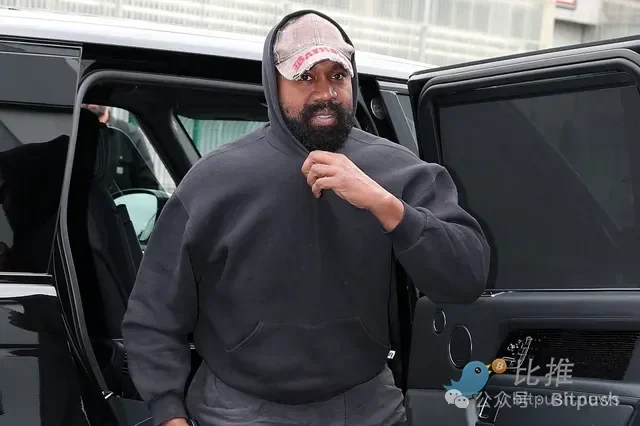
Citing two people familiar with the matter, Roose reports that after meeting Kanye, Altman proposed letting him join GPT-3's private beta.
At the time, GPT-3 had not yet been publicly released and was OpenAI's crown-jewel core asset. Jack Clark, then OpenAI's policy director, stepped in to block the proposal, noting that Kanye had recently posted a video that appeared to show him urinating on a Grammy award, and that his public behavior was concerning. Then, not long after, Kanye began publicly expressing admiration for Hitler.
The invitation never went through, but it further deepened Amodei's dissatisfaction with Altman's judgment. Roose writes that, taken individually, most such incidents would not have been enough to make him resign, but cumulatively they had made it hard for him to believe Altman was fit to wield a technology as powerful as AGI.
Roose discloses in the book that by 2020, Amodei had become thoroughly disillusioned with OpenAI's leadership. He described Altman as a "two-faced manipulator" and considered Brockman "power-hungry and reckless."
In fact, the core conflict between them came down to two words: trust.
Amodei reportedly kept a private little notebook throughout his time at OpenAI, jotting down the moments when he felt Altman had misled him.
In one of those notes, he wrote: "OpenAI's problem is Sam himself."
Forming Factions and Cliques?
On the other side, people inside OpenAI were also growing increasingly fed up with Amodei.
According to Roose's reporting, Amodei and his sister Daniela gradually drew in a group of like-minded colleagues. They set up private chat channels, held separate meetings, and frequently discussed safety issues. To some employees outside the circle, this group became increasingly difficult to work with.
One former colleague complained to Roose that Amodei would often declare a particular choice to be the morally correct one, as if merely invoking safety should end the debate. This infuriated other teams.
Amodei felt that commercial goals would always override safety commitments; some colleagues felt he had turned safety into an unanswerable justification. Their mutual dissatisfaction thus spread from specific decisions to working styles and judgments of character.
Ultimately, the conflict converged on one concrete power: could the safety team veto new product launches?
According to Roose, before leaving, Amodei presented Altman with a set of conditions for staying, including giving the safety team such veto power. He hoped that the pressure of core researchers potentially leaving en masse would push Altman to accept changes.
In a Secret Group Chat, the Countdown to a "Split" Begins
Meanwhile, even as negotiations were underway, an exit route was already being prepared.
Amodei and six colleagues set up a private Slack channel named "BATNA"—the best alternative to a negotiated agreement. Members included his sister Daniela, as well as Jack Clark, Sam McCandlish, Tom Brown, Chris Olah, and Jared Kaplan.
The very name of the group said it all about their situation: they were still negotiating, but they were already prepared to leave.
When the conditions for staying could not be agreed upon, both sides brought in lawyers and began negotiating what was internally called "the divorce."
According to Roose's reporting, Altman agreed to give this group a recruitment window of several weeks to hire OpenAI employees, in exchange for a commitment not to poach anyone for a year afterward; the two sides also agreed not to disparage each other in public.
In December 2020, OpenAI held an all-hands virtual meeting.
At first, it looked no different from usual. Altman reported on research progress, introduced new employees, and then handed the floor to Amodei.
Next, Amodei announced that he and six other leaders would be leaving to found a new organization focused on AI safety.
According to Roose's description, the chat window was quickly flooded with surprised messages and emojis. As the meeting drew to a close, Jack Clark typed a line in the chat—"I love you all"—and then the screen abruptly went black.
Seven core OpenAI members, including Dario Amodei and his sister Daniela Amodei, were kicked out of the meeting at the same moment, and their email and Slack access was revoked on the spot.
Then, in early 2021, Anthropic was founded.
When Will the Grudges End?
Starting over, however, did not free Amodei from the problems that had once troubled him.
Anthropic likewise needed to raise funds, expand computing power, and develop more powerful models. Only by mastering frontier technology could it study the most cutting-edge risks; but to stay at the frontier, it had to keep investing and face competitors closing in. As the company grew, Amodei also had to answer a familiar question: when safety, business, and competition collide, which one gives way first?
The mutual resentment between the two sides has not dissipated in the slightest.
People familiar with the matter say Amodei once used the word "evil" to describe Altman and OpenAI; meanwhile, some inside OpenAI felt that the Amodei siblings presented themselves as moral paragons while being just as hungry for power. They were especially irked that Anthropic publicly warned about AI risks while simultaneously accelerating its participation in the race.
In the book, Roose describes these AI leaders as "a spiderweb tangled with hostility": Hassabis looks down on Altman, Amodei looks down on Altman, Altman looks down on Amodei, and Altman also looks down on Musk.
Several years on, the web has not unraveled; instead, each of them has new troubles. Bloomberg reports that Anthropic is seeking to go public as early as mid-November, with a target valuation of up to $2 trillion; yet its prospectus also reveals the other side: revenue of about $4.6 billion in 2025, but operating losses exceeding $8 billion, plus a future commitment to invest more than $500 billion in computing power. Altman, for his part, remains cautious about an IPO, saying there is no rush to go public before safety and alignment are sorted out—but OpenAI has likewise been dogged by AI safety incidents recently.
Back then, Amodei left because he did not trust Altman, wanting to build a company where safety commitments truly counted. Now his own company faces the same dilemma: the sustainability of growth and safety concerns—neither can be loosened. On this question, neither of them has turned in their answer yet.