The Death of Hsin-Ju, the Sorrow of Crypto
 Tapbit Wire
Why Hsin-Ju died in the Mojave Desert is actually still undetermined, but I think people can very easily fall into conspiracy theories.

Hsin-Ju Chuang, former Hack VC partner and head of platform. On August 24, 2026, she was found inside a vehicle near an I-15 freeway ramp in California's Mojave Desert, at the age of 37. The cause of death has not yet been released.
According to public records from the San Bernardino County Coroner, at 9:47 p.m. on August 24, California Highway Patrol officers responded to a location on southbound I-15, south of Field Road, and confirmed the death of 37-year-old Hsin-Ju Chuang.

I-15 desert stretch from Barstow toward Nevada
As of now, however, Hsin-Ju's cause of death remains unclear, and the case has not yet been classified as a criminal matter.
The incident is currently widely speculated to be the result of her former company Hack VC using some means to physically erase her from the face of the earth.
But regardless, I believe the death of Hsin-Ju is the sorrow of Crypto!!
The feud between Hsin-Ju and Hack VC
About a year ago, Hsin-Ju, who worked at Hack VC, had a labor dispute with the company.
According to Hsin-Ju's own public statement on August 24, during her time at Hack VC she suffered from Graves' disease, hyperthyroidism, and severe insomnia, yet still endured long-term high-intensity work, including a series of events during Hack Summit and Korea Blockchain Week.
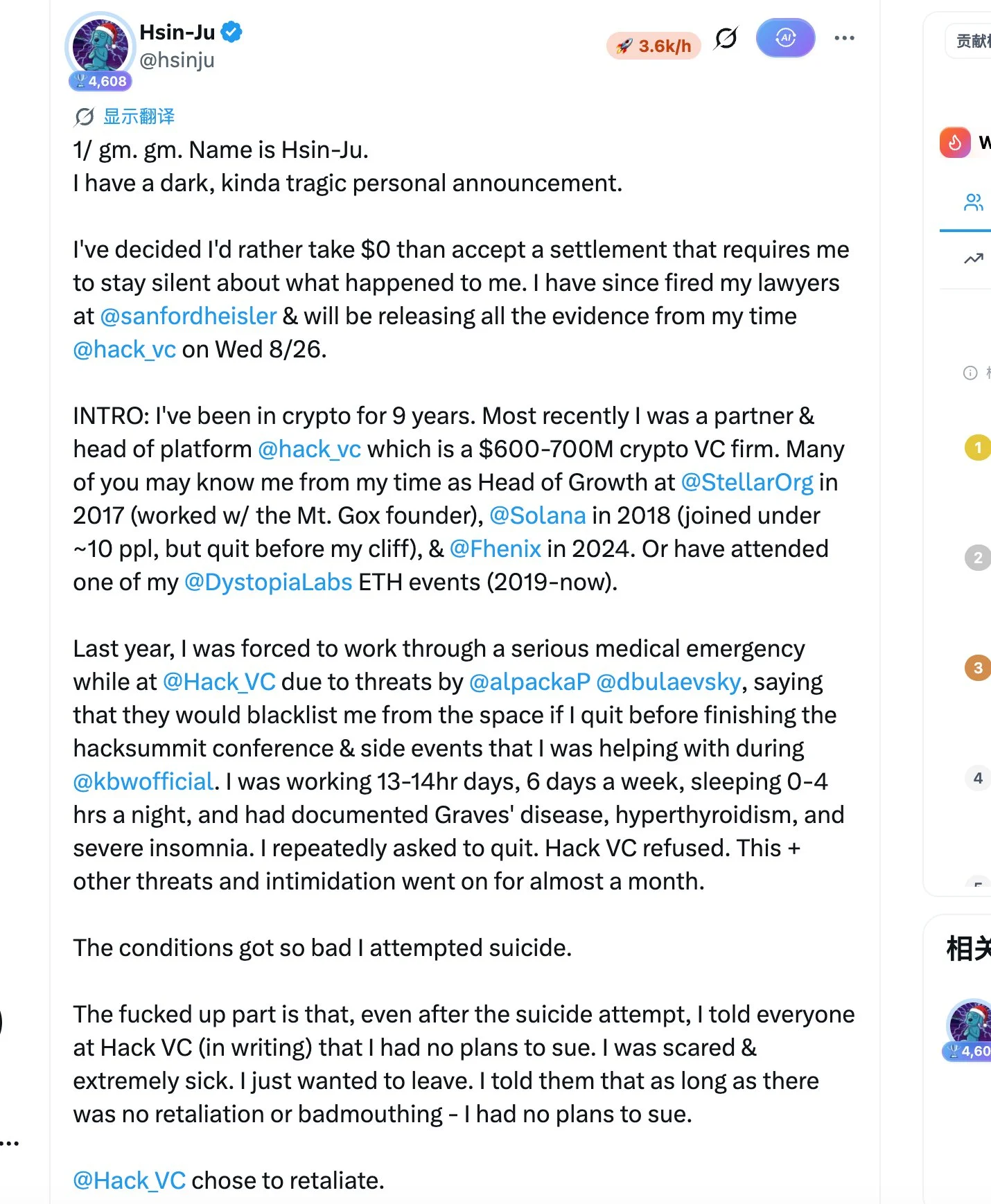
Original post https://x.com/hsinju/status/2091571258869879015
She said she worked 13 to 14 hours a day, six days a week, and could only sleep 0 to 4 hours each night. Because the work was so painful and torturous, Hsin-Ju even contemplated suicide.
She also accused Hack VC co-founder Alex Pack and partner Daniel Bulaevsky of pressuring her when she tried to exit projects and leave the company, including a so-called "industry blacklist."
Of course, all of these are allegations unilaterally raised publicly by Hsin-Ju, and Hack VC does not agree with Hsin-Ju's account — each side has its own version of the story.
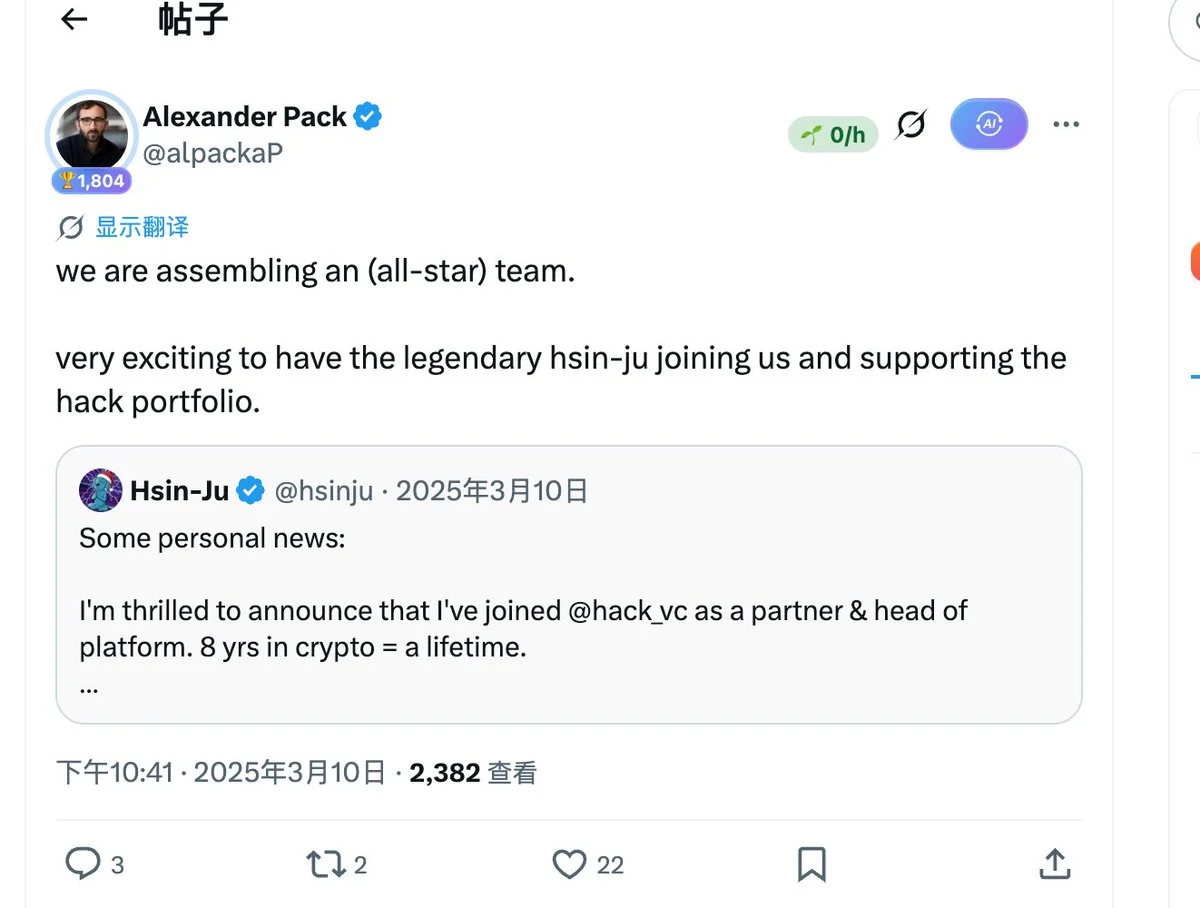
Hack VC co-founder Alexander Pack's welcome post when Hsin-Ju joined https://x.com/alpackaP/status/1899108367072661597
Judging from her position, Hsin-Ju seems to have played a significant role at Hack VC.
As a veteran of the industry, she did growth at Stellar in her early years, joined the then still very early Solana team as head of growth in 2018, later founded Dystopia Labs and long organized Ethereum developer events, then served as head of growth at Fhenix, and ultimately became a partner and head of platform at Hack VC.
From the perspective of someone like Hsin-Ju who has been deeply rooted in the industry for years, her core asset is essentially her industry relationship network. Conferences, project teams, developers, funds, media, investors, introductions, endorsements — these things together constitute her professional value.
So the word "blacklist" in a traditional industry might just be empty talk from a boss, but in VC and Crypto, industries that rely heavily on relationship networks, its nature is actually different.
Although Crypto has always preached permissionlessness and decentralization on-chain, from the perspective of a practitioner, an ordinary worker, her resume, financing relationships, industry reputation, and collaboration opportunities all live off-chain.
The crypto VC space in particular is a very typical acquaintance society — many positions are not publicly recruited, some project financings are not publicly tendered, and many opportunities come from internal referrals or joining through connections.
Although on-chain assets enjoy extremely high exit freedom, off-chain professional relationships are highly centralized. In other words, a wallet can come and go freely, but in the crypto industry, especially in these core areas, a person's livelihood cannot.
On the other hand, there is a very wide disparity in power between the two sides.
Hack VC is a top-tier VC in the crypto industry, having invested in a host of top projects including EigenLayer, Goldfinch, Mysten Labs (Sui), io.net, Elixir, Berachain, and others.
As of the third quarter of 2025, its AUM had reached approximately $700 million.
So for an individual, what you face is not merely a company — you face the capital, connections, and industry credit network behind that company.
This is also why Hsin-Ju was so wary of the so-called industry blacklist. After all, a few phone calls and background checks from Hack VC, plus a mark that "this person is difficult to work with," could all have real consequences for Hsin-Ju's career.
A settlement that can never be "reached"
According to Hsin-Ju, the two sides' lawyers had been in contact for nearly a year and were preparing to enter private mediation and settlement, but she ultimately fired her own lawyer and refused to accept compensation that came with confidentiality conditions from Hack VC.
Hsin-Ju publicly stated that she would rather take $0 than exchange silence for a settlement, and announced that on August 26 she would make public the written evidence she had retained from her time at Hack VC and the subsequent dispute, to support her earlier allegations regarding high-intensity work, industry blacklist threats, insurance handling, and subsequent negotiations.
Hack VC subsequently responded that the company had taken note of her posts and cared about her health, but that the two sides had major disagreements over what happened, and for privacy reasons would not publicly discuss specific details for the time being.
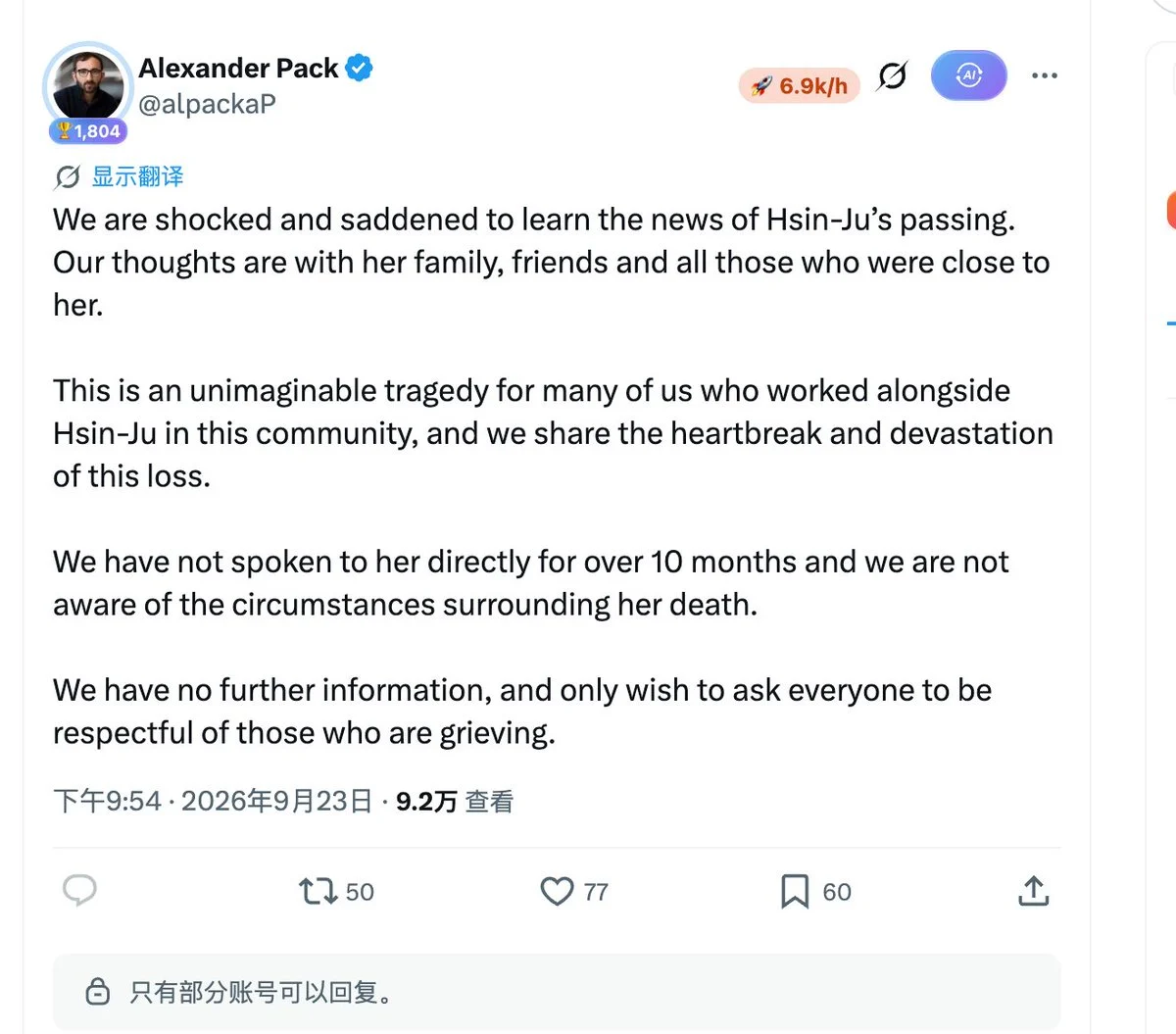
Hack VC co-founder Alexander Pack posted on social media yesterday saying he had not spoken directly with Hsin-Ju for more than 10 months, confirming how long they had been going back and forth.
https://x.com/alpackaP/status/2102758451390595098
Of course, we don't need to demonize a normal commercial settlement. Confidentiality clauses are very common in labor disputes and commercial disputes, and in themselves do not prove that anyone has a guilty conscience.
From the perspective of the interest structure, once Hsin-Ju refused to settle and made public the so-called evidence she held, the nature of the whole matter would change.
In the private mediation stage, this is a matter between the two sides' lawyers, but once she makes the evidence public, it would spread from a legal issue into a reputational issue.
At that point, Hack VC's LPs, portfolio companies, other employees, and partners would all pay more or less attention to the matter, and ultimately it would more or less affect Hack VC's credibility.
So it is not hard to see that Hsin-Ju was extremely dissatisfied with the settlement terms Hack VC offered, and believed the conflict between the two sides had reached an irreconcilable point. At this moment, she hoped to drag a dispute that could have remained in private space back into public space.
So on August 24 she announced her refusal to settle and previewed that she would release the evidence on August 26.
But on the night of August 24, she was found dead in the Mojave Desert.
These two points in time are simply too close. So close that any normal person seeing this timeline would make associations in their mind.
But associations are still just associations.
At present, we have no evidence to prove that Hack VC, any manager, or this labor dispute has a causal relationship with her death.
She had previously publicly mentioned her Graves' disease, hyperthyroidism, and severe insomnia, and had also said she had experienced a suicide attempt.
The death could have come from illness, accident, environmental factors, or other circumstances we do not yet know about.
Until the coroner and police provide more material, the word "silencing" is, I think, actually all conspiracy theory.
Why did people so naturally think of "silencing" after this happened?
A report released by Chainalysis in August this year shows that as of the end of June 2026, 46 violent incidents targeting cryptocurrency holders had been publicly recorded worldwide, of which 12 ultimately succeeded in obtaining payment, with more than $30 million in crypto assets known to have been violently taken. Home invasions already accounted for 37% of this year's related incidents, and kidnappings about 52%.
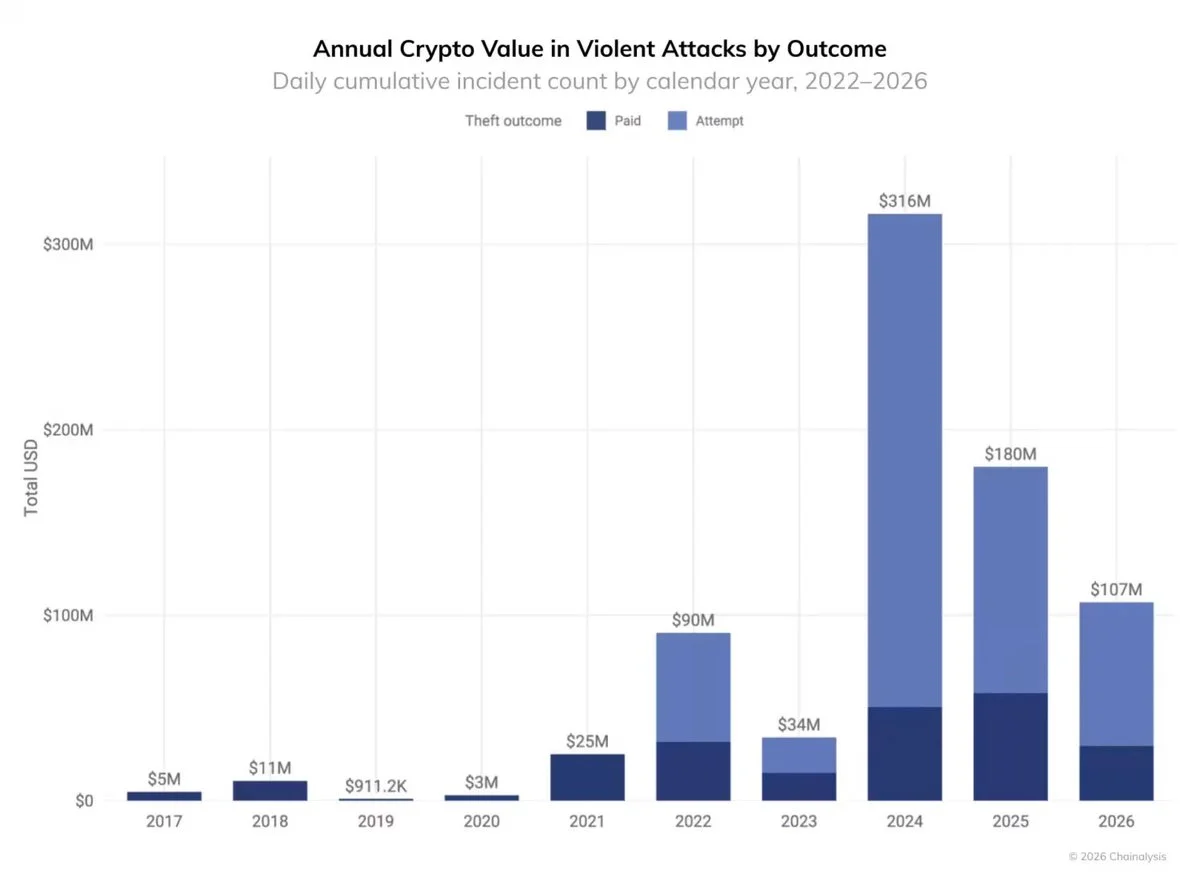
Crypto industry wrench attack data chart
Image source: https://www.chainalysis.com/blog/violent-crypto-wrench-attacks-2026/
Although these data have no direct relationship with Hsin-Ju's death, Crypto's offline violence risk already truly exists in the collective experience of this industry.
In the traditional financial system, a person's wealth is usually separated by banks, custodians, freezing mechanisms, and clearing systems.
Crypto has removed a large number of these middle layers — money can cross half the globe in ten seconds — so attacks that used to happen online are gradually extending offline.
In other words, if I can't get your private key, then I'll find the person who holds the private key.
It is precisely because this industry has already seen a large number of similar cases that when elements like "publicly defending one's rights," "previewing the release of evidence," "dying that same night," and "desert highway" appear at the same time, the public automatically pieces them together into a complete story.
In fact, this story establishes a complete logic psychologically, but that does not mean it holds up evidentially.
I even think that Chen Jian's earlier view — don't easily burn bridges, don't push things to the extreme, the jianghu is about human relationships and worldly wisdom — is more valuable than all kinds of "100% silenced" rhetoric, because after all it represents a very typical kind of risk awareness in the crypto world.
And in the crypto industry, when a serious conflict of interest arises between an individual and a company, many practitioners usually do not think of labor law, judicial procedures, or corporate governance first, but rather leave each other a way out.
Because subconsciously everyone knows that this industry has a large number of punishment mechanisms outside formal institutions.
These punishment mechanisms can be not giving you the next round of financing, can be labeling and smearing you within the circle, or can be constantly wearing you down with relationship costs. These things are not necessarily illegal, and some can never even be proven, but they can still determine whether a person can continue to survive in this industry.
So the phrase "the jianghu is about human relationships and worldly wisdom" actually exposes the real sense of security of many people in the crypto industry — that is, when institutions are not reliable enough, people begin to rely on personal relationships to control risk.
Rational thinking
So let us think rationally. From the perspective of interests, Hack VC is not a fund that has already been pushed to the edge of a cliff and needs to save its life at all costs. On the contrary, it was still in an obvious expansion phase at the time.
In 2024, Hack VC's AUM was still about $425 million, and by the third quarter of 2025 it had grown to about $700 million, with about $550 million in committed capital at year-end. In 2025 it deployed about $50 million, completing 29 investments, with 26 portfolio projects issuing tokens, and its early investment Rail was acquired by Ripple for $200 million. After entering 2026, Hack VC was still continuously investing in and leading new projects.
In other words, this is a VC that is still fundraising, investing, expanding its team, and constantly dealing with LPs, project teams, and founders.
For such an institution, the most important asset is not the few hundred million dollars on its books, but rather its credibility.
So from a pure risk-reward perspective, taking any extreme or even illegal measures to handle a former employee's labor dispute is actually an extremely unprofitable deal. The only benefit such a move could obtain is to silence a former employee and avoid some negative public opinion and reputational damage.
But once the matter is exposed, what it faces could be criminal investigation, litigation, LP questioning, partner severance, obstruction of future fundraising, and even the burial of the entire fund's brand and the management's careers.
The former is at most a reputational crisis; the latter could directly become an existential crisis.
Moreover, unlike many ordinary companies, a VC is itself a business built on long-term credibility. No matter how ugly a labor dispute becomes, in theory it can still be resolved through lawyers, compensation, arbitration, and PR; but if it truly crosses the criminal red line, the nature changes completely.
So at least from the perspective of institutional rationality and economic interests, I find it hard to identify a reasonable motive for Hack VC to voluntarily assume this kind of unlimited downside risk over a labor dispute. At least from an economic logic standpoint, it is not an explanation that easily holds up.
The death of Hsin-Ju, the sorrow of Crypto
The crypto industry has always been a field that is inconsistent inside and out. Crypto has always outwardly championed the ideals of decentralization, personal sovereignty, free exit, and "Code is Law," yet Crypto's off-chain world is highly centralized, not the ideal utopia of a DAO.
A few funds control a large amount of early-stage capital, a few conferences control industry exposure, a few trading platforms control liquidity entry points, and a group of core Builders, VCs, and KOLs form a relationship network that is not as large as one might imagine.
The technology is decentralized, but resource allocation remains highly centralized. Hsin-Ju was in fact precisely a person living on-chain.
Whether serving as head of platform, head of growth, organizing conferences, or connecting projects and capital, she was herself a node in this relationship network.
And the crypto industry itself is a highly transnational industry with extremely fast personnel turnover and widespread remote collaboration. Many professional relationships are not entirely maintained by a unified set of institutions; industry credit, connections, endorsements, and reputation are often another set of invisible rules.
So a person who worked in the industry for nine years, who did Stellar, Solana, Ethereum events, and ultimately became a Crypto VC Partner, still publicly claimed after a serious conflict with her institution that she feared being blacklisted by the industry;
and even wrote despairingly in her final public post that she knew the outcome of this matter could be very bad for her, even mentioning death. The two sides were originally going through legal mediation procedures, but in the end Hsin-Ju lost her life.
While the cause of Hsin-Ju's death remains undetermined, how much genuinely reliable institutional protection does an industry that preaches personal sovereignty and permissionlessness all day long actually leave for an ordinary practitioner who refused to stay silent and was preparing to publicly burn bridges?
When a practitioner completely falls out with an institution, the first thing everyone worries about is whether they will pay a price outside the institutions, rather than resolving the problem through institutions.
Thus, keeping things quiet and not pushing things to the extreme has instead become the default survival mode for many crypto workers.
This reaction itself, I think, already exposes the huge governance problems in the crypto industry's professional sphere, and this incident has clearly become a health check report on the crypto industry's off-chain ecosystem.
The death of Hsin-Ju, the sorrow of Crypto.