





Published: March 6, 2026
If you’ve ever looked at a prediction market and thought, “This is just options with better packaging,” Nasdaq is basically agreeing — in public, on paper, to the SEC. Nasdaq MRX has filed a rule change asking for approval to list what it calls Outcome-Related Options (OROs) on the Nasdaq-100 (NDX) and the Nasdaq-100 Micro Index (XND). The pitch is simple: a contract that settles to a fixed amount if a condition is met at expiration, and to zero if it isn’t.
What Nasdaq is proposing (the parts that matter)
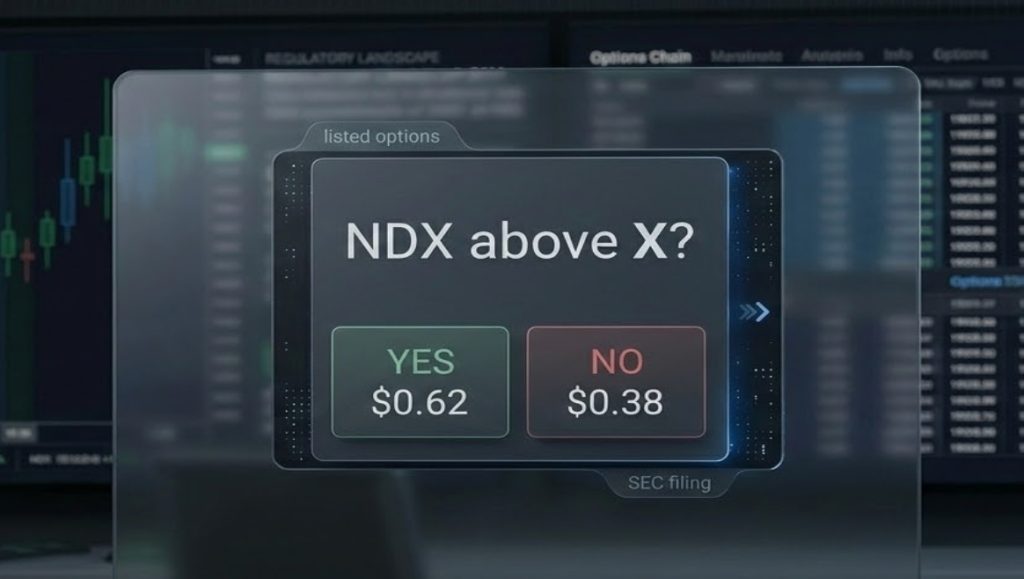
Nasdaq’s filing describes OROs as cash-settled, European-style binary options — meaning there’s no early exercise and settlement happens at expiration. It explicitly says MRX wants to list OROs on NDX and XND.、
The pricing model is what makes this “prediction-market-ish.” Reuters and Bloomberg both highlighted the same key detail: the contracts would be priced between $0.01 and $1.00, where the price effectively reflects the market’s view of the outcome being true, and they pay a fixed amount if the condition is met.
In human terms: it’s a yes/no contract on an index outcome — except it’s being delivered through a listed-options exchange, under the SEC’s regime, inside the plumbing brokers already understand.
Why Wall Street is chasing the yes/no format
The yes/no interface is a cheat code for engagement. It takes something intimidating (options chains, greeks, volatility surfaces) and turns it into a single number that feels like probability. That’s why event contracts took off on platforms like Kalshi and Polymarket — and why traditional exchanges are now racing to offer something that looks similar but lives in a more familiar regulatory wrapper.
There’s also a market-structure reason: binary-style contracts can be attractive when traders want defined risk and a clean expression of a short-term view. You don’t need to pick a strike and model delta; you’re paying a premium for one outcome.
The regulatory subtext: SEC rails vs. “event contract” rails
Nasdaq’s choice matters because it’s drawing a clear boundary: this is an index-linked option product filed with the SEC, not a broad marketplace for politics, sports, or cultural events. That distinction is not academic. Reuters has reported on the tension around event-style contracts and how they can attract scrutiny depending on category and jurisdiction.
Meanwhile, other incumbent exchanges are moving in parallel. The Federal Register recently published a Cboe filing notice (a reminder that this “prediction-market moment” isn’t a one-off Nasdaq experiment).
What traders should watch next
- SEC process and timing: the key question is whether the SEC approves as filed, delays for comment, or asks for changes. The filing status can be tracked via Nasdaq MRX’s rule filings page.
- Contract definition: in binary products, the exact settlement language is everything (what condition, what time, what calculation agent).
- Liquidity design: spreads and market maker incentives will determine whether this trades like a useful tool or a gimmick.
- Copycat products: if one major index gets a yes/no wrapper, others tend to follow quickly.
How X reacted (and what people actually focused on)
On X, this didn’t travel as “Nasdaq filed a rule change for a new options product.” It traveled as “Nasdaq is building a prediction-market-style interface.” The yes/no framing is what stuck — not the acronym (ORO), not the exchange (MRX), and not the fine print.
The mainstream headline version came from major news accounts. Bloomberg’s business feed framed it as Nasdaq bringing “yes-or-no bets” to one of the most-watched U.S. equity benchmarks.
Crypto-native accounts quickly translated the mechanics into prediction-market language. CoinMarketCap’s official account highlighted the 1-cent-to-$1 pricing and the resemblance to probability-style contracts.
Another thread of discussion focused on the rails: “this looks like prediction markets, but it’s being filed through SEC-listed options.” In other words, the product may feel familiar to anyone who’s used Kalshi/Polymarket, but the regulatory wrapper is different. Posts from Milk Road and Coinpaper leaned hard on this distinction while summarizing the basic contract format. A smaller but interesting angle tied the filing to the broader “markets becoming more always-on” narrative, pointing to Nasdaq’s wider push toward extended trading access and more simplified trading interfaces.
If you want the primary source rather than social summaries, start with the filing itself: SR-MRX-2026-05 (PDF).
Tapbit angle: why crypto traders should care
Even though the product is equities-native, the direction is familiar to crypto: markets are being redesigned around outcomes. Whether it’s “BTC above X,” “CPI above Y,” or “NDX closes above Z,” traders clearly like contracts that compress a view into a single number. The growth of event-style interfaces also tends to pull more short-term, narrative-driven capital into the system — and that can spill into crypto during big macro weeks.
If you’re trading around macro headlines and fast moves, you can monitor markets and manage positions on Tapbit. Existing users can sign in via Tapbit Login, and new users can get started here: Tapbit Register.
FAQ
Are these “prediction markets” or “options”?
Nasdaq is filing them as listed options — specifically “Outcome-Related Options” — under the SEC framework. They may feel like prediction markets because of the yes/no payoff, but the venue and rulebook matter. SR-MRX-2026-05 (PDF)
How does pricing from $0.01 to $1.00 work?
Think of the price as the market’s implied chance of the outcome being true at expiration, expressed in dollars. A $0.40 price looks like “about 40%” in simple intuition (fees and spreads aside). If the condition is met, the contract pays the fixed amount; if not, it goes to zero.
What’s the difference between NDX and XND?
NDX is the Nasdaq-100 index. XND is the Nasdaq-100 Micro Index (a smaller-sized benchmark often used for micro-style products). Nasdaq’s filing says it wants OROs on both.
Why is Wall Street doing this now?
Demand for simple, outcome-driven trades has surged. Traditional exchanges want to offer that interface inside familiar brokerage rails, while keeping products tied to well-defined underlyings (like major indexes). Bloomberg and Reuters both framed Nasdaq’s move as an attempt to bring prediction-market mechanics into a regulated listed-options format.
What should traders be careful about with yes/no contracts?
The simplicity can be misleading. Binary-style contracts can still lose 100% of premium at expiration, and pricing can move sharply near the cutoff. The most important details are settlement language, fees, and spreads — not the headline format.
Disclaimer: Cryptocurrency trading involves significant risk of loss. Prices are highly volatile and can change rapidly. Regulatory policies and implementation details are subject to change. This article is for informational purposes only and does not constitute investment, legal or financial advice. Always conduct your own research (DYOR) and consult qualified professionals before making decisions.