Half of the stocks have entered a bear market, and the US stock market has reached a "crossroads," with key attention on the volatility of US Treasury bonds
 Tapbit Wire
U.S. stock indices are hovering near historical highs, but the market internally has quietly split.
Morgan Stanley's Chief Equity Strategist Mike Wilson issued a warning in his latest report: There is about a 12% divergence gap between the breadth of the current U.S. stock market and index prices, and this discrepancy must be bridged in some way ------ either the index will pull back to meet the market breadth, or bond volatility will cool down, and individual stocks will rally to push the index higher. There are two paths, with completely opposite directions, and there is only one ultimate arbiter: the U.S. Treasury market.
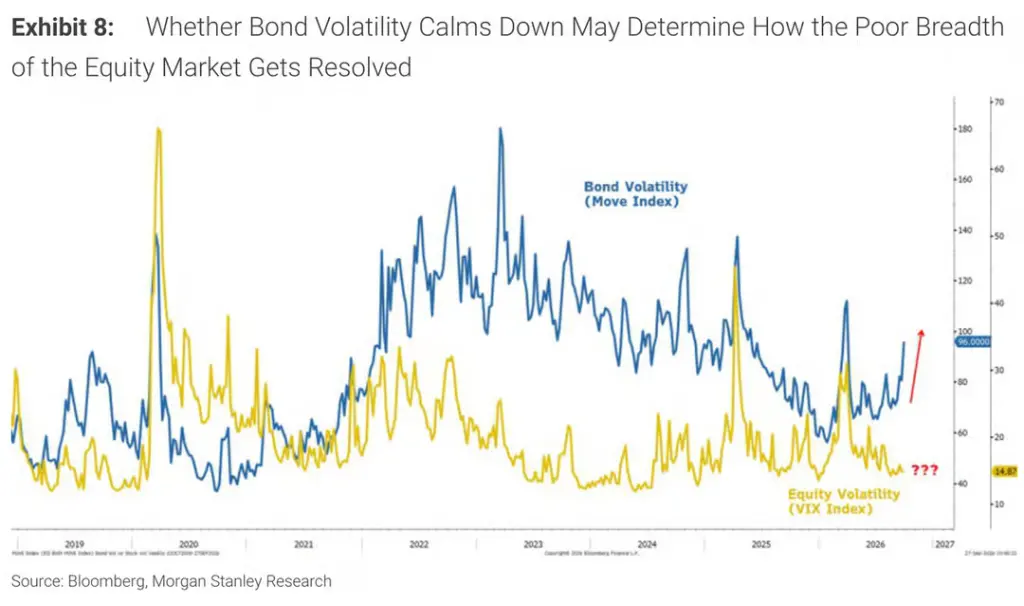
Currently, 51% of the Russell 3000 constituents have fallen more than 20% from their June highs, officially entering bear market territory, and the median stock in the S&P 500 is down 16% from its 52-week high, with market breadth at its lowest level since the dot-com bubble burst. Meanwhile, the yield on the 10-year U.S. Treasury has returned to 5.25%, the MOVE index, which measures U.S. Treasury volatility, has surpassed 100, while the "fear index," the VIX, remains below 15, creating a rare divergence between stock and bond volatility that has made the market highly vigilant.
Wilson's conclusion is: If bond volatility cannot calm down, the S&P 500 could dip to around 6800 to 7300 points in the next month, after which a year-end rebound may be expected; if bond volatility cools first, individual stock rallies will drive both the index and breadth higher together.
Half of the Stocks Are Deep in Bear Market, Index "Overvalued" Hides Internal Collapse
On the surface, the S&P 500 index is still operating near historical highs, but the internal damage to the market is quite severe.
Wilson pointed out in the latest issue of the "Weekly Warm-up" report that 51% of the Russell 3000 constituents have cumulatively fallen more than 20% from their June highs, worsening from "over 40%" two weeks ago. Meanwhile, the forward price-to-earnings ratio of the S&P 500 has dropped to about 19 times, matching the low during the most intense phase of the Iran conflict in March this year.
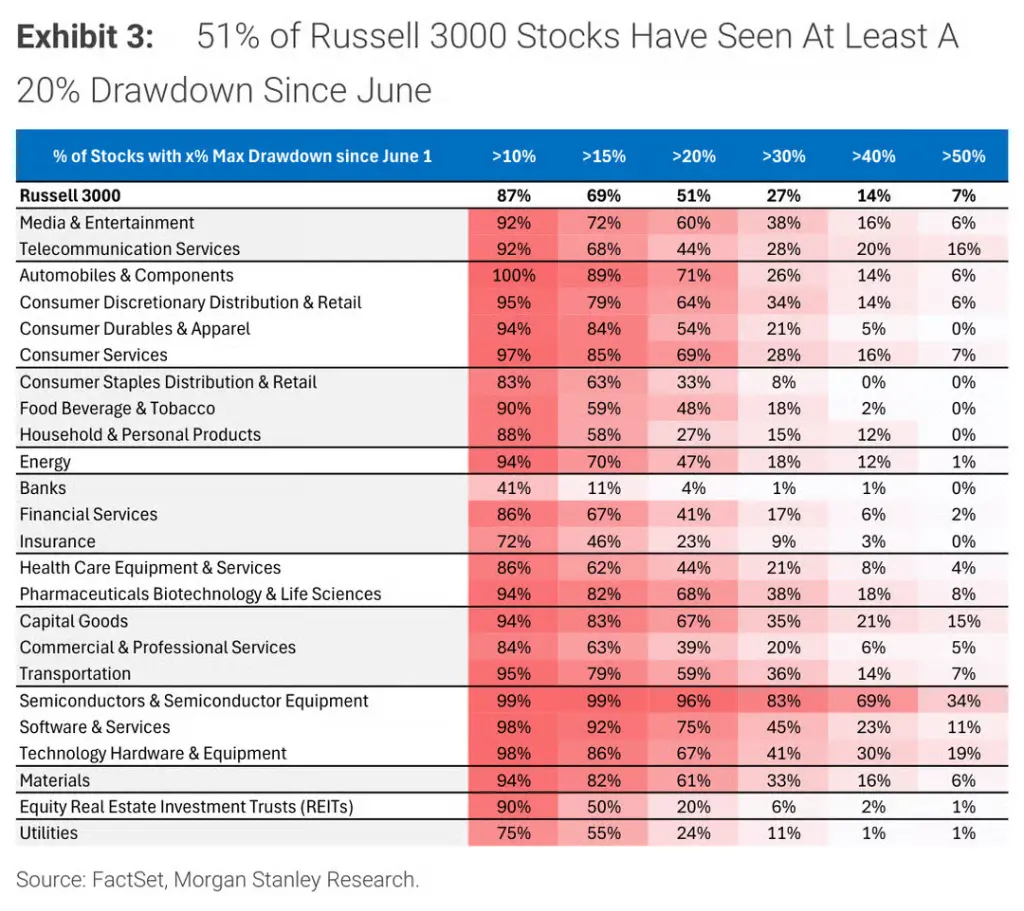
By industry, the distribution of damage is extremely uneven. In the semiconductor sector, 96% of stocks have fallen more than 20% from their June highs, with 69% down more than 40%; in the automotive sector, 71% of stocks have dropped over 20%, and every automotive stock has declined at least 10%; in the software sector, this ratio is 75%. The banking sector is an exception, with only 4% of stocks experiencing similar declines.
Wilson characterizes these heavily impacted areas as "typical early-cycle winners" ------ semiconductor and automotive stocks significantly outperformed the market from the rolling recession low in April 2025 to June 2026, but Morgan Stanley signaled as early as June that the breadth of earnings revisions for these early-cycle winners had peaked, and the market was transitioning from early-cycle to mid-cycle, with quality factors beginning to dominate. The Fed's hawkish pivot is another classic signal of this cycle transition.
Goldman Sachs' data further corroborates this judgment. According to Goldman Sachs TMT strategist Peter Callahan, the median stock in the S&P 500 is currently down 16% from its 52-week high, and market breadth has fallen to its lowest level since the dot-com bubble burst. Goldman Sachs warned as early as May 1 that the sharp decline in breadth "historically often precedes a higher-than-average pullback in the S&P 500 within the next 6 to 12 months," and five months later, this indicator continues to deteriorate.
The Trigger for the Collapse of Breadth: Jackson Hole, Not Oil Prices
The deterioration of market breadth did not happen overnight, and Wilson's timeline analysis is particularly critical.
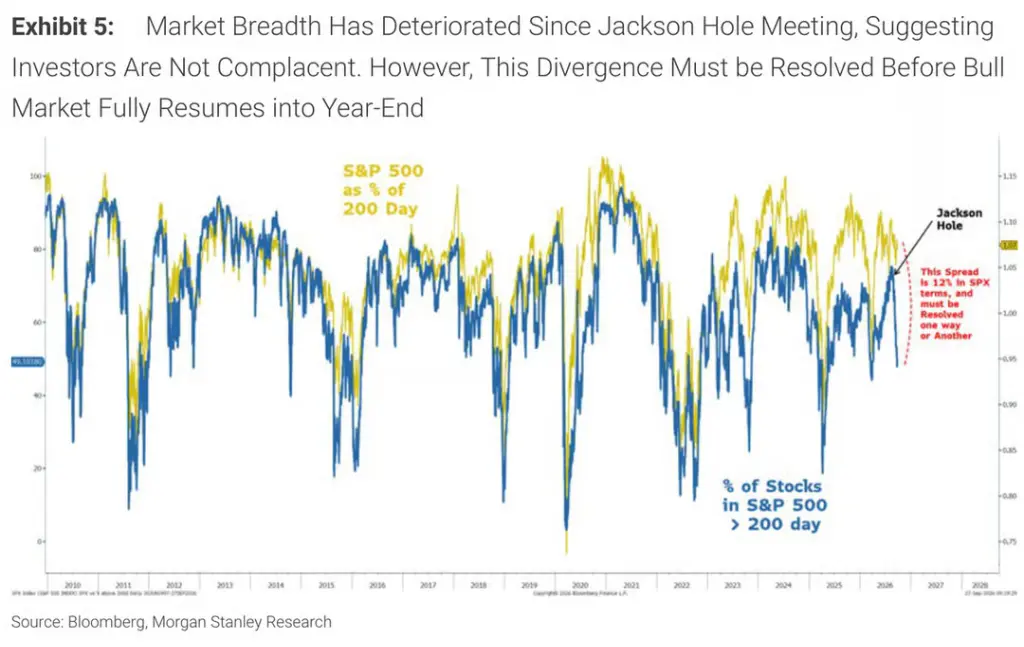
Throughout the summer, the proportion of S&P 500 constituents above the 200-day moving average rose from 59% at the end of May to about 75%, even against the backdrop of rising oil prices and U.S. Treasury yields, market breadth was still improving. However, this trend took a sharp turn downward after the Jackson Hole global central bank annual meeting in late August, and the current proportion has dropped to 49%.
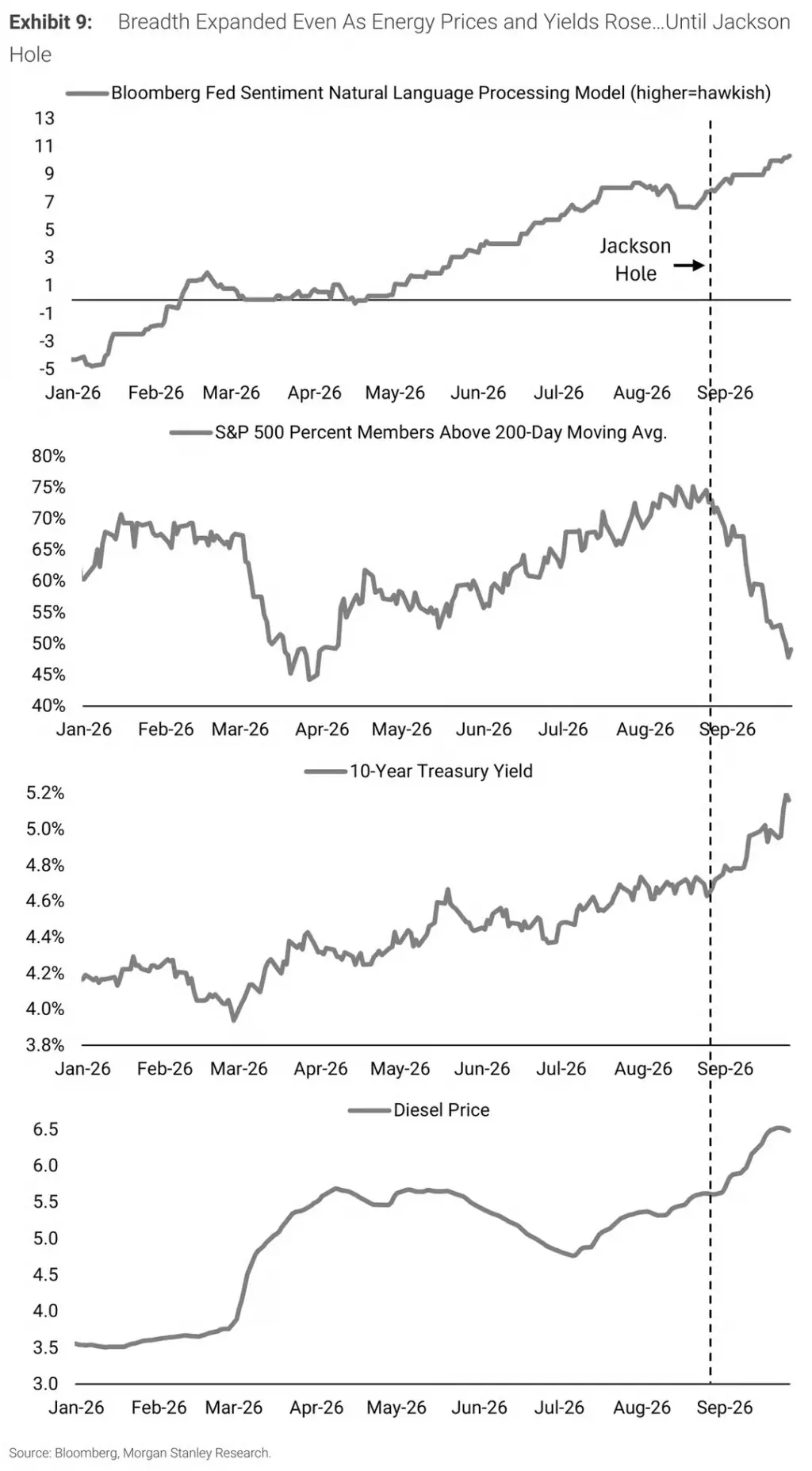
Wilson clearly pointed out that the sudden narrowing of breadth was not triggered by rising oil prices, but rather by the market beginning to digest a more hawkish Fed path after Jackson Hole.
"The same shift is clearly visible in the interest rate market. The acceleration of nominal GDP growth and rising energy prices drove yields up in the first half of the year, but since late August, the further rise in yields increasingly reflects the Fed's hawkish pivot ------ and this pivot occurs against a backdrop of strong economic growth, which is not necessarily bad for the overall stock market, but it does affect the leading direction of the market."
BTIG strategist Jonathan Krinsky's statistics provide another dimension of evidence: According to data cited by Bloomberg, there have been 57 trading days this year where price and breadth moved in opposite directions, matching the highest record in the past 30 years, with four and a half months remaining until the end of the year.
Wilson quantifies the current divergence between the index and breadth as "about a 12% gap in the S&P 500 that must be bridged in some way."
Fundamentals Have Not Stalled, But Valuation Compression Is Underway
However, despite the deterioration in market breadth, Morgan Stanley and Goldman Sachs have rarely reached a consensus on fundamental judgments: The current market weakness is not due to a deterioration in fundamentals, but rather the result of valuation compression.
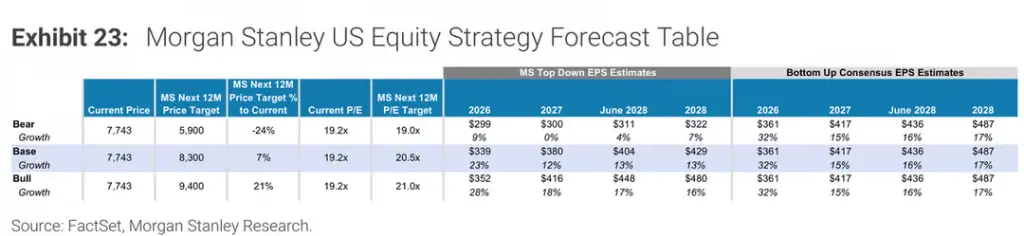
Wilson pointed out that the breadth of EPS revisions for the S&P 500 is 25%, far higher than the 7% for the lower-quality Russell 2000, and the median stock's EPS growth is in the mid-teens percentage range. "The index has been stagnant since early June, not because of a halt in earnings, but because valuations have digested the shock."
According to Goldman Sachs, citing its own data, the S&P 500's EPS grew by 51% year-on-year in the second quarter, and the forward price-to-earnings ratio has dropped from about 23 times to about 19 times, with Goldman Sachs' 12-month target price of 8700 points almost entirely excluding the contribution of valuation expansion.
It is worth noting that Morgan Stanley's forecast for 2026 EPS is $339, about 6% lower than the bottom-up market consensus expectation of $361 ------ even this strategist, who insists that "earnings are carrying the load," has a forecast that is clearly below market consensus.
U.S. Treasury Volatility: The Final Variable Determining Market Direction
Wilson attributes the current situation to two scenarios, both of which depend entirely on whether U.S. Treasury volatility can cool down.
Scenario One: If bond volatility remains high, market breadth and index prices will "meet in the middle" within the next month, meaning the S&P 500 faces about 6% pullback pressure, corresponding to an index level of about 7300 points, after which a strong year-end rebound may be expected.
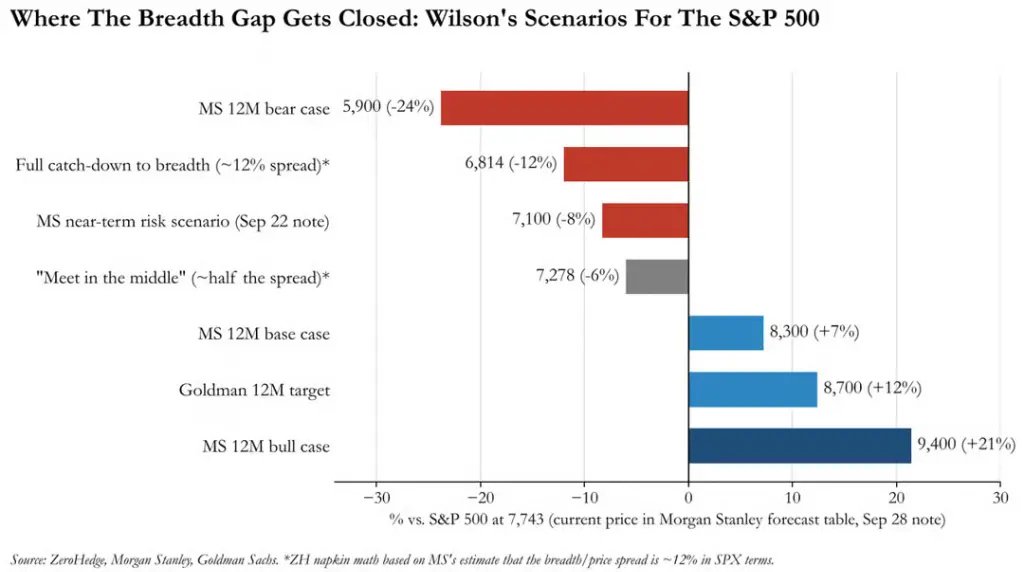
Scenario Two: If bond volatility cools first, individual stock breadth will catch up with index prices, driving both higher together.
Wilson has long viewed 4.50% as the critical point at which the 10-year U.S. Treasury yield exerts substantial pressure on stock valuations. After the 10-year U.S. Treasury yield broke this level in May, the forward price-to-earnings ratio of the S&P 500 has continued to decline. As of last Friday, the 10-year U.S. Treasury yield returned to 5.25%, erasing all gains after the non-farm payroll data was released.
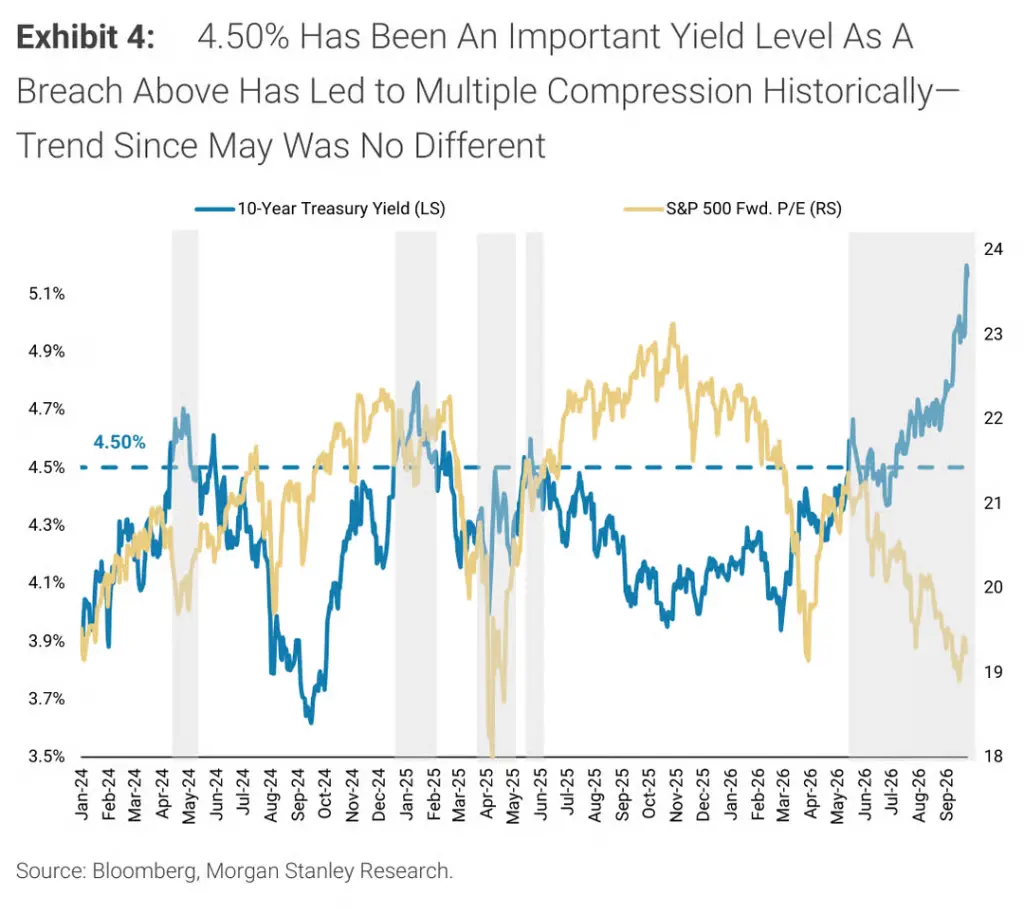
The MOVE index, which measures U.S. Treasury volatility, has currently surpassed 100, while the VIX remains below 15. Wilson pointed out, "The calmness of the VIX during the recent collapse of breadth and valuations is striking," and he marked this abnormal divergence with a red question mark. He believes that whether stock and bond volatility can synchronize, and when they do, will ultimately determine how the gap between breadth and the index is bridged.
"Walsh Put Options": Exist, But No One Knows the Strike Price
It is noteworthy that Wilson specifically discussed the impact of the new Fed Chair Walsh on market pricing in his report.
Since Jackson Hole, the 2-year U.S. Treasury yield has risen nearly 60 basis points, and the market interprets the signals released by Walsh as: Inflation not only needs to decrease, but it needs to decrease "quickly enough." The rate hike in September further reinforced this reaction function.
However, Wilson believes the bond market may be overreacting. "In our view, the bond market may have recently shifted to an overly hawkish stance." He also pointed out that the term premium is currently performing well, which has somewhat alleviated market concerns about fiscal sustainability or the Fed falling significantly behind the curve.
More critically, Wilson offers a unique interpretation of Fed Chair Walsh's monetarist stance:
"The market may be assuming too many rate hikes in the coming year while underestimating Walsh's willingness to use the balance sheet to finance deficits or stabilize financial conditions at the first sign of trouble. Our judgment is that Walsh will ultimately provide liquidity when necessary, but the market may want to test his resolve first. The recent rise in yields and bond volatility is a step in that direction."
In other words, "Walsh put options" objectively exist, but the strike price is still unclear, and the market seems to be actively searching for this price.
Wilson Recommends Sticking to Large-Cap Quality Stocks, Waiting for Entry Opportunities
At this stage, Wilson recommends sticking to large-cap quality stocks, especially light-asset companies with improving earnings revisions, and focusing on quality and operational efficiency factors such as high free cash flow yields, low accruals, and high sales per capita.
If the index does indeed pull back, completing the "adjustment that has been ongoing beneath the surface for months," Wilson believes that will be the time to increase holdings in higher-risk stocks, with a time window of about the next month.
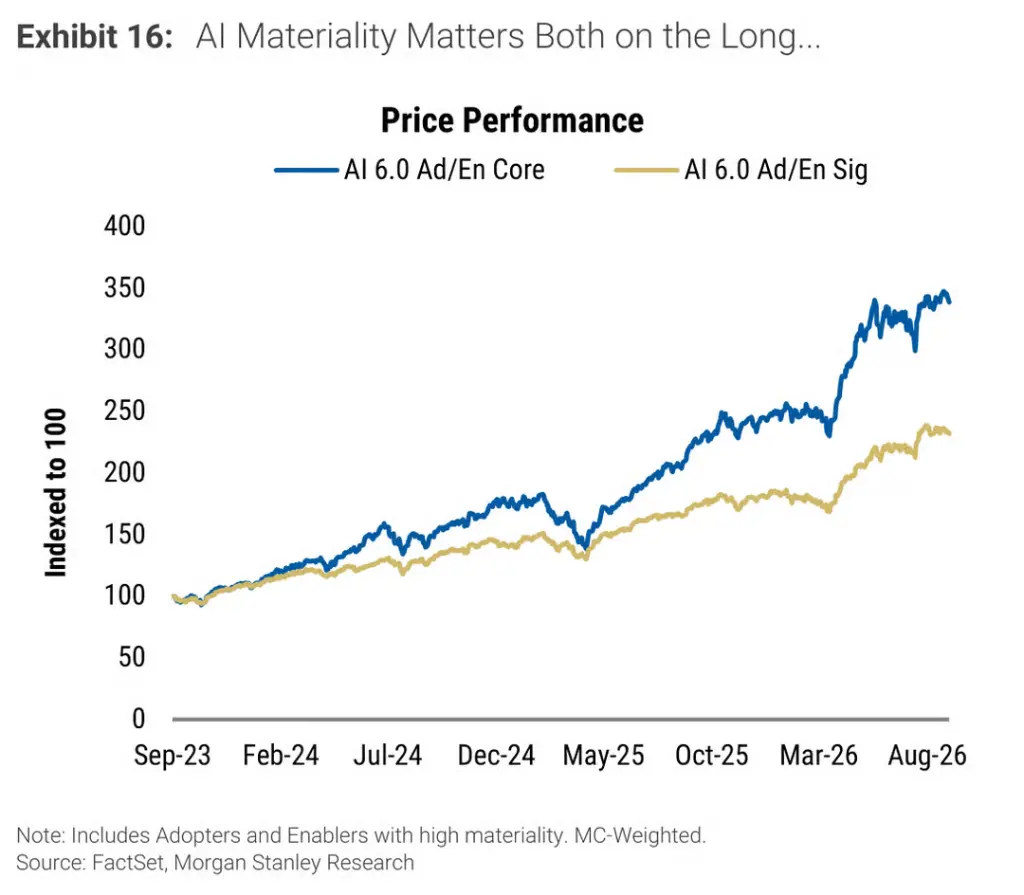
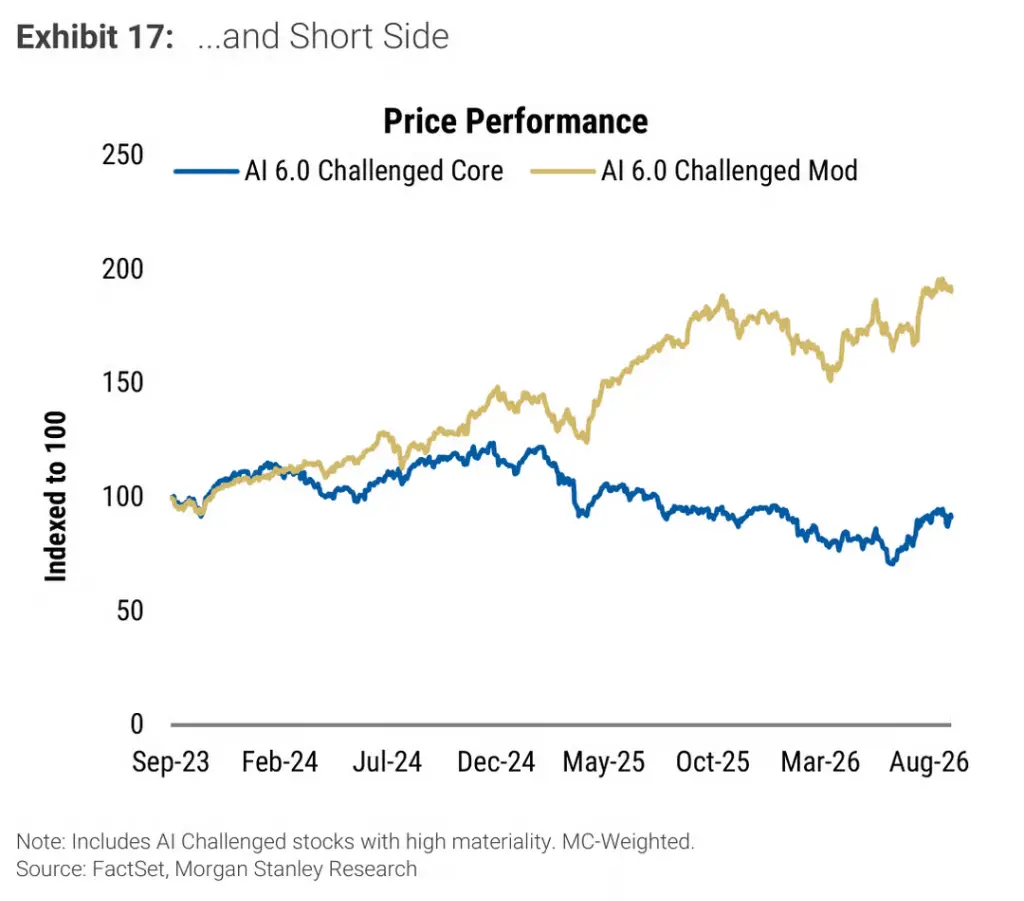
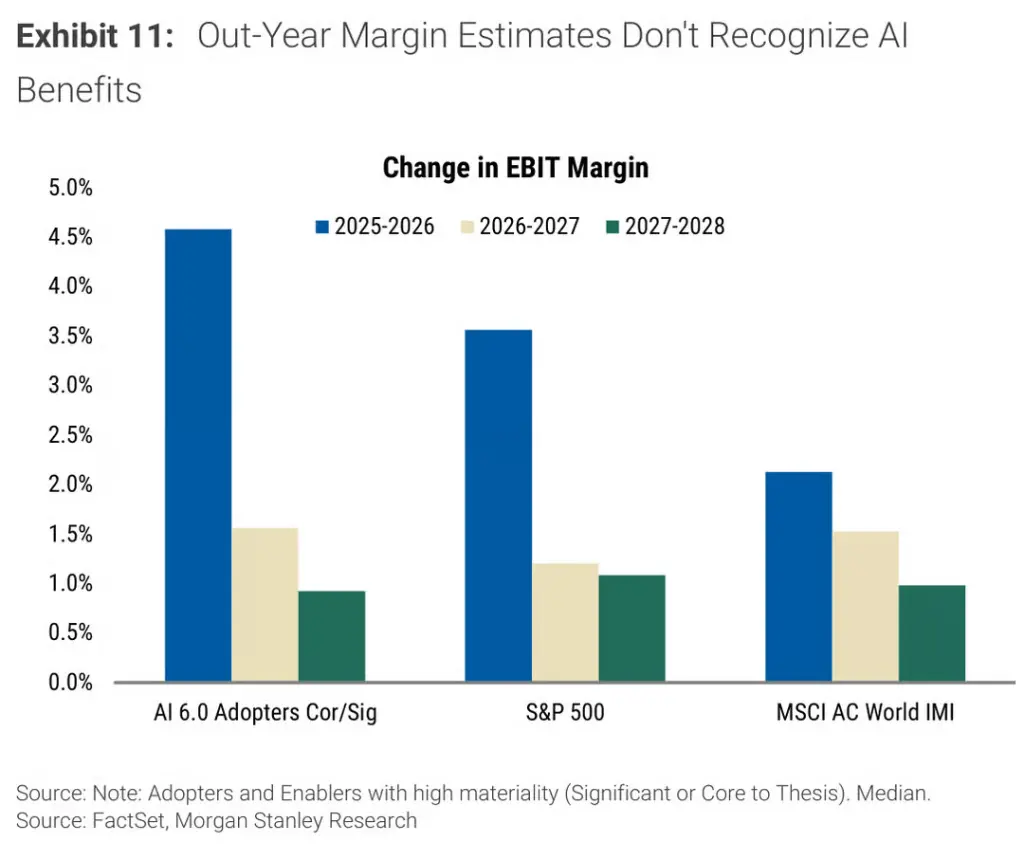
In terms of AI themes, Morgan Stanley analyst Michelle Weaver's sixth AI landscape analysis of approximately 3,600 global stocks shows that the market is rotating from "AI enablers" to "AI adopters." The market widely expects that highly correlated AI adopters will achieve a 4.6% EBIT profit margin expansion in 2025 to 2026, surpassing the overall level of the S&P 500, but this advantage nearly disappears in longer-term forecasts, indicating that analysts have incorporated the initial AI dividend into valuations but have not fully priced its sustainability.
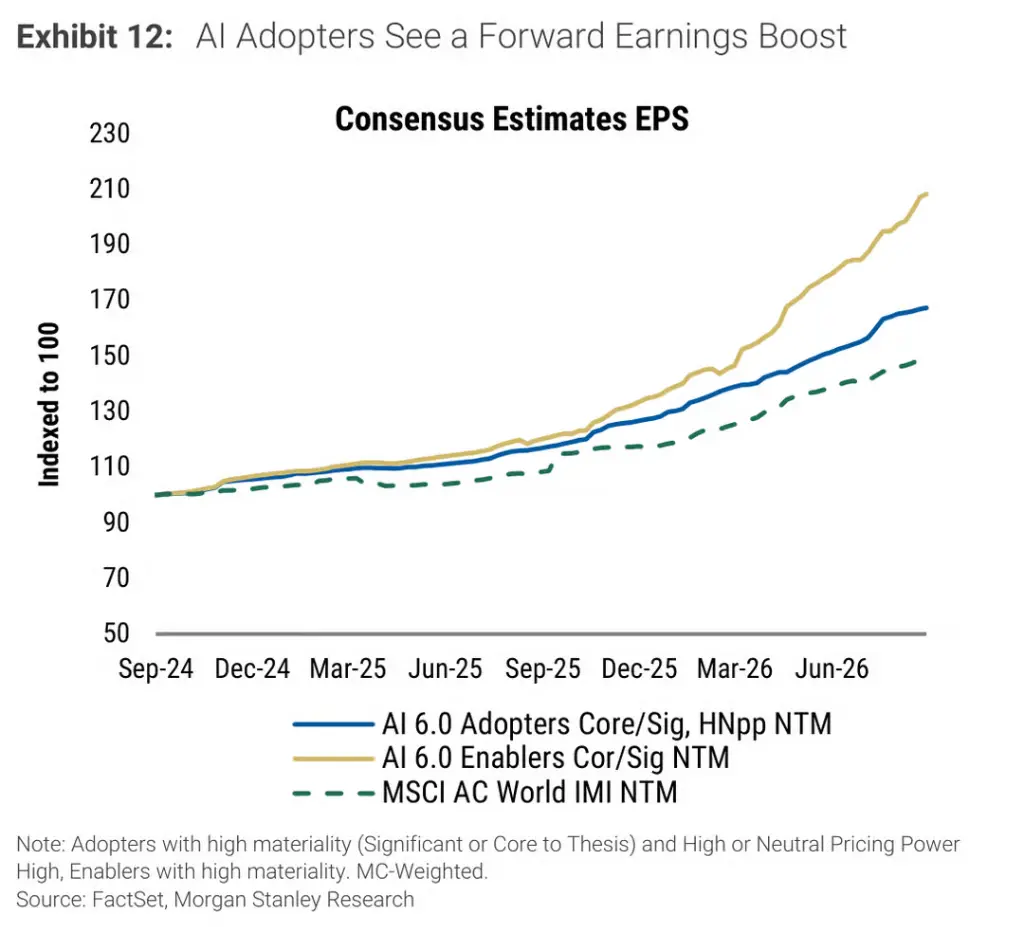
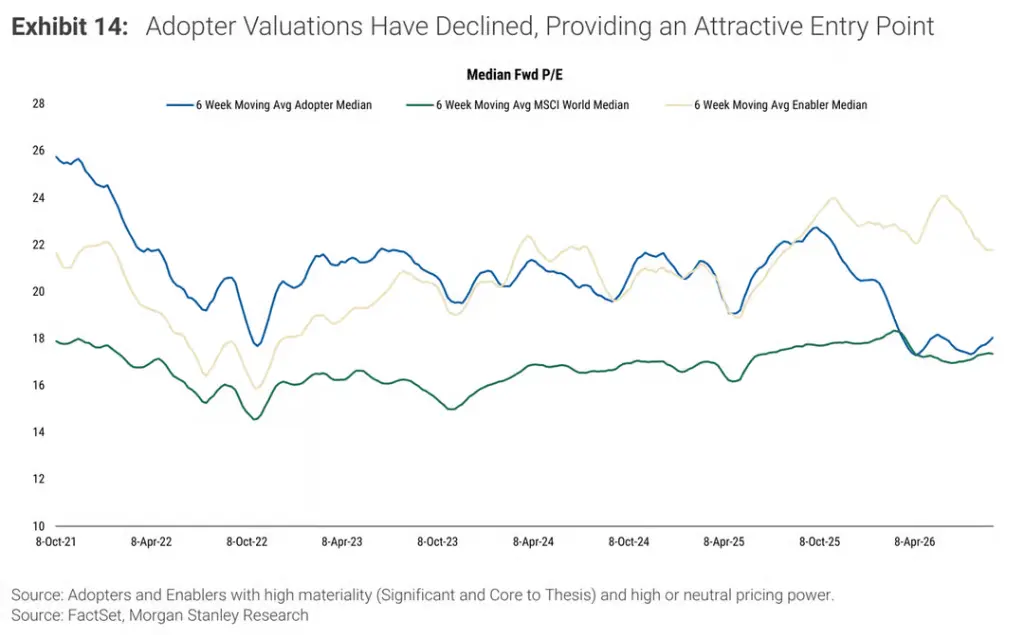
On the valuation front, the future 12-month EPS of highly correlated AI adopters has cumulatively risen by about 70% over two years (with enablers increasing by more than double), but the median adopter is currently trading at only 18 times forward P/E, in line with the MSCI World Index, and far below the 22 times of enablers.
Additionally, companies with "AI core to investment logic" outperform "only significant" companies by 107%; while companies facing core AI threats underperform those facing moderate impacts by about 161%, indicating that the market's pricing of AI's impact has become increasingly refined.