Crypto Stalls, So Robinhood Swaps In a New Money Printer
 Tapbit Wire

Robinhood's growth engine is changing.
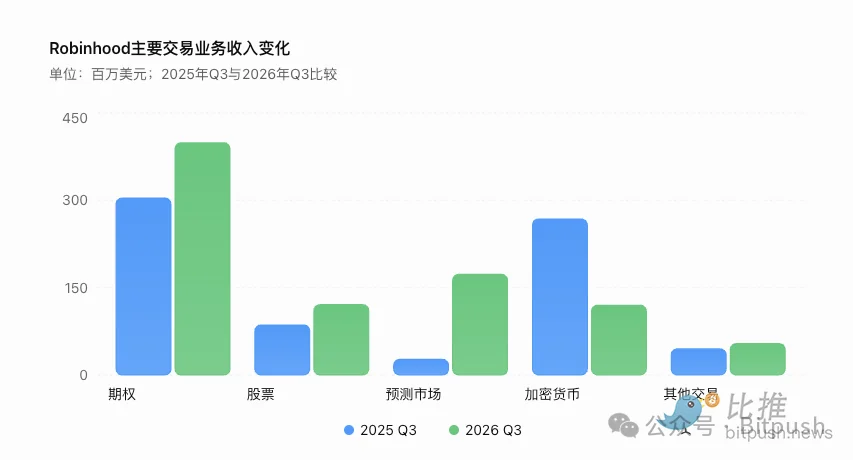
The Q3 2026 results released on October 27 show that Robinhood's revenue reached $1.424 billion, up 12% year over year and a new record high, while net income was $476 million, down 14% year over year. Crypto revenue, which once powered the company's growth, plunged 55%, while prediction-market revenue surged more than fivefold year over year to $173 million, clearly exceeding crypto revenue in the same period for the first time.
The US online brokerage that started out in zero-commission stock trading is expanding its business map from stocks and crypto to prediction markets, tokenized assets and even blockchain infrastructure.
Crypto Trading Cools Off as Prediction Markets Steal the Show
In the third quarter, Robinhood's crypto-related revenue was just $120 million, far below the $268 million of a year earlier.
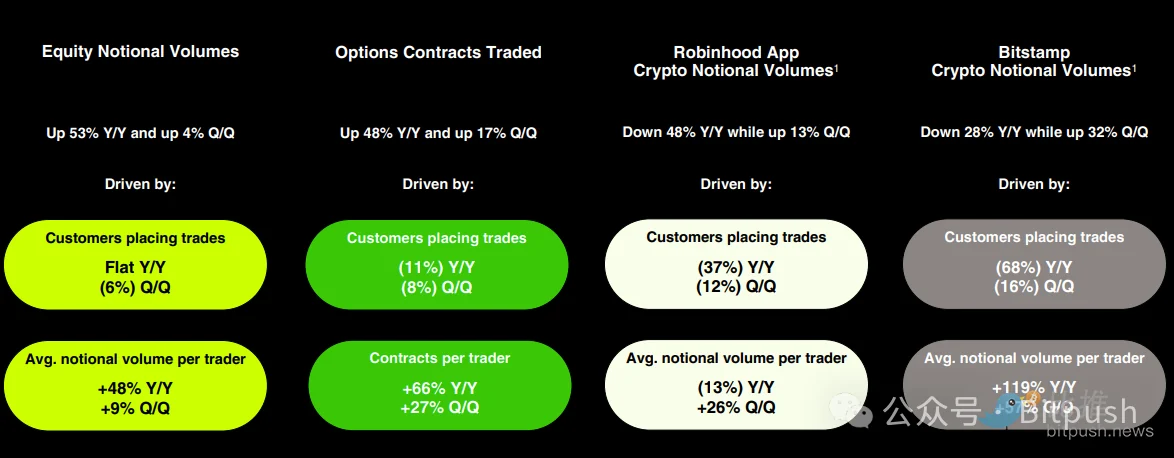
Trading data is no more encouraging. Crypto notional volume across the Robinhood App and its crypto exchange Bitstamp totaled about $49.8 billion, down 38% year over year. Crypto volume on the Robinhood App alone fell 48%, and the number of customers trading crypto dropped 37%.
Although crypto revenue rose 20% from the second quarter, the increase came mainly from new businesses. Robinhood Chain contributed $26 million of revenue in the quarter; excluding that, traditional crypto trading revenue from the Robinhood App and Bitstamp combined was only $94 million, a 6% decrease from the prior quarter.
Prediction markets stand in sharp contrast to the crypto business.
In the third quarter, Robinhood's prediction-market revenue reached $173 million, versus just $27 million a year earlier. In a single year the business grew more than fivefold, with event-contract volume reaching 16.4 billion contracts, up more than sevenfold year over year.
Notably, the $146 million year-over-year increase in prediction-market revenue is almost equivalent to the $150 million increase in Robinhood's total revenue over the same period. Options and equity trading revenue also kept growing, but the sharp decline in crypto offset a considerable part of that gain.
Prediction markets have become an important force driving Robinhood's growth.
Wall Street is also beginning to reassess the potential of this business. A team led by Bernstein analyst Gautam Chhugani estimates in a report that by 2028 Robinhood's prediction-market revenue could reach $1.7 billion, exceeding the $1.6 billion in crypto-related revenue projected for the same period.
Robinhood is pushing further upstream in the prediction-market value chain. Rothera, an exchange the company runs with Susquehanna, contributed about $28 million of revenue in the quarter. Compared with simply providing users a trading gateway, taking part in the exchange and clearing layers could broaden its revenue sources.
Still, prediction markets face no small amount of uncertainty. Hot events such as sports matches and elections can easily cause trading volume to spike, but may also create significant seasonal swings. At the same time, the US regulatory dispute over event contracts has yet to be fully resolved. Whether prediction markets can become a sustained and stable source of revenue remains to be seen.
Tokenization Gets Off the Ground, But Buzz Is Not the Same as Adoption
With crypto trading revenue under pressure, Robinhood is also looking for new blockchain growth opportunities, the most closely watched being Robinhood Chain and its stock-tokenization business.
This year, Robinhood launched its own blockchain network and continued to expand its stock-token products. The company hopes to bring traditional financial assets on-chain so users can trade the related assets at more flexible times, and to gradually explore on-chain collateral, lending and other financial services.
Judging by the third-quarter data, Robinhood Chain has gotten off to a fairly fast start.
The results show that in its first quarter after the mainnet launch, the network recorded more than $80 billion in decentralized exchange (DEX) volume and generated over $50 million in on-chain fees, with Robinhood recognizing $26 million of related revenue. The company says that by trading volume and revenue, Robinhood Chain already ranks among the world's top five blockchain networks.
However, a booming on-chain trading market is not the same thing as progress in tokenizing stocks and other real-world assets.
For now, a large part of Robinhood Chain's trading activity still comes from crypto-native assets such as memecoins, rather than tokenized stocks.
StoneX analyst Mark Palmer previously noted that Robinhood's brand influence, its open token-issuance mechanism, trading-fee subsidies, and the interplay between memecoins and tokenized stocks have together driven the network's rapid growth.
That also reflects the opportunity and the challenge facing Robinhood: relying on crypto-native trading can quickly attract volume and liquidity, but turning that traffic into long-term demand for stock tokens, on-chain credit and other financial services will take time.
Regulation is another hurdle. Robinhood's stock tokens are currently aimed mainly at eligible offshore users and are not yet fully open to US users. Moreover, the rights enjoyed by stock-token holders are not entirely equivalent to directly holding shares in the listed company.
For Robinhood, tokenization matters not only as a way to add new trading products, but more importantly as a chance to take part in asset issuance, trading, settlement and other on-chain financial services in the future. But judging by the data at this stage, it remains a long-term build-out still to be proven.
The Growth Story Enters a New Phase
Robinhood is gradually shedding its dependence on a single trading market.
Beyond prediction markets and blockchain, the company's third-quarter options revenue reached $399 million, up 31% year over year; Gold paid subscribers rose to 5.2 million, and banking, credit card and wealth management businesses are also expanding. The company is trying to transform from a trading app for retail investors into a comprehensive platform covering trading, payments, investing and financial infrastructure.
But rapid expansion comes with new pressure. In the third quarter, Robinhood's monthly active users fell to 13 million, down 800,000 year over year; net income dropped 14% year over year, partly due to fair-value losses on investments and higher income tax expenses. New businesses are bringing revenue growth, but their long-term profitability still needs to be tested.
In the coming quarters, whether prediction markets can sustain high trading volume, when the traditional crypto business will stabilize, and whether Robinhood Chain can form a genuine tokenized-asset ecosystem beyond memecoin trading will be important indicators for judging the success of the company's transformation.
Crypto's stall has not stopped Robinhood from continuing to grow: prediction markets are filling the space left behind, and tokenization opens up a longer-term horizon of imagination. But whether these new businesses can keep generating profit for the company as consistently as traditional stock and options trading still needs more data to prove.