Brazil election sees epic reversal, prediction markets become insider cash machines
 Tapbit Wire
On October 26 Beijing time, Brazil's Superior Electoral Court confirmed Lula's re-election victory. After trailing in the first round, Lula overtook former President Bolsonaro's son Flávio Bolsonaro by approximately 4.4 million votes, with 51.79% to 48.21%.
Since Brazil restored direct presidential elections in 1989, no first-round leader had ever lost in the second round. Along with this election that broke historical patterns came the Brazilian Ibovespa index, which fell 10% after the open and triggered a circuit breaker, as well as numerous traders on prediction markets who bet on Lula's defeat.
A Historic Election Upset
Prediction market Polymarket is a platform where users can bet on the outcome of any event: elections, Federal Reserve interest rate decisions, AI model release dates... events across almost all sectors and domains can become tradable products.
Just before the Brazilian election results were announced, the probability of Lula winning was only 18.5%. On this platform where probability equals odds, that number meant that if Lula won, traders who predicted correctly could earn more than 5x returns.
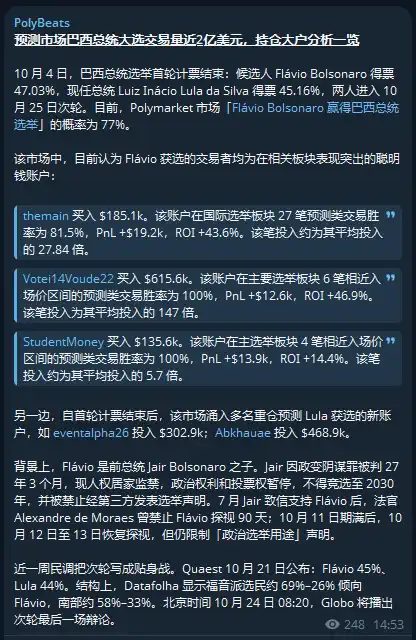
On October 23, PolyBeats, an information channel that monitors suspicious trades on the platform, identified 2 new accounts in the election market that registered at the most competitive point of the race and placed large bets on Lula's victory: Abkhauae and eventalpha26.
Three days later, these 2 accounts had collectively profited $1.77 million. Abkhauae changed its name to Abkha after profiting, and eventalpha26 has now withdrawn and exited. Neither had any other trades on the platform.
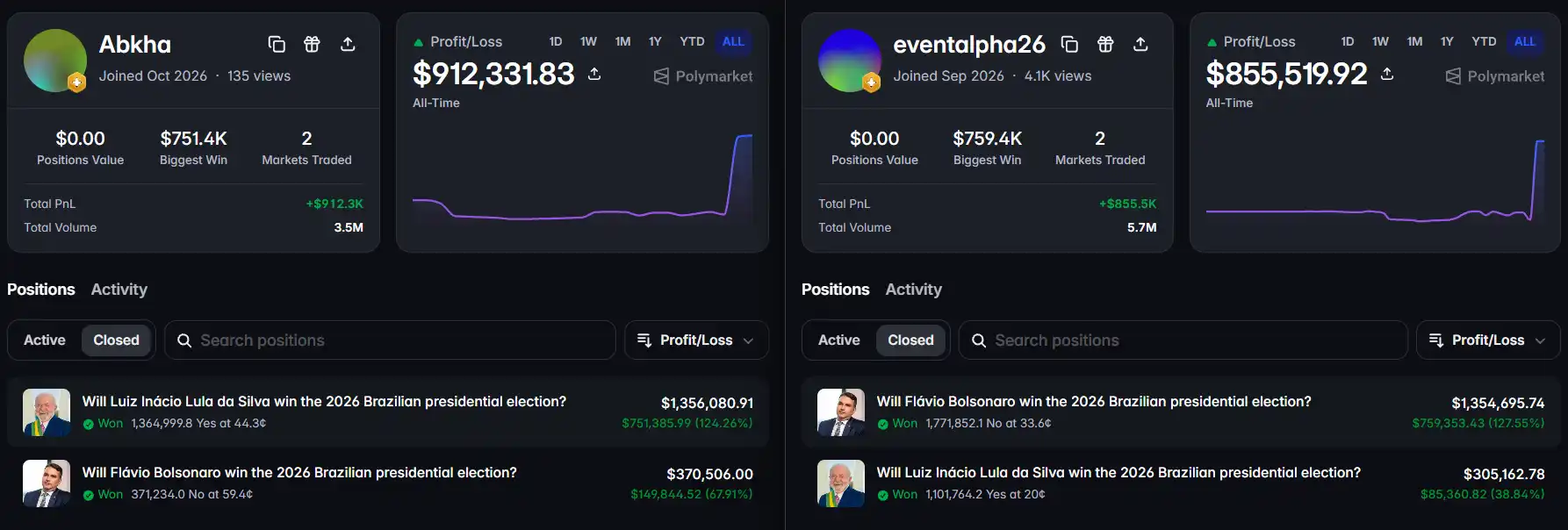
These behaviors clearly do not match the characteristics of typical "prediction market users," but rather resemble insiders exploiting an information gap for profit. PolyBeats previously reported in January that it had identified an insider account that bet exclusively on war-related topics in US-Israel-Iran markets and profited over $100,000; the following month, multiple media outlets reported that an Israeli Air Force reserve major behind the account had been arrested.
The profiles of these 2 new accounts are strikingly consistent with that major: highly concentrated participation in a single market, name changes to avoid scrutiny, and profit withdrawal.
In the same PolyBeats alert, 3 "smart money" accounts that bet on Flávio's victory were also named. Among them, Votei14Voude22 was the account with the largest loss in that election market, exceeding $430,000 cumulatively. Before that, it had maintained a 100% win rate in similar prediction trades in major election sectors.
Circuit Breaker in Brazilian Stock Market and On-Chain Liquidations
Betting on "first-round lead means certain victory" wasn't just happening in prediction markets.
According to Reuters, between the first round of voting and the second round, the Brazilian stock market rose nearly 7%, and the real appreciated nearly 5% against the dollar. The market expected that Flavio's victory would drive fiscal tightening and lower financing costs, and priced that expectation in advance.
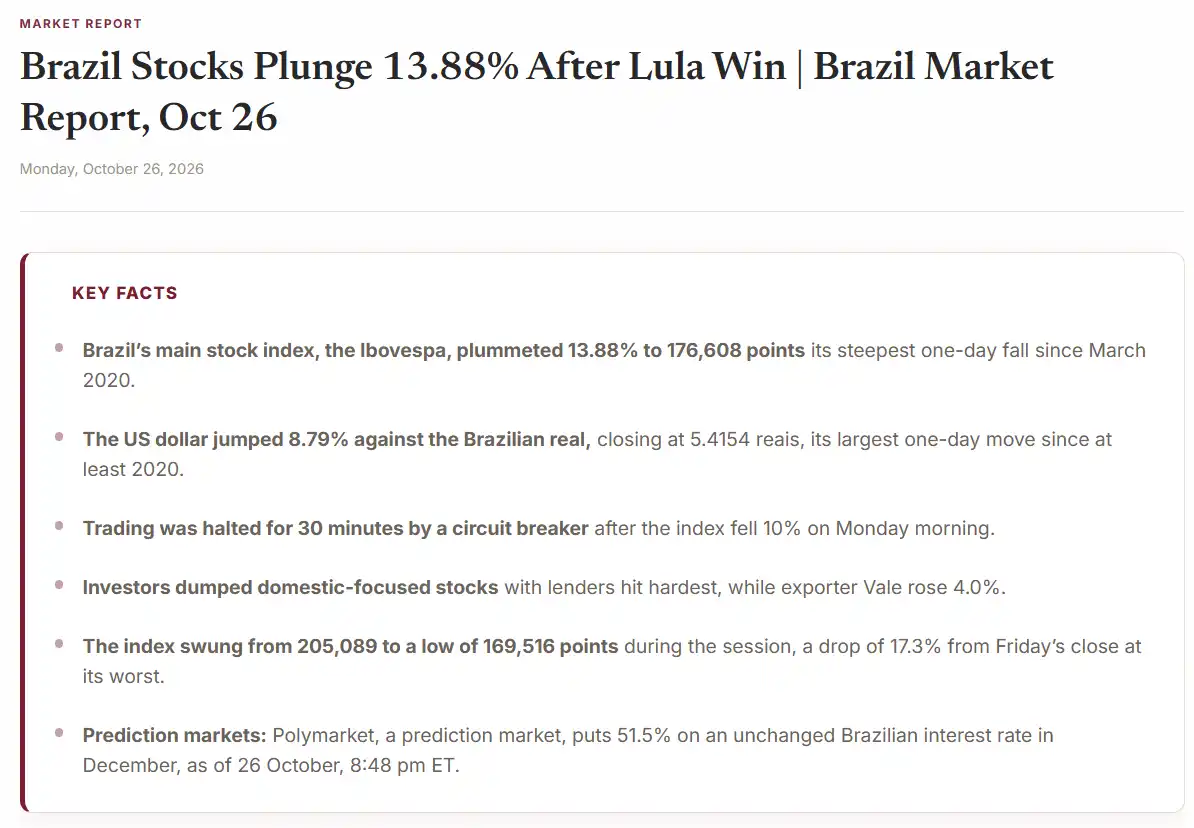
At the open on October 26, that trade reversed sharply. Brazil's Ibovespa index fell 10%, triggering a circuit breaker that halted trading for 30 minutes—the first time since March 2020. After trading resumed, the decline widened to as much as 17.34%, closing down 13.88%, the largest single-day drop since March 2020. The dollar rose 8.79% against the real that day.
On-chain reaction was faster. According to TradingBeats monitoring, the Brazilian stock ETF contract EWZ deployed by Trade.xyz on Hyperliquid fell 27.22% in 24 hours, with $14.9167 million in liquidations across the network, including $14.7275 million in long positions.
From Polymarket to the B3 exchange to Hyperliquid, what was misjudged this time wasn't just a few individuals' read on the political direction, but the entire market's overreliance on a historical pattern.
Prediction markets make every bet public on-chain, and anyone can reconstruct their timelines after the fact. But for those who placed bets before the results came out, all this transparency can do is reconstruct things after the fact.