




Bitcoin is back above the $72,000 mark, and this latest move is being supported by a factor the market still watches closely: steady ETF demand. Recent U.S. spot Bitcoin ETF flows remained positive, with another $155 million in net inflows reported for Wednesday, extending a roughly two-week run of net buying.
At the same time, CoinMarketCap’s live data showed Bitcoin trading near $72,398 at the time of writing, with 24-hour volume above $75 billion and daily gains of roughly 6%. That combination — stronger price action and consistent institutional inflows — is giving the current rebound more credibility than a simple short-lived bounce.
BTC Is Climbing, but the More Important Signal Is Under the Surface
Bitcoin moving above $72,000 is the headline, but the more important development is the return of buyers through ETF products. When flows stay positive for multiple sessions, traders tend to read it as a sign that larger allocators are stepping back into the market rather than waiting on the sidelines.
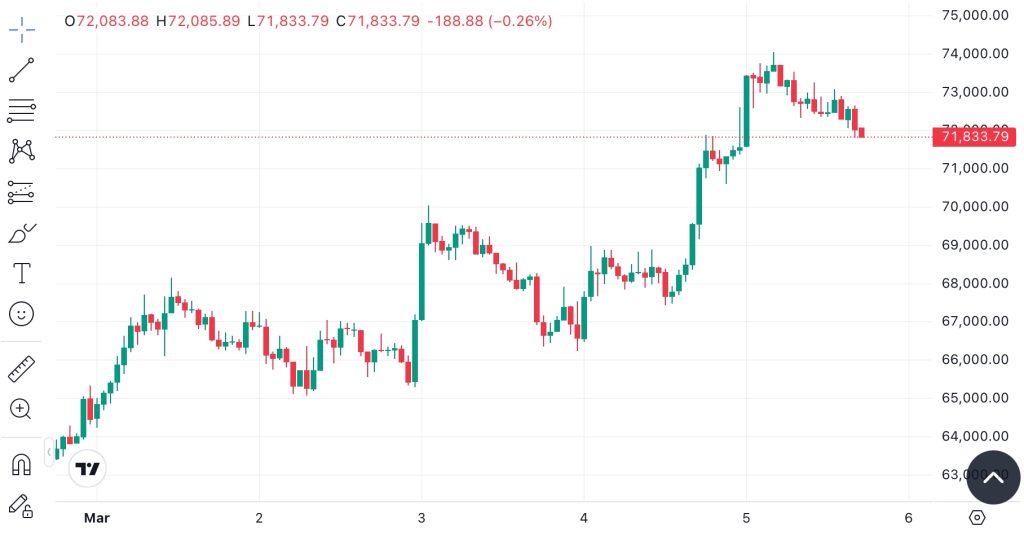
That does not automatically mean a straight-line rally is coming. But it does suggest that recent upside is not being driven by sentiment alone. In a market that spent weeks dealing with shaky risk appetite, ETF demand has become one of the clearest signs that institutional positioning is improving.
Why the $155 Million Inflow Still Matters
On its own, $155 million is not the biggest single-day ETF print the market has seen this year. But context matters. Coming after a series of recent inflow sessions, it helps reinforce the idea that demand is building in a more stable way rather than relying on one outsized spike.
That matters because Bitcoin’s recovery has already been broad enough to attract attention outside crypto-native media. Other market reporting this week also pointed to stronger ETF activity and a wider rebound in crypto risk assets, with some outlets noting that spot Bitcoin ETF inflows have climbed into the hundreds of millions over recent sessions and helped lift BTC toward the low-to-mid $70,000 range.
This Looks Stronger Than a Pure Short Squeeze
Relief rallies happen all the time in crypto, especially after sharp drawdowns. But this setup looks a bit firmer than a move driven only by traders covering shorts. Price is rising while ETF demand remains supportive, which gives the market a stronger foundation than a purely technical rebound.
That said, traders should still be careful not to read too much into one breakout. Bitcoin has reclaimed an important psychological level, but sustained upside will likely depend on whether ETF inflows keep coming and whether the market can hold above the low-$70,000 range instead of slipping back into recent chop.
What Traders Should Watch Next
The next question is not whether Bitcoin can briefly trade above $72,000. It already has. The more important test is whether that level can start acting like support.
If ETF inflows remain positive into the next few sessions, traders may start treating this rebound as part of a broader recovery phase rather than a tactical bounce. If flows cool off quickly, the market may still need to prove that the latest breakout can hold.
For now, the message is simple: institutional demand is back in the conversation, and that is helping Bitcoin regain momentum at a key level.
Trade the Market With a Clearer View
As Bitcoin reacts to changing ETF flows and fast-moving sentiment, active traders need to stay flexible. You can track price action and manage positions on Tapbit. Existing users can sign in through the Tapbit login page, while new users can get started through the Tapbit registration page.
Bottom Line
Bitcoin pushing back above $72,000 matters, but the bigger story is that ETF buyers are still showing up. Another $155 million in net inflows may not look dramatic on its own, yet it adds to a pattern the market cannot ignore. Right now, that pattern is helping turn a rebound into something that looks more durable.
Disclaimer: This article is for informational and educational purposes only and does not constitute investment advice. Markets can move sharply during geopolitical events, and both commodities and crypto assets carry risk.