0G Launches 'Compute Finance (ComFi)', a New Financial System with AI Computing Power as Its Core Asset
 Tapbit Wire
Source: 0G

Almost all scarce assets follow a similar path: first they are produced, then priced, and finally financialized. Oil has benchmark crudes and futures markets, electricity has forward contracts, and now compute is beginning to walk the same road.
Today, users can rent a GPU within minutes. Rental prices for mainstream GPUs have already formed a daily-updated benchmark, and major global exchanges are beginning to prepare for compute futures. But compared with mature commodities such as oil and electricity, compute still lacks a true financial layer of its own: people can buy and rent compute, yet it remains difficult to hold it as a long-term asset, earn yield from it, or own tradable rights to future compute.
This is precisely the market that "Compute Finance" seeks to describe. At its core, it turns compute itself into an underlying asset. DeFi financialized capital, while Compute Finance aims to financialize one of the most critical means of production in the AI era—computing resources.
Mining has already validated this path
Compute Finance is not entirely without precedent. The development of the Bitcoin mining market has already provided a relatively complete reference.
In the early days, hashpower existed only in mining rigs and data centers: input electricity, run equipment, earn block rewards. Later, platforms such as NiceHash began building hashpower rental markets, allowing miners to sell compute and buyers to determine prices through open bidding. But a trading market alone was not enough, because the industry still lacked a unified price benchmark.
The real turning point came when Luxor launched Hashprice. It abstracted hashpower across different mining machines, different electricity costs, and different operating conditions into a standardized revenue metric. Subsequently, forward contracts emerged around this metric, and eventually exchange-listed hashpower futures were developed. Today, miners can already hedge future mining revenue just as farmers hedge agricultural commodity prices.
This path can be summarized as: first a spot market, then a price benchmark, and finally financial derivatives. The compute market is now repeating this process, only on a larger scale.
Compute already has a price, but not yet a true capital market
At present, the spot market for compute is actually quite mature. Large cloud service providers such as AWS and Google Cloud offer on-demand and reserved compute, platforms such as Vast.ai and RunPod rent GPUs by the hour, and decentralized networks such as Akash, Render, and io.net have brought similar models on-chain.
In other words, compute is not lacking trading venues. What is truly lacking is the financial infrastructure built on top of the spot market.
This shift has already begun to emerge. Daily rental price benchmarks for mainstream GPUs already exist in the market, with some data even feeding into financial terminals; forward price curves are beginning to take shape, and major exchanges have already announced plans to launch cash-settled compute futures. Meanwhile, large buyers and sellers have begun locking in future compute prices through over-the-counter agreements.
Traditional finance is gradually treating compute as a tradable commodity.
But if we shift our perspective back to the end users who actually consume compute, the situation is entirely different. The most common form today remains cloud service credits or prepaid points. These credits are typically non-transferable, carry no property rights attributes, and may even expire. Even if a user rents a GPU, once the rental period ends, no asset remains that can continue to be held.
This is the biggest gap in the compute market today: the pricing layer has already begun to establish itself, but the capital layer has not.
What components might compute finance consist of?
First, compute finance is not chip company stocks, nor data center REITs, nor simply the GPU rental market. It emphasizes that investors directly hold rights tied to compute itself, rather than gaining indirect exposure through a company that sells compute.
The first important concept is Compute Yield. Traditional staking returns are typically tokens or interest, but the logic of compute yield is: users commit capital and ultimately receive computing resources they can actually use. In this way, compute ceases to be merely a cost and can become a continuously generated return on the balance sheet.
This is especially important for AI Agents. In the future, an Agent could very well hold certain assets itself and continuously obtain the inference resources needed to sustain its own operation. Once compute can become stable cash flow, it can be valued; and once it can be valued, it has the foundation for further trading and financialization.
The second concept is Compute Claims. It represents a transferable right to future compute usage. Users can buy when compute prices are low, sell when demand surges, or use it as collateral for borrowing. At this stage, what the market truly begins to price is no longer just Nvidia, cloud providers, or data centers, but compute itself.
The third direction is a self-financing AI economy. Today, the inference costs of the vast majority of AI products are ultimately borne by corporate budgets or venture capital, but in the future, an AI service could directly use a portion of its own revenue to purchase the next stage of compute. It would no longer rely on continuous external funding, but instead use business revenue to pay for its own inference costs.
For Agents, this shift is especially critical. An Agent that cannot cover its own inference costs is more like an experimental product, whereas an Agent that can earn money and pay for its own operating costs is only beginning to truly approach an independent economic entity.
However, the premise for this model to work is that there must be a real revenue loop. The other side of any "future compute rights" means someone bears the delivery obligation, and compute delivery itself incurs costs every day. Therefore, the questions that truly need answering include: Who is responsible for providing compute? Who actually pays for inference? If revenue is insufficient to cover costs, how are compute rights redeemed?
If these questions have no reliable answers, so-called "compute assets" may ultimately be just another packaged IOU.
Can compute be standardized like oil?
One of the biggest problems facing compute finance is that compute itself is highly non-standardized.
Although one barrel of crude oil may differ in quality from another, overall they can still be traded through a benchmark pricing system. Compute is far more complex. H100s and B200s are not equivalent, the same chip performs differently at different computing precisions, and actual AI workloads are also affected by factors such as VRAM, networking, and communication efficiency.
What is even more troublesome is that chips iterate extremely quickly. Today's flagship GPU may be only a mid-range product a few years later. If the underlying asset keeps changing, what should financial contracts use as the settlement standard?
But the mining market has actually already answered a similar question. Bitcoin mining machines also come from different generations and have different energy efficiency and cost structures. Hashprice does not try to make all mining machines completely identical, but instead establishes a unified reference metric, and then lets different hardware form discounts and premiums around that benchmark.
Financial markets have long handled non-standardized commodities in a similar way. For example, crude oil of different grades and electricity from different regions can ultimately form a pricing system around a certain benchmark.
Compute is very likely to move toward a similar structure: select a reference GPU or standardized computing unit, establish a settleable benchmark, and then let different types of hardware trade around it. The truly valuable infrastructure may not be proving that all GPUs are the same, but establishing a system of discounts, premiums, and basis that the market can accept.
Why now?
The most direct reason is that AI is making compute increasingly resemble a scarce commodity. Demand is growing rapidly, supply expansion requires large capital expenditures, and prices are clearly volatile. From historical experience, such assets ultimately tend to develop their own financial markets.
What the crypto industry excels at happens to be exactly the infrastructure this system needs: programmable rights, transparent collateral, and open markets.
More importantly, AI Agents may become the most natural users of compute finance. An Agent does not need an office, nor does it hire traditional employees. Its core cost is inference. For an Agent, compute is simultaneously equivalent to wages, rent, and raw materials.
Therefore, an economy truly composed of Agents can hardly rely on corporate credit cards and monthly cloud service bills in the long term. It needs a compute asset that can be directly held, earned, and spent by software.
From this perspective, the compute market has probably already reached the middle stage of the path toward financialization. Spot markets already exist, price benchmarks are forming, and exchanges are exploring
How does 0G understand this system?
0G positions itself at the base layer of this compute financial system and has launched two related products.
Ascend is the liquid staking product of the 0G Ecosystem. After users stake 0G, they can obtain a0G, continuing to participate in DeFi while maintaining staking yields; a0G is also the basis for subsequently minting compute-related assets.
Infinite AI (iAI), scheduled to launch on September 29, is positioned as a digital asset linked to compute. Users can use a0G to mint iAI and, by staking eligible iAI, obtain compute credits for use with ecosystem products such as 0G Private Computer and 0G App. According to the initial design, eligible iAI stakers can receive a certain amount of compute credits in usage value each day, subject to product terms.
This process can be summarized as: stake 0G → obtain a0G → mint iAI → stake iAI → obtain compute → use AI.
In 0G's framework, Ascend serves as the staking and liquidity layer, iAI corresponds to compute rights, and the compute credits actually consumed are used to connect financial assets with real AI usage demand.
Team and early investor token unlocks delayed by one year
In addition to product-level progress, the 0G Foundation has also adjusted the unlock arrangements for team and early investor tokens. The two categories of tokens together account for 44% of total supply, and the first unlock date has been postponed from October 22, 2026 to October 22, 2027. Subsequent releases will still occur linearly on a monthly basis, completing in September 2029; the total allocation amount remains unchanged.
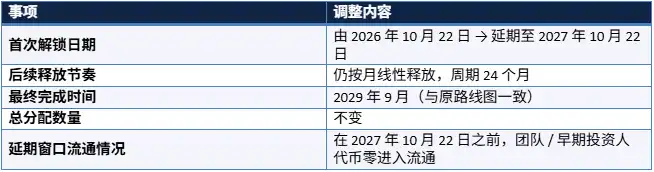
This means that this portion of tokens will not enter circulation before October 22, 2027. The adjustment changes the short- to medium-term circulating supply pace, rather than the total supply or the final unlock endpoint.
Compute power may be becoming a new financial primitive
In the past, concepts such as "tokenized hardware" and "GPU-backed credit" have appeared in the market, but these mostly describe isolated products rather than a complete market.
The so-called Compute Finance attempts to propose a broader category: compute power is no longer just a cost item for AI companies, but is beginning to have the potential to become an independent asset class.
If spot trading, price benchmarks, compute rights, yield products, and derivatives can ultimately be connected, the compute market may gradually form a financial system similar to energy and commodities.
This market is still very early. Many key issues, including standardization, delivery responsibility, credit risk, liquidity, and regulation, remain far from resolved.
But at least one thing is becoming increasingly clear: as AI expands from the software industry into new economic infrastructure, compute power itself is also gradually transforming from a technical resource into an asset that needs to be priced, financed, and risk-managed.