
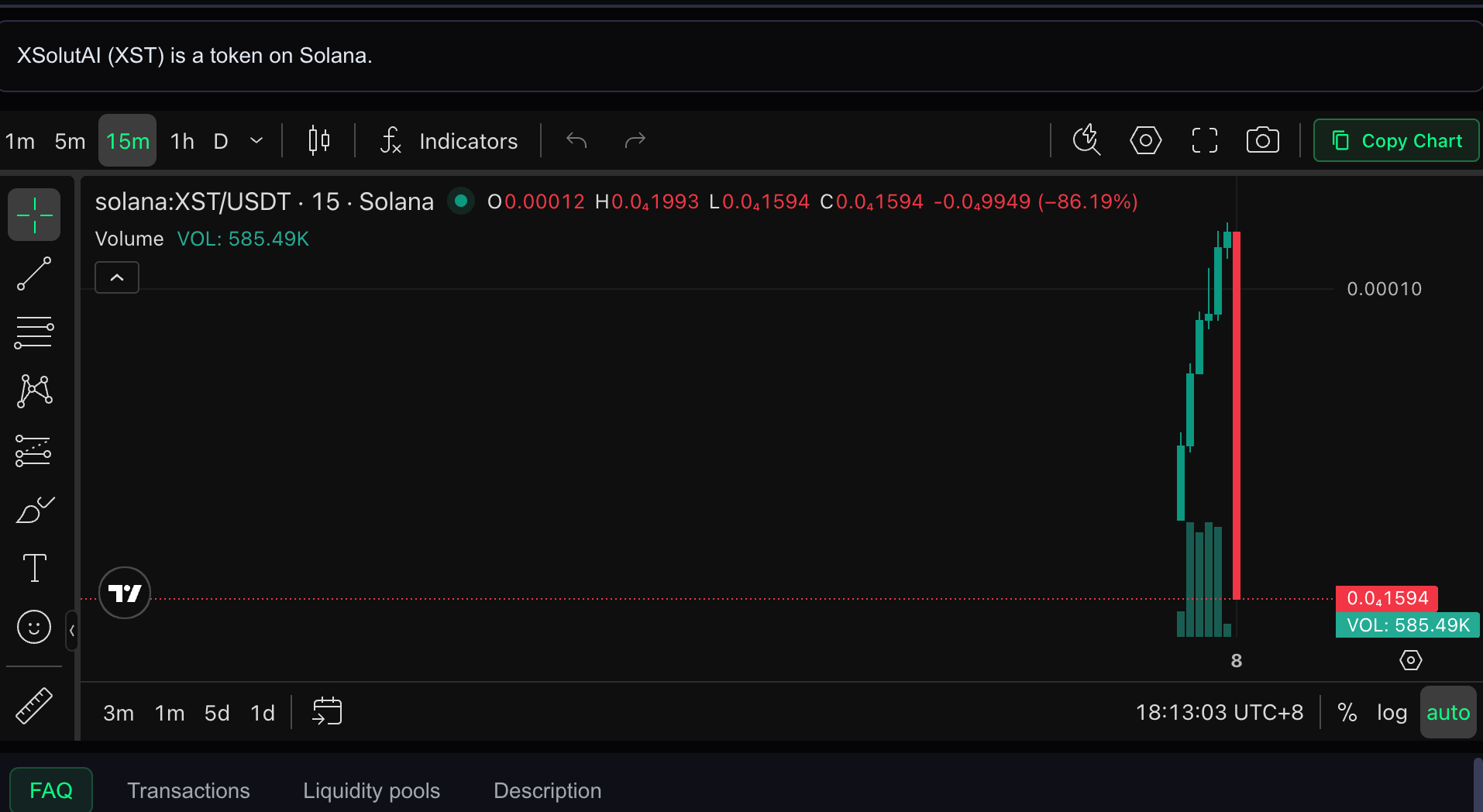
XSolutAI could theoretically reach $0.01 in 2026, but the supplied XST chart shows that the path is exceptionally difficult. The 15-minute snapshot displays a close near $0.00001594 after an approximately 86.19% decline in a single candle. From that baseline, XST would need to rise about 627 times to reach one cent.
The target is therefore not a modest recovery. It requires both a large repricing and enough liquidity to support real buying and selling near the quoted price. No verified Tapbit XST market was identified, so readers interested in wider crypto markets can create a Tapbit account without interpreting the link as an XST listing.
XST Price Today: What the Supplied Chart Shows
The provided chart identifies the asset as XSolutAI on Solana and displays a 15-minute XST/USDT market. The visible candle opened near $0.00012, reached a high around $0.00001993, recorded a low and close near $0.00001594, and finished down 86.19%. The volume indicator shows approximately 585.49K units.
Those values reveal severe short-term instability, but they do not identify the full Solana mint address or prove that this market represents the deepest XSolutAI pool. Several tokens have appeared under the XST or XSolutAI name. Price analysis is meaningful only after the chart, supply and liquidity data are matched to the same contract.
How Much Must XST Rise to Reach $0.01?
The required multiple is calculated by dividing the target by the supplied closing price:
$0.01 ÷ $0.00001594 ≈ 627.35
That equals a gain of approximately 62,635%. Even after a 10x move to $0.0001594, XST would still need to rise another 62.7 times to reach $0.01. Small unit prices can make a target look close, but percentage and valuation math show the true distance.
If the relevant XSolutAI mint has about 1 billion tokens, one cent would imply a fully diluted valuation and market capitalization near $10 million if nearly all supply is circulating. That figure is not inherently impossible for a crypto project, but market cap alone ignores liquidity, distribution and whether the last price can support meaningful trade size.
XST 2026 Scenario Table
| Scenario | Illustrative price range | What would need to happen |
|---|---|---|
| Bear case | Below $0.00001 | Liquidity fades, the rally unwinds, contract confusion persists and product progress remains limited |
| Base case | $0.00002–$0.00050 | Trading stabilizes, one mint gains clearer recognition and the project maintains a small active community |
| Bull case | $0.001–$0.01 | Verified identity, deeper liquidity, product launch, stronger adoption and sustained AI-token demand |
These ranges are scenarios rather than forecasts with assigned probabilities. The current market history is too short and contract identification too uncertain for a precise statistical model. The table instead defines the conditions that would support or invalidate different outcomes.
Bull Case: How XSolutAI Could Approach $0.01
The strongest bullish argument is valuation scale. If XST’s correct supply is close to 1 billion, a $10 million valuation is reachable in crypto markets when a project gains genuine adoption. XSolutAI’s AI-infrastructure theme also sits within a narrative that can attract speculative capital quickly.
For that narrative to become durable, the project would need to publish verifiable product documentation, demonstrate a working AI marketplace and show usage beyond token trading. A clearly authenticated mint address, transparent team communication, reputable integrations and liquidity measured in hundreds of thousands or millions of dollars would make the price more credible. Consistent volume across weeks would matter more than one vertical candle.
Base Case: Volatile Trading Below One Cent
A more conservative outcome is continued trading far below $0.01. XST could experience repeated rallies as AI and Solana narratives rotate through the market, yet fail to sustain them because liquidity and product evidence remain limited. In this scenario, price action would be driven mainly by community attention and DEX activity.
For the base case to improve, the token would need higher lows, broader holder participation and reduced slippage. The project would also need to separate itself from same-name XST contracts. Without those changes, quoted prices from individual pools may diverge too widely to support a stable market.
Bear Case: Why the Rally Could Fully Reverse
The supplied chart already shows how quickly a low-priced token can surrender gains. An 86% candle means a holder buying near the local high could face an immediate and substantial drawdown. Thin liquidity can make exits difficult, while headline market capitalization may remain high only because the last trade set an artificial reference price.
The bearish case strengthens if official channels do not establish one verifiable contract, liquidity disappears, major wallets dominate supply or project development stalls. Duplicate mints can fragment buyers and create misleading charts. If the market shown in the screenshot has only shallow backing, even small sales may push the price below the displayed range.
What Could Drive XST Toward $0.01?
- Product delivery: a usable AI marketplace with measurable activity.
- Contract clarity: consistent publication of one authenticated Solana mint.
- Liquidity growth: deeper pools that reduce slippage and resist manipulation.
- Holder expansion: broader ownership instead of dependence on a few wallets.
- Exchange access: reputable venues verifying the correct contract and supporting deposits and withdrawals.
- AI-market momentum: renewed demand for early-stage AI tokens across Solana.
These catalysts must work together. Marketing attention may lift price temporarily, but product adoption without liquidity can still leave holders unable to transact efficiently. Likewise, deep liquidity does not create long-term utility by itself.
Signals That Would Invalidate the $0.01 Thesis
The thesis weakens if the token cannot maintain reliable liquidity, if official channels publish conflicting mint addresses or if on-chain activity falls toward zero. Continued extreme gaps between pools would suggest that the market lacks a dependable reference price.
Other warning signs include concentrated holder supply, unverifiable partnerships, anonymous control over key project accounts and no visible development after the launch period. A target should be abandoned when the evidence behind it deteriorates, not defended because the token once rallied.
Conclusion
XSolutAI reaching $0.01 in 2026 is mathematically possible but highly speculative. Based on the supplied close near $0.00001594, the target requires roughly a 627x increase and would imply a valuation near $10 million for a 1 billion-token supply. That valuation is achievable only if the correct XST contract gains clear recognition, meaningful liquidity and real product demand. The chart’s 86.19% drop shows that current price discovery is fragile, so contract verification and market depth matter more than the one-cent headline.
FAQ
How many times must XST rise to reach $0.01?
From $0.00001594, XST would need to rise approximately 627 times, equal to about 62,635% upside.
What market cap would XST have at $0.01?
With roughly 1 billion tokens, the implied market capitalization would be about $10 million. The estimate changes if the verified supply is different.
Why did XST fall 86% on the supplied chart?
The chart alone cannot prove the cause. Thin liquidity, concentrated selling and rapid reversal after a speculative launch can produce such moves.
Is every XST token the same XSolutAI asset?
No. Multiple projects and Solana mints use XST. Users must confirm the network and full contract address before comparing data.
Is XST available on Tapbit?
No verified Tapbit XST market was identified for this analysis. Check Tapbit’s live market directory rather than assume a listing from the ticker.


