

SXP coin may have speculative upside if Solar restores development momentum, expands network use, and resolves its migration and supply concerns. However, it remains a high-risk investment in 2026. Solar is operational, but official governance documents acknowledge that forward development has slowed and that no active roadmap is currently in place.
SXP should not be evaluated only by its low unit price or previous market highs. Investors need to examine network activity, supply inflation, exchange support, liquidity, governance participation, and whether Solar can attract developers and users.
SXP is not being presented here as available on Tapbit. Readers can create a Tapbit account to explore supported crypto markets while checking current listings independently.
What Is SXP Coin?
SXP is the native asset of Solar, an open-source Layer-1 blockchain launched in March 2022. Solar uses Delegated Proof of Stake, or DPoS, with 53 elected block producers responsible for validating transactions and maintaining the network.
SXP previously had associations with the Swipe ecosystem before migrating to the independent Solar mainnet. Holders must distinguish native Solar SXP from legacy versions on other networks and verify which deposit network a wallet or trading platform supports.
According to Solar’s official website, the mainnet remains live with eight-second blocks. Its reported native supply was approximately 684 million SXP when the site was last reviewed in June 2026.
What Gives SXP Utility?
| SXP use | How it works | Investment relevance |
|---|---|---|
| Network fees | Pays for Solar transactions | Depends on real network demand |
| Voting | Holders vote for block producers | Supports DPoS participation |
| Rewards | Some producers share rewards | Variable and not guaranteed |
| Governance | Used in community proposals | Depends on voter participation |
| Token creation | Supports assets issued on Solar | Requires developer adoption |
| Payments | Transfers value on mainnet | Depends on wallet and merchant use |
Solar documentation states that users do not need to transfer or lock SXP when voting for a block producer. Some producers voluntarily distribute part of their rewards to voters, but commissions and sharing policies vary. Rewards should not be confused with risk-free yield because block producers can change policies, prices can fall, and new rewards increase supply.
The Bull Case for SXP
The strongest investment case begins with Solar remaining an operational sovereign blockchain rather than only an abandoned token contract. Its ledger continues advancing, and block producers continue validating transactions.
Solar also has wallets, an explorer, APIs, software-development kits, governance tools, and support for token creation. If contributors revive development and attract applications, SXP could benefit from increased demand for fees, voting, and ecosystem participation.
A successful future transition could provide another catalyst. Solar contributors proposed an optional migration framework in 2026 based on a 1:1 conversion, audited tooling, no duplicated supply, and voluntary participation. The proposal received unanimous approval among validators voting yes or no but failed because participation did not meet the required quorum.
Why SXP Is High Risk in 2026
The official governance proposal states that development velocity has slowed because of structural and technical constraints and that no forward-looking development roadmap is active.
Reduced exchange access is another problem. Solar’s official FAQ says Binance ended SXP spot trading on April 1, 2026. Fewer established venues can reduce liquidity, accessibility, and the ability to enter or exit larger positions. The FAQ also raises questions about legacy SXP on Ethereum and BNB Chain alongside native supply.
| Risk | Why it matters |
|---|---|
| Slow development | Limits applications and user growth |
| No active roadmap | Makes future catalysts harder to evaluate |
| Weak liquidity | Can cause slippage and sharp price swings |
| Supply inflation | Block rewards continually create new SXP |
| Legacy-token confusion | Increases deposit and supply-analysis risks |
| Reduced exchange support | Limits access and price discovery |
| Migration uncertainty | Could fragment users or add complexity |
| Low governance participation | Can delay important decisions |
How SXP Supply and Staking Affect Its Value
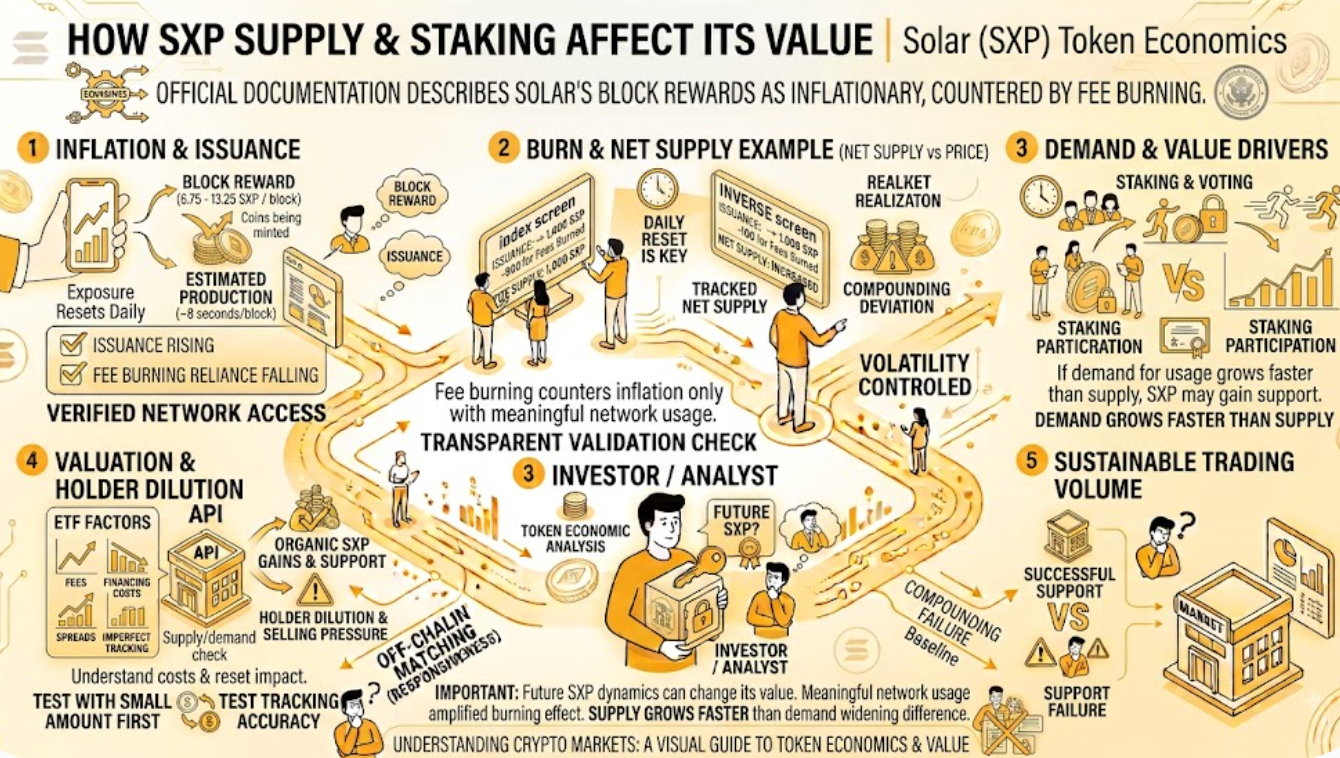
Solar’s block rewards are inflationary. Official documentation states that each block can create between 6.75 and 13.25 SXP, with blocks produced approximately every eight seconds. Ninety percent of each reward goes to the block producer, while 10% supports the development fund and Solar Blockchain Foundation.
Transaction fees partly counter this inflation: Solar documentation says 90% of transaction fees are burned and 10% go to the producer. Whether burning offsets a meaningful share of issuance depends on actual network usage.
If demand for transactions, governance, applications, and voting grows faster than circulating supply, SXP may gain support. If issuance continues while demand remains weak, holders face dilution and potential selling pressure from reward recipients.
Is SXP Staking Worth It?
SXP voting rewards may generate additional coins, but results depend on the selected block producer, commission, uptime, sharing policy, and SXP’s market price.
A quoted reward rate should be compared with coin inflation. Receiving more SXP does not improve purchasing power if the coin loses considerably more value or supply grows at a similar rate. Users must also follow official wallet instructions because legacy-network SXP may not provide the same functionality as native Solar SXP.
Who Might Consider SXP?
SXP may suit an experienced, high-risk investor who understands small-cap blockchains, can verify native Solar network support, accepts limited liquidity, follows governance developments, and uses a small position relative to the overall portfolio.
It is less suitable for someone who needs deep liquidity, a clear product roadmap, broad institutional support, simple custody, or predictable long-term token economics.
What Would Improve the SXP Investment Case?
The outlook would strengthen if Solar publishes and executes a credible roadmap, increases developer activity, attracts functioning applications, and improves daily network use.
Other constructive signals include deeper liquidity, wider native-mainnet support, clearer accounting of legacy and native supply, higher governance participation, and a transparent migration framework. Further exchange withdrawals, declining validator participation, inactive repositories, falling transactions, or contradictory migration instructions would weaken the case.
Conclusion
SXP coin is not an obviously good investment for the average crypto buyer in 2026. Solar remains operational and SXP has genuine network functions, but slow development, no active roadmap, inflationary issuance, reduced exchange support, supply complexity, and weak governance participation create substantial uncertainty.
The bull case depends on a technical revival, clearer governance, stronger applications, and renewed liquidity. Until those improvements become visible, SXP is better viewed as a speculative, high-risk blockchain asset than a core long-term holding.
Frequently Asked Questions
Is SXP coin still active?
Yes. Solar’s official website states that its mainnet remains live and continues producing blocks. Network operation does not guarantee strong development or investment returns.
Is SXP the same as Swipe?
SXP originated in the Swipe ecosystem but later migrated to the independent Solar blockchain. Investors should distinguish native Solar SXP from legacy versions on other networks.
Can SXP be staked?
Native SXP holders can vote for Solar block producers. Some producers share rewards with voters, although policies and commissions vary.
Does SXP have a maximum supply?
Solar issues inflationary block rewards, so SXP should not be treated as having Bitcoin-style fixed scarcity. Current supply should be checked through the official explorer.
What is the biggest SXP investment risk?
The central risk is that issuance continues while development, adoption, liquidity, and exchange support remain weak. Migration and legacy-supply uncertainty add further complexity.


