

Onyxcoin entered September with a clearer catalyst than its previous rallies often had.
Onyx has signed an agreement to acquire Chain.com's technology and intellectual property, with the goal of combining that infrastructure with Onyx Layer 1 and Onyx Wallet — creating a blockchain‑native neobank focused on stablecoins, payments, and everyday financial services.
XCN rose as the proposal moved into DAO governance. The market now has a more concrete narrative to price, but much of it remains provisional. The acquisition is not yet finalized, product timelines are still unspecified, and Onyx has yet to demonstrate substantial user activity on its own network.
XCN Price Recovered After the OIP-4 Announcement
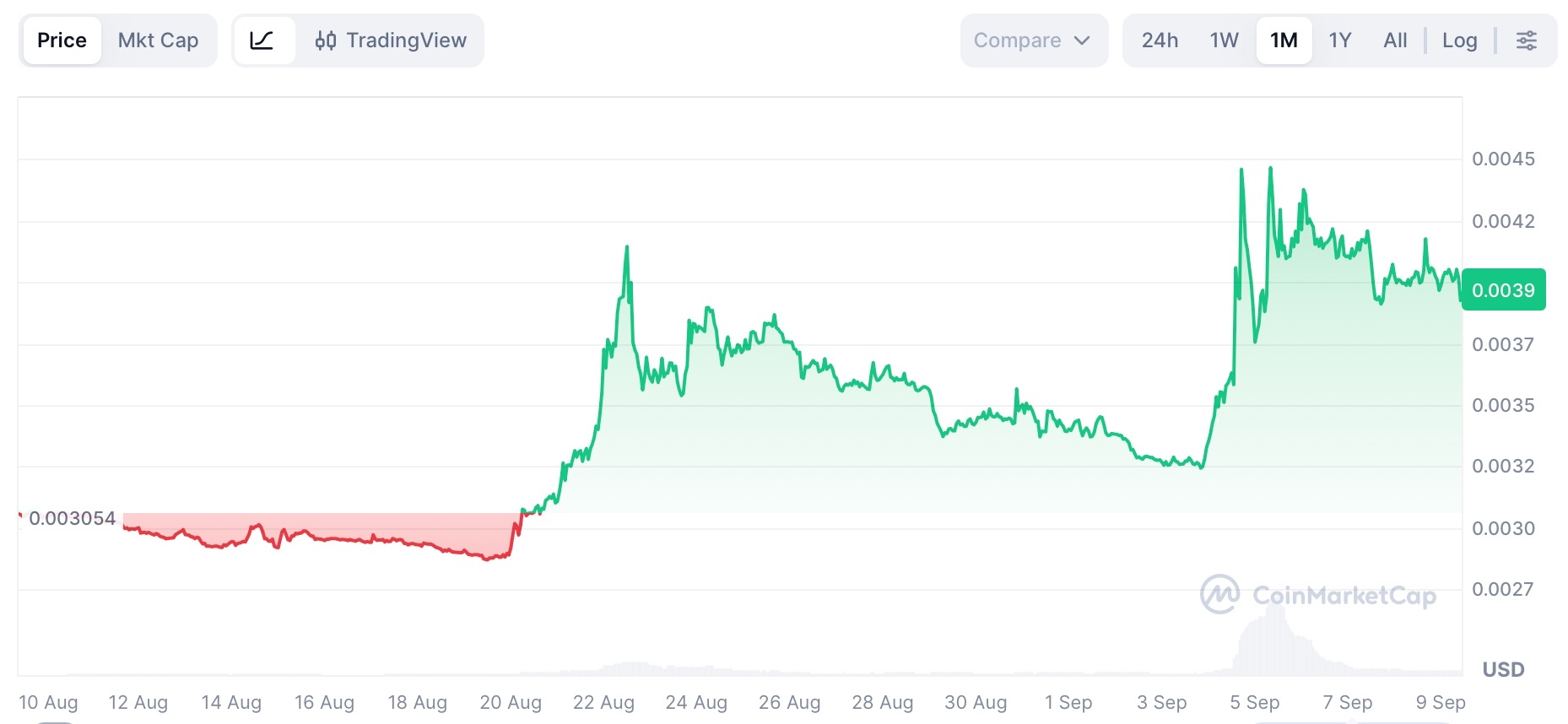
XCN traded near $0.00326 on September 2 before climbing above $0.004 during the following sessions. It closed around $0.00436 on September 4 and remained close to $0.004 on September 7.
Trading activity rose much faster than the price. XCN’s daily volume reached approximately $82.4 million on September 5, compared with less than $3 million at the beginning of the month. By September 8, volume had fallen back to roughly $4.6 million.
The timing points to OIP-4 as the most credible explanation for the move. This rally was different from the brief August bounce, which occurred without a significant Onyx announcement.
It was not a clean breakout, however. The rapid decline in volume suggests that much of the initial interest came from traders responding to the acquisition proposal. Holding the higher range will require demand that lasts beyond the governance event.
What Onyx Plans to Acquire
On September 1, Onyx announced that it had entered into a definitive agreement to acquire Chain’s technology and intellectual property.
Chain has developed infrastructure spanning wallets, stablecoin payments, financial accounts, ledger systems, card services and connections to traditional financial networks. Onyx intends to bring those components into its existing ecosystem.
The proposed structure is relatively easy to understand. Onyx Layer 1 would provide the blockchain and settlement network. Onyx Wallet would act as the user interface. Chain’s technology could supply payment, stablecoin and traditional finance connectivity.
The long-term plan includes supported stablecoin balances, transfers, financial applications and debit card functionality inside the wallet. According to the Onyx announcement, the aim is to make blockchain settlement part of the underlying financial infrastructure without requiring users to manage every technical step themselves.
That is a more focused product proposition than simply describing Onyx as an institutional blockchain. It also puts the project into a competitive market that already includes crypto cards, stablecoin payment companies, digital wallets and established neobanks.
OIP-4 Has Advanced, but the Acquisition Is Not Complete
The agreement required approval from the Onyx DAO. Holders of staked XCN were able to vote through OIP-4, and the proposal subsequently entered the governance execution queue.
Onyx’s governance system places approved proposals in a timelock before they become executable. Community updates indicated that OIP-4 reached that stage around September 6. Onyx governance records show the proposal moving beyond voting and into the execution process.
This does not prove that the acquisition has closed.
Onyx has said the transaction remains subject to the required governance process and satisfaction of the conditions in the definitive agreement. The project has not publicly provided a complete purchase price, financing structure, liability breakdown or integration schedule.
Until a closing announcement appears, the accurate description is that Onyx has agreed to acquire Chain’s technology and has advanced the proposal through governance. Saying that Onyx already owns those assets would go beyond the available evidence.
Why the Neobank Plan Matters for XCN

XCN already has several functions within the Onyx ecosystem. It is used for network fees, staking and governance. Those roles give the token technical utility, but utility only creates meaningful demand when the underlying network is used.
A functioning financial application could broaden that demand. Payments and stablecoin transfers generate recurring activity in a way that roadmap announcements do not. If the planned neobank attracts users, XCN could benefit from network fees, staking requirements and participation in governance.
The word “if” carries most of the weight.
Onyx has not yet disclosed how much XCN users would need to interact with the neobank, whether fees could be paid through other assets or how financial activity would translate into token demand. A consumer product may use Onyx infrastructure while hiding XCN from the user entirely.
That could improve the customer experience without necessarily producing the level of token demand implied by bullish price expectations.
Onyx Is Building, but Adoption Remains Difficult to Measure
Onyx has delivered more infrastructure than its weak price history might suggest. Its Layer 1 network, Mesh architecture, wallet, bridge, staking and onchain governance are operating in some form. Passkey support was also added to Onyx Wallet in early September.
Development is therefore not the central concern. The question is whether these products are attracting activity outside the existing XCN community.
Onyx Markets still displays only a small number of active markets. Individual swaps confirm that the network is functioning, but the available activity does not yet resemble a widely used financial ecosystem.
The neobank thesis needs evidence that can be measured: active accounts, payment volume, stablecoin balances, card transactions, outside developers and identifiable business integrations. None of those figures has been published at a scale that validates the current ambition.
Token Emissions Remain Part of the XCN Valuation
Onyx’s official distribution schedule says the XCN Timelock releases 200 million tokens every 30 days through March 1, 2030.
A separate DAO contract has a monthly distribution allowance of up to 200 million XCN. Those tokens are released when users claim rewards or when approved governance proposals require funding. Unused capacity can roll into later months.
An unlock is not the same as a sale. Released tokens only create direct selling pressure if recipients move them into the market. Even so, recurring emissions matter when organic demand remains limited.
Third-party trackers currently disagree about the date of the next XCN unlock. One points to September 15, while another identifies September 30.
A Better Story Still Needs Better Numbers
Onyxcoin is no longer trading only on vague claims about enterprise blockchain infrastructure. The proposed Chain acquisition gives the project a recognizable product direction and helps explain why XCN recovered from its August lows.
It also raises the standard by which Onyx should be judged.
A neobank needs customers, financial partners, compliant payment infrastructure and a product people are willing to use. The acquisition proposal may give Onyx useful technology, but it does not guarantee that the project can turn that technology into a competitive financial service.
XCN’s September rally reflects a more credible narrative. Whether it becomes a lasting revaluation will depend on transaction completion, product delivery and measurable adoption.
Readers tracking XCN and other emerging crypto narratives can explore market coverage through Tapbit. Log in to access an existing account or register with Tapbit to get started.
Frequently Asked Questions
Why did Onyxcoin rise in September 2026?
XCN rose after Onyx announced an agreement to acquire Chain’s technology and intellectual property. The proposed acquisition would support a blockchain-native neobank built around Onyx Layer 1, Onyx Wallet, stablecoins and payment services.
Has Onyx completed the Chain acquisition?
A completed acquisition has not yet been publicly confirmed. The agreement and OIP-4 governance process have advanced, but Onyx has said the transaction remains subject to approval, execution and satisfaction of its closing conditions.
What is OIP-4?
OIP-4 is the Onyx governance proposal covering the acquisition of Chain Technology and its intellectual property. Staked XCN holders participated in the vote, after which the proposal entered the execution queue.


