
World Liberty Financial has built one of the largest politically connected crypto brands in the market. Its USD1 stablecoin has grown to more than $4 billion in circulation, while the project has expanded into lending, payments and multichain infrastructure.
The WLFI token has followed a very different path. As of August 3, 2026, WLFI was trading near $0.055, approximately 83% below its record high. The contrast raises an important question: why has the growth of USD1 not produced stronger demand for WLFI?
The answer involves token supply, limited value capture and an unresolved debate over what WLFI holders actually receive from the ecosystem’s growth.
WLFI Remains Close to Its Record Low
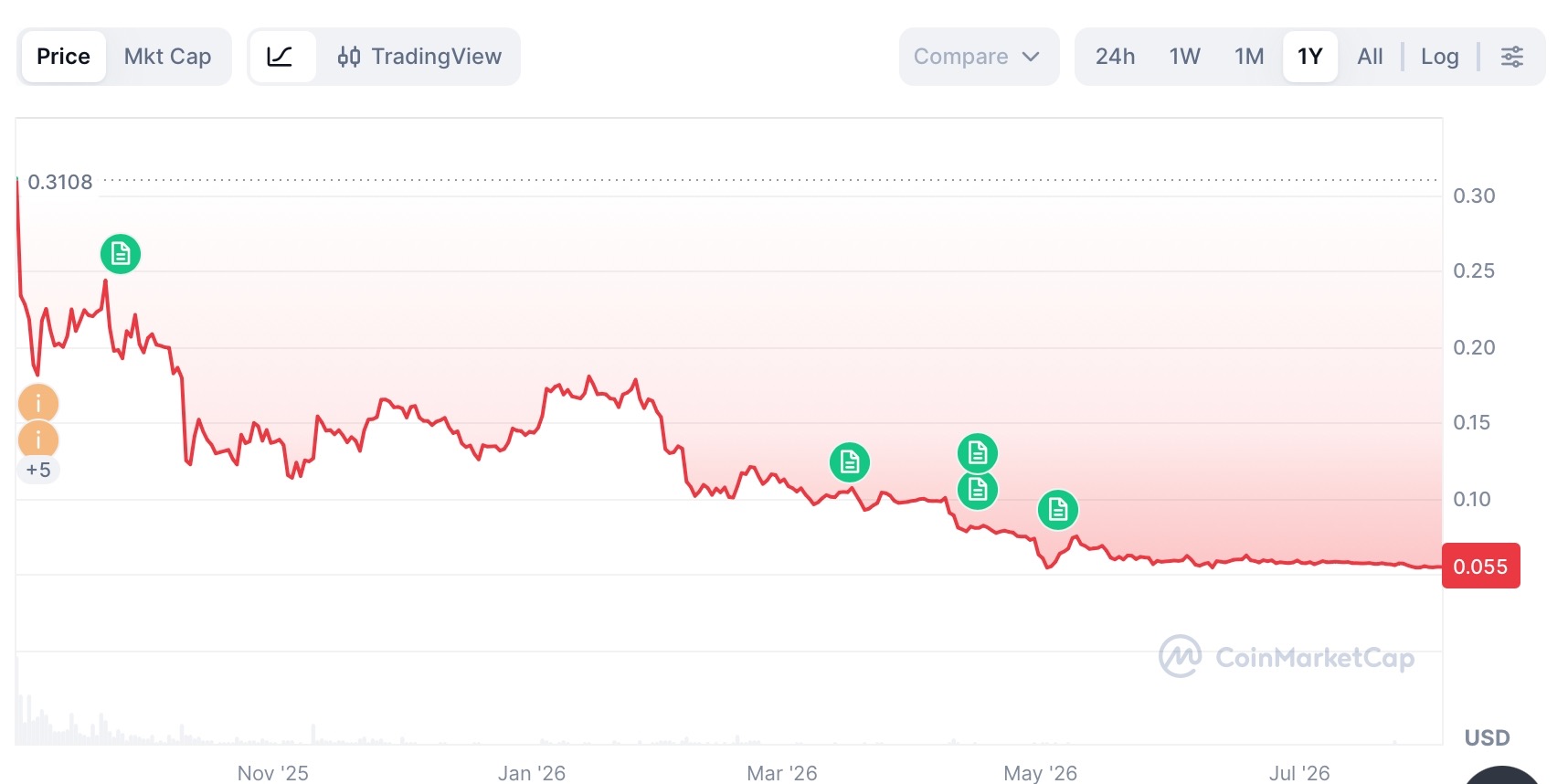
WLFI was trading at approximately $0.0551 at the time of writing, with a market capitalization of around $1.78 billion and daily trading volume of about $32 million. Its circulating supply stood near 31.78 billion tokens, compared with a maximum supply of 100 billion.
The token had recovered slightly over the previous 24 hours but remained close to the record low of approximately $0.0516 reached on July 23. It was also still roughly 83% below its $0.3313 peak.
This price structure does not confirm that WLFI has reached a final bottom. A token can remain near historical lows for an extended period when available supply grows faster than new demand.
WLFI’s fully diluted valuation also remains considerably higher than its circulating market capitalization because a large percentage of the 100 billion maximum supply is not yet freely tradable.
Why August 12 Matters for WLFI
One of the most important near-term events involves WLFI tokens held by AI Financial Corporation, or AiFi.
A June 10 filing with the US Securities and Exchange Commission disclosed that AiFi holds two WLFI allocations totaling approximately 6.91 billion tokens. The company expects these tokens to become fully transferable on August 12, 2026.
At WLFI’s current price, that position would be worth roughly $386 million. The number of tokens is equivalent to about 21.7% of WLFI’s currently reported circulating supply.
However, this should not be described as a confirmed sale or a standard market-wide token unlock.
AiFi stated that the availability of the tokens should not be interpreted as an intention to sell. The company may instead use some of the holdings for collateral, staking, lending or other strategic purposes.
Even without an immediate sale, full transferability can affect market expectations. Traders may price in the possibility of future sales, collateralized borrowing or liquidation risk. The market will therefore be watching AiFi-linked wallets and exchange inflows around August 12.
The Broader WLFI Unlock Picture Is More Complicated
World Liberty Financial is also discussing a much larger vesting proposal covering approximately 62.28 billion WLFI. The proposal includes around 17.04 billion tokens allocated to early supporters and 45.24 billion allocated to founders, team members, advisers and partners.
Under the proposed terms, early supporter tokens would face a two-year cliff followed by two years of linear vesting. Founder, team, adviser and partner allocations could enter a two-year cliff followed by three years of vesting. Participants in the second group would also accept a possible burn of up to 4.52 billion WLFI.
Holders who do not accept the new schedule would remain locked indefinitely under the proposal.
This suggests that the wider supply overhang is not necessarily about billions of tokens entering the market immediately. The larger concern is uncertainty. Investors still need clear information about which proposals have passed, which holders have opted in and when each allocation can become transferable.
USD1 Is Growing Faster Than WLFI

The strongest part of the World Liberty Financial ecosystem is currently USD1.
USD1 had an on-chain market capitalization of approximately $4.15 billion at the time of review. The stablecoin is backed by reserves that include short-term US government securities, dollar deposits and other cash equivalents held through BitGo-related entities.
World Liberty Financial has also connected USD1 with centralized exchanges, lending applications and several blockchain networks. That growth gives the project a recognizable product beyond political branding.
But USD1 adoption does not automatically create WLFI demand. WLFI is primarily a governance token. It does not represent equity in World Liberty Financial, ownership of USD1 reserves or a direct claim on the revenue generated by those reserves. A trader can use USD1 without buying or holding WLFI.
The relationship may become stronger if WLFI is required for governance staking, access to specific products or other ecosystem functions. Several proposals have discussed these possibilities, but planned utility should not be treated as established demand before it is implemented and widely used.
Governance Has Become a Market Risk
WLFI’s governance structure has come under increased scrutiny following the dispute between World Liberty Financial and TRON founder Justin Sun.
Sun sued World Liberty Financial in April, alleging that the project wrongfully froze his WLFI holdings and restricted his governance rights. He asked the court to prevent the tokens from being seized, destroyed or further restricted.
World Liberty Financial later filed a defamation lawsuit against Sun. The company alleged that he had improperly transferred tokens and participated in activity intended to push WLFI’s price lower. Sun denied those accusations.
The competing claims have not been resolved. They should therefore be presented as allegations rather than established facts.
For the market, the dispute raises a broader question: how meaningful are token-holder governance rights if the issuer can restrict certain wallets under its published terms?
Clear rules around freezes, voting eligibility and token transfers will be important if World Liberty Financial wants WLFI to be valued as a functional governance asset rather than a politically driven speculative token.
Political Attention Can Increase Volatility
World Liberty Financial remains closely associated with US President Donald Trump and members of his family. That connection helped the project attract attention, but it also exposes WLFI to political and regulatory headlines.
In July, Democratic lawmakers continued to question World Liberty Financial’s ownership, revenues and possible conflicts of interest. Debate over the ethics provisions in US crypto market structure legislation also kept the company in the political spotlight.
These inquiries do not prove wrongdoing. They do, however, create an additional source of uncertainty that most governance tokens do not face.
WLFI may react to developments in Washington even when those events do not change the protocol’s technology, token supply or user activity. Political branding can attract liquidity during favorable periods, but it can amplify downside volatility when sentiment turns.
What Could Support a WLFI Recovery?
USD1 growth alone may not be enough. A more durable WLFI recovery would likely require evidence that ecosystem activity creates recurring demand for the governance token.
That could include active governance staking, broader participation in voting, transparent token burns or product access that requires WLFI. Investors would also benefit from clearer reporting on unlock schedules, treasury holdings and large-wallet movements.
The August 12 transferability event will provide an early test. If the newly transferable AiFi holdings remain off exchanges and are used without creating visible selling pressure, some supply concerns may ease. Large deposits to trading venues or collateral liquidations could produce the opposite reaction.
Price confirmation will still matter. A brief rebound from the current low would not establish a lasting reversal without stronger volume, improved liquidity and follow-through above previous resistance areas.
Traders monitoring WLFI and other digital assets can follow market activity through Tapbit. Existing users can access their accounts through the Tapbit login page, while new users can register here.
Conclusion
WLFI’s decline is not simply a story about fading political attention. It reflects a deeper gap between the growth of the World Liberty Financial ecosystem and the value currently captured by its governance token.
USD1 has reached a market capitalization of more than $4 billion, but WLFI remains close to its historical low. The August 12 transferability event, the proposed long-term vesting structure and the unresolved Justin Sun dispute will all shape the next phase of market sentiment.
The most important question is not whether World Liberty Financial can continue expanding USD1. It is whether that expansion can create transparent, recurring and measurable demand for WLFI.
Cryptocurrency trading involves substantial risk. Market prices can change rapidly, and historical performance does not guarantee future results. This article is for informational purposes only and does not constitute investment advice.
Frequently Asked Questions
What is WLFI?
WLFI is the governance token of the World Liberty Financial ecosystem. It allows eligible holders to participate in certain governance decisions. It does not represent equity in World Liberty Financial or a direct claim on the reserves and income associated with USD1.
Why has the WLFI price fallen so much?
WLFI has faced weak secondary-market demand, uncertainty over future token supply, governance concerns and declining enthusiasm for politically linked crypto assets. Its price also reflects the wider decline in the crypto market. At the time of writing, WLFI was approximately 83% below its historical high.
What will happen to WLFI on August 12, 2026?
AI Financial Corporation expects approximately 6.91 billion WLFI tokens in its holdings to become fully transferable on August 12. This means the tokens may be transferred or used more freely, but it does not mean they will automatically be sold.


