
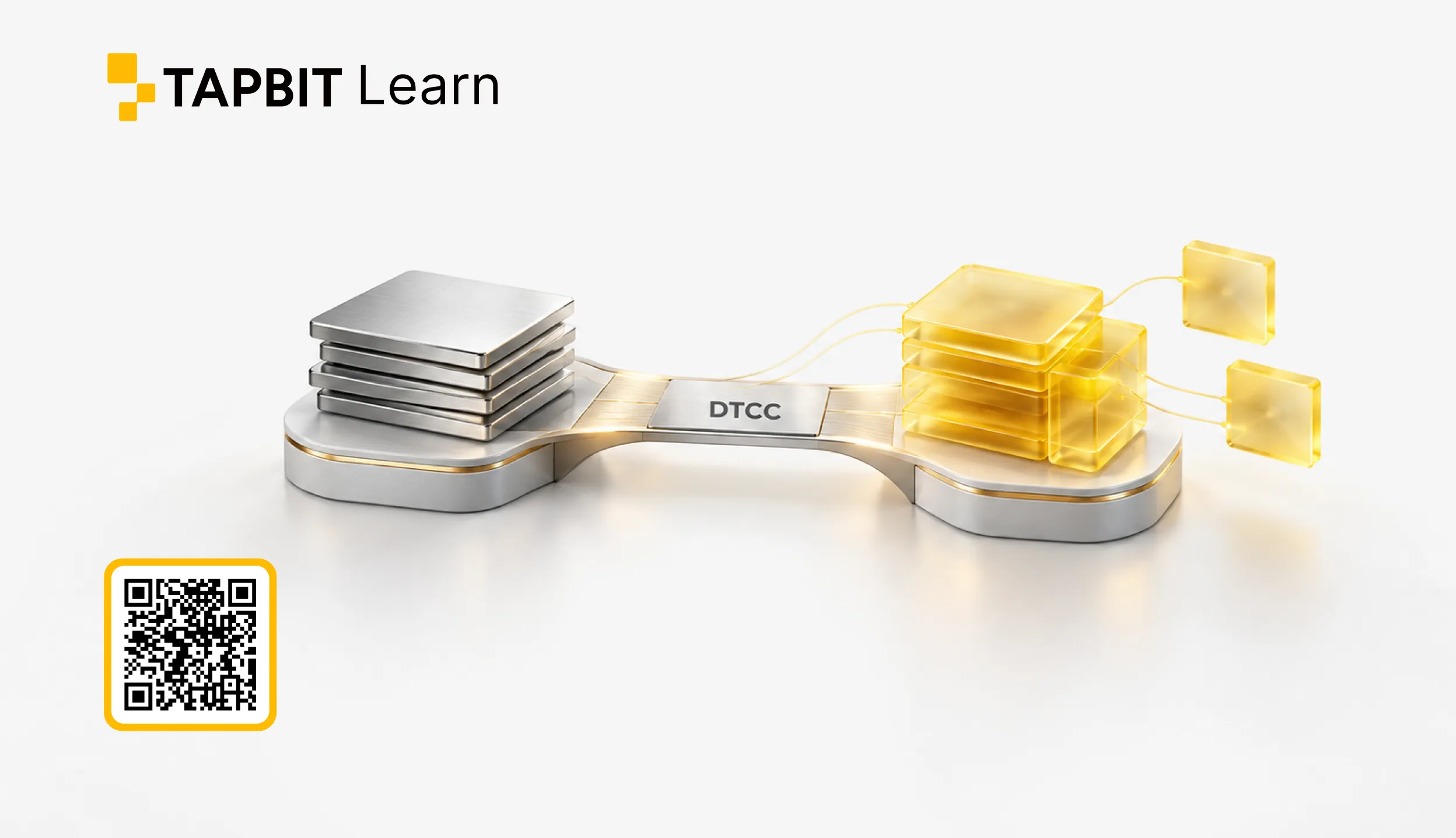
What Is DTCC Tokenization?
DTCC tokenization is a regulated process for representing eligible, traditionally held securities as blockchain-based entitlements. The underlying asset remains a stock, ETF or U.S. Treasury security. The blockchain token changes how the ownership record can be held and delivered; it does not replace the asset with an unrelated crypto token.
DTCC is the Depository Trust & Clearing Corporation, a major provider of post-trade market infrastructure. Its subsidiary, the Depository Trust Company, or DTC, holds securities and processes changes in ownership after trades occur. DTCC is not a stock exchange and does not decide the market price of a share.
In May 2026, DTCC said it planned to launch DTC’s tokenization service in October 2026 after limited production activity. Unless DTCC publishes a separate confirmation, this timing should be described as a plan rather than a completed launch.
What Does DTCC Do in Traditional Markets?
A stock trade contains several stages that are easy to combine in everyday language. First, an investor submits an order through a broker. A trading venue matches the buy and sell orders. Clearing then calculates what each party must deliver. Settlement completes the exchange of securities and cash, while custody systems update the ownership records.
DTCC subsidiaries sit mainly in these post-trade stages. DTC acts as a central securities depository, allowing ownership to change through electronic book entries instead of repeatedly moving paper certificates. DTCC reported that DTC held more than $114 trillion of assets in custody when it described the new tokenization service.
This existing position is important. A new blockchain platform can create a token, but it still needs a dependable connection to the legally recognized asset. DTC begins with assets already held inside established market infrastructure.
How Does DTCC Tokenization Work?

The process starts with an eligible security held through DTC. An eligible DTC participant requests tokenized delivery and provides the required instructions. Depending on the workflow, those instructions can include the selected blockchain and a registered digital-wallet address.
DTC then represents the participant’s entitlement in tokenized form. The token is not meant to be a second, economically different share. It represents the same regulated ownership position using blockchain infrastructure. The entitlement may later be transferred within the approved system or converted back into a traditional book-entry position through de-tokenization.
The approved Nasdaq structure adds an important detail: tokenization is a post-trade instruction. Traditional and tokenized orders can use the same order book and execution priority. After a trade is executed, the participant’s tokenization preference is sent to DTC for settlement processing.
Which Assets Can Be Tokenized?
The SEC no-action framework described by DTCC covers a defined group of liquid assets. These include constituents of the Russell 1000, ETFs that track major indices and U.S. Treasury bills, notes and bonds.
The restricted scope allows market infrastructure, wallets, controls and cross-chain processes to be tested with widely followed securities. It does not mean every private company share, small-cap stock, foreign security or crypto asset automatically qualifies.
DTCC also convened more than 50 firms from traditional finance and digital assets to work on operational standards. The group included custodians, asset managers, brokers, trading venues, technology companies and blockchain businesses. The range shows that tokenization requires more than minting: custody, compliance, wallet controls, reporting and interoperability must work together.
Do Tokenized Securities Preserve Investor Rights?
Investor rights are the central difference between DTC’s model and many price-tracking stock tokens. Under the approved Nasdaq proposal, a tokenized eligible security must be fungible with the traditional version, share its CUSIP and ticker, and provide the same rights and privileges.
Those rights include an equity interest in the company, applicable dividends, voting rights and a claim on residual assets if the company is liquidated. A tokenized share and its traditional counterpart would also use the same Nasdaq order book and execution priority.
This parity prevents tokenization from quietly changing a shareholder into an unsecured customer of a token issuer. It also keeps market surveillance and established securities rules connected to the transaction.
Does DTCC Tokenization Mean Instant Settlement?
No. Blockchain can support faster, more programmable asset delivery, but tokenization does not automatically cancel the legal, funding and risk processes surrounding a securities trade.
Under the approved Nasdaq framework, tokenized trades continue to settle on a T+1 basis. That means settlement is scheduled for one business day after the trade date. Nasdaq’s matching engine handles the trade in the same way whether the participant requests traditional or tokenized settlement; the format preference reaches DTC after execution.
This distinction separates four concepts. Trading hours determine when orders may be submitted. Matching creates the trade. Clearing calculates obligations. Settlement completes the exchange of cash and securities. A blockchain can improve the final ownership and delivery layer without immediately making every earlier stage continuous or instantaneous.
DTCC Tokenization vs. Crypto-Native Stock Tokens
| Feature | DTC tokenized security | Conventional share | Price-tracking stock token |
|---|---|---|---|
| Underlying position | DTC-custodied regulated security | Regulated security | Depends on issuer structure |
| Direct ownership rights | Designed to match the traditional share | Yes | May not provide them |
| Voting and dividends | Preserved where applicable | Preserved where applicable | Depends on product terms |
| Execution | Same Nasdaq order book under the approved proposal | Traditional exchange order book | Platform-specific market |
| Settlement | T+1 under the current Nasdaq structure | Generally T+1 in U.S. equities | Platform-specific |
| Blockchain record | Yes | No tokenized form | Yes |
Why Is Wall Street Moving Assets On-Chain?
The first benefit is interoperability. A standardized tokenized entitlement can be designed to move across approved systems while retaining a clear link to the security in custody. DTCC said its working group was testing how DTC tokenized assets could operate across multiple chains.
The second benefit is collateral mobility. Banks and brokers hold large pools of securities that may serve as collateral. A controlled blockchain record could make it easier to identify, transfer and program those assets across connected financial processes, reducing repeated reconciliation between separate databases.
The third benefit is programmability. Compliance rules, wallet eligibility and transaction instructions can be incorporated into the operating workflow. That does not remove intermediaries or regulation; it gives them a different technical layer.
Longer trading hours and faster settlement may develop from this infrastructure, but neither is guaranteed by tokenization alone. Market rules, cash availability, liquidity providers and risk systems must also support the change.
Following Tokenized Stock Themes on Tapbit
Tokenization is closely linked to companies building brokerage and digital-asset infrastructure. Traders can follow parts of this theme through verified Tapbit perpetual futures such as HOOD-USDT and NVDA-USDT.

These contracts are not DTC tokenized shares. They provide price exposure through perpetual futures and do not give holders voting rights, dividends or direct ownership in Robinhood or Nvidia. The distinction matters because “stock-linked,” “tokenized stock” and “stock futures” describe different legal and economic products.
How to Trade a Stock Market Theme on Tapbit
FAQ
Is DTCC a blockchain?
No. DTCC is financial market infrastructure. Its DTC subsidiary is developing a service that uses blockchain to represent eligible securities.
Does a DTC tokenized stock represent real ownership?
Under the approved structure, an eligible tokenized share is designed to carry the same ownership, dividend, voting and residual rights as its traditional counterpart.
Are DTCC tokenized securities traded 24/7?
Tokenization alone does not create 24/7 exchange trading. Trading hours depend on the venue and applicable market rules.
Is a tokenized stock the same as a stock futures contract?
No. A tokenized stock can represent ownership in the underlying share. A futures or perpetual contract provides derivative price exposure without direct shareholder rights.


