
GameStop became the center of the 2021 meme-stock movement, when retail traders gathered online, challenged heavily shorted positions and turned a struggling video game retailer into a symbol of market rebellion.
Five years later, that story has returned in a different form.
A community-created token called GME has appeared on Robinhood Chain, the Layer 2 network launched by Robinhood in July 2026. The token uses GameStop imagery and references the conflict between retail traders and brokerage platforms, but it is not GameStop stock. It is also not an official token issued or endorsed by Robinhood.
The distinction matters because Robinhood Chain supports several very different types of assets. It hosts official Stock Tokens designed to provide economic exposure to securities. It also operates as a permissionless blockchain where independent developers can create ordinary crypto tokens without Robinhood’s approval.
The GME memecoin belongs to the second category. Its early price surge attracted traders, but that momentum did not last. The token’s current market capitalization is roughly 99% below the approximately $21 million figure cited during its initial burst of attention. Liquidity in its main trading pool is also limited.
For traders, the lesson is not simply that GME went up and then fell. It is that a familiar ticker, a popular narrative and deployment on a well-known company’s blockchain do not create official backing or underlying asset rights.
What Is the GME Memecoin?
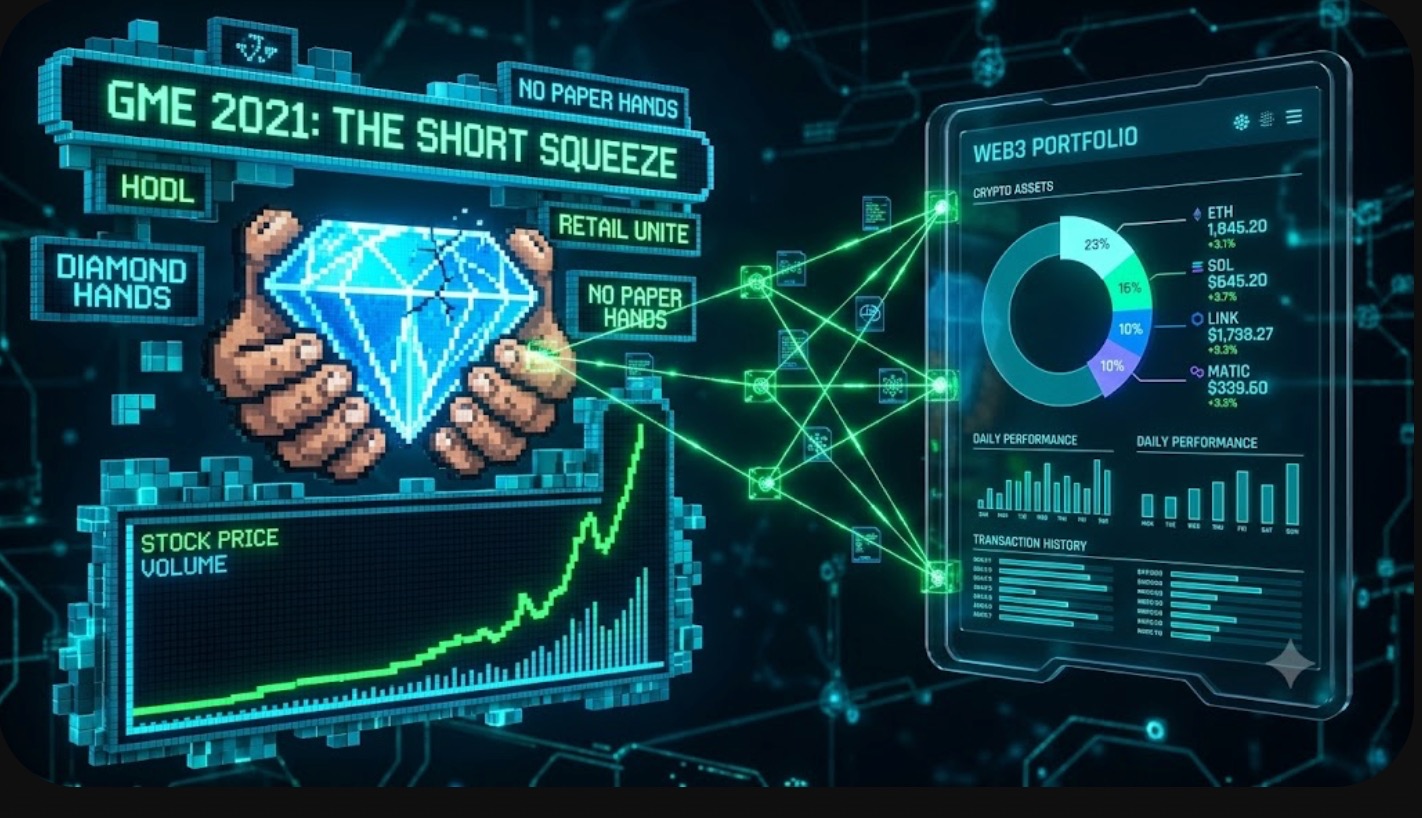
GME is an independently issued ERC-20-style memecoin deployed on Robinhood Chain.
The project is built around the culture of the 2021 GameStop trading event. Its website uses phrases associated with the original movement, including “diamond hands,” “we like the coin” and references to Robinhood’s decision to restrict certain GameStop purchases during the 2021 volatility.
However, its own disclaimer is unusually direct.
The website states that GME:
-
is a memecoin;
-
has no intrinsic value or expectation of financial return;
-
has no formal team or conventional roadmap;
-
is not a stock or security;
-
and is not affiliated with GameStop, Robinhood or Keith Gill.
Those statements make the token’s status relatively clear: it is a speculative community asset, not a claim on a business or investment portfolio.
Robinhood Chain Does Not Automatically Endorse Its Tokens
Robinhood launched the public mainnet of Robinhood Chain on July 1, 2026. The network is an Ethereum-compatible Layer 2 built using Arbitrum technology. It uses ETH for gas and is designed to support tokenized real-world assets, decentralized finance and other on-chain applications.
More importantly, Robinhood Chain is permissionless.
Robinhood’s documentation says anyone can interact with the network, build applications and deploy smart contracts. Standard Ethereum tools can be used to create and deploy tokens without requesting Robinhood’s approval.
That openness is a normal feature of public blockchain infrastructure.
Ethereum does not officially endorse every Ethereum token. Solana does not endorse every Solana memecoin. The same principle applies to Robinhood Chain.
Robinhood’s own documentation says that even inclusion of third-party applications in its ecosystem materials should not be interpreted as endorsement, affiliation, sponsorship or a warranty of safety.
Therefore, describing GME as “Robinhood’s GME token” would be inaccurate. The more precise description is: GME is a third-party memecoin deployed permissionlessly on Robinhood Chain.
GME Memecoin Is Not GameStop Stock
Holding the GME memecoin does not provide ownership in GameStop Corp.
It does not give holders:
-
voting rights in GameStop;
-
entitlement to GameStop dividends;
-
shareholder information rights;
-
a claim on GameStop’s assets;
-
or legal protection as a GameStop shareholder.
The project’s use of the GME ticker is cultural and promotional. It refers to the meme-stock story, not to an ownership relationship with the company. This distinction is especially important because Robinhood Chain also supports a separate Robinhood Stock Token linked to GameStop.
That official product and the community memecoin are not the same asset.
Why Did the GME Memecoin Attract So Much Attention?
GME combined several powerful speculative narratives at the same time.
The GameStop Story
The original GameStop event remains one of the best-known moments in retail trading history. It introduced terms such as “diamond hands” and “meme stock” to a much wider audience.
A token using the GME ticker therefore begins with instant name recognition.
The Robinhood Connection
Robinhood played a controversial role in the 2021 event after restricting purchases of certain securities during extreme volatility.
Launching a GME-themed memecoin on Robinhood’s own blockchain creates an ironic and emotionally charged story. The project’s website deliberately leans into that contrast.
A New Blockchain
New blockchain launches frequently attract speculative capital.
Early users search for the first native memecoin, DEX, lending protocol or community asset that could become closely associated with the network. Robinhood Chain’s July mainnet launch created exactly that type of environment.
Extreme Early Price Momentum
The original article reported that GME briefly reached a market capitalization of approximately $21 million, with about $2.2 million in liquidity and $12.3 million in 24-hour trading volume. It also cited a daily increase of more than 2,100%.
Rapid price appreciation often becomes its own marketing engine. Traders see the chart, social activity increases and more capital enters because of the recent performance rather than because the asset has developed new utility.
That same mechanism can work in reverse when early participants begin taking profits.
What Happened After the Initial Surge?
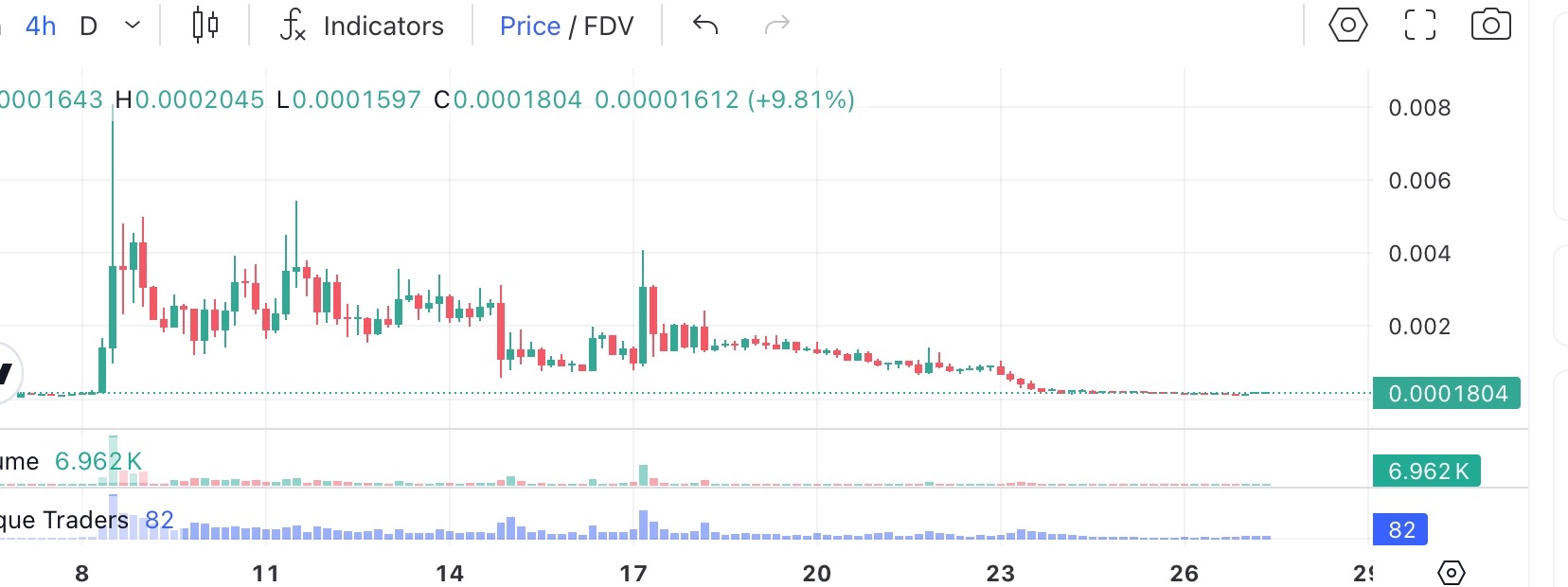
GME’s latest on-chain data looks very different from its launch-period snapshot.
At the time of writing, GeckoTerminal showed:
-
a price near $0.000188;
-
market capitalization and fully diluted valuation near $176,700;
-
about $42,200 in main-pool liquidity;
-
approximately 2,524 holders;
-
and roughly $109,700 in 24-hour trading volume.
DEX Screener showed a similar market capitalization of around $181,000 and liquidity near $42,000, although its reported volume differed because of update timing and data methodology.
These figures change continuously, particularly for a low-liquidity memecoin. They should be treated as a market snapshot rather than permanent characteristics.
Still, the difference from the earlier approximately $21 million valuation is substantial. Using the two snapshots, GME’s nominal market capitalization has fallen by roughly 99% from the figure cited during its early surge.
That decline does not by itself prove fraud or contract abuse. It demonstrates how quickly a memecoin valuation can disappear when attention, momentum and incoming liquidity weaken.
Contract Verification Still Matters
GeckoTerminal’s automated security page reported that it did not detect a honeypot or proxy in the contract and assigned the pool a security score near 59 out of 100. It also noted that the contract was verified.
Automated scanners are useful for initial screening, but they are not guarantees.
Before interacting with an unfamiliar token, traders should still examine:
-
whether more tokens can be minted;
-
whether transfers can be paused;
-
whether wallets can be blacklisted;
-
whether ownership has been renounced;
-
whether the contract can be upgraded;
-
whether taxes can be changed;
-
and how the largest wallets acquired their holdings.
Different explorers and scanners may interpret proxy or permission structures differently. When data sources conflict, uncertainty should be treated as risk rather than ignored.
Can Buying the GME Memecoin Cause a GameStop Short Squeeze?
There is no verified mechanism showing that purchases of the GME memecoin automatically create buying pressure in GameStop’s publicly traded shares.
The memecoin and the official Robinhood Stock Token are separate contracts. The primary GME memecoin pool tracked by GeckoTerminal is a GME/WETH pool, not a direct pool containing ordinary GameStop shares.
Even Robinhood’s official GameStop-linked Stock Token does not provide direct legal ownership of the underlying company. It is a tokenized debt security offering economic exposure under Robinhood’s product structure.
Claims that buying the memecoin must force the purchase of actual GameStop shares therefore require evidence about:
-
the exact liquidity-pool structure;
-
who provides or rebalances the assets;
-
how the official token is minted and redeemed;
-
and whether any transaction creates an obligation to purchase the underlying stock.
Without that evidence, the “on-chain short squeeze” argument should be treated as an unverified social-media narrative.
Tapbit View
GME is an example of what happens when traditional market culture meets permissionless blockchain infrastructure. Robinhood Chain was designed partly for tokenized financial assets, but its open architecture also allows independent communities to issue ordinary crypto tokens.
That openness creates opportunities for experimentation. It also places more responsibility on users.
The GME memecoin is not GameStop stock, does not provide shareholder rights and is not an official Robinhood Stock Token. Its project website openly describes it as a memecoin with no intrinsic value or formal roadmap.
Its early surge demonstrated the strength of the GameStop narrative. Its subsequent decline demonstrated the limits of attention without deep liquidity or utility.
For Tapbit users, the most important lesson is simple: A well-known ticker can attract buyers, but only the contract and legal structure reveal what an asset actually is.
Traders can track live market conditions through the Tapbit homepage. Existing users can access their accounts through Tapbit login, while new users can begin from the Tapbit registration page.
Frequently Asked Questions
What is GME on Robinhood Chain?
GME is an independently created memecoin deployed on Robinhood Chain. It is inspired by the GameStop trading movement but does not represent GameStop shares or an official Robinhood product.
What is the GME memecoin contract address?
The contract address published by the project and reflected by major on-chain trackers is:
0x7e86381A763F0Ecca2bDF27C54eAC403ddD48123
Is GME an official Robinhood token?
No. Robinhood Chain is permissionless, meaning independent developers can deploy tokens without Robinhood’s approval. Robinhood’s official documentation says matching names or tickers do not establish that a token is an official Stock Token.


