
USDf is Falcon Finance's synthetic dollar: an onchain asset designed to track the U.S. dollar while being created against eligible collateral. The lowercase “f” is part of the official styling. USDf is different from USDF-branded products issued by other organizations.
The easiest way to understand USDf is to compare it with a collateralized loan. A user supplies an approved asset, the protocol applies its collateral rules, and USDf is minted against that position. The deposited asset supports the system while the user receives dollar-denominated liquidity.
How Does Falcon Finance Create USDf?
Falcon Finance lists eligible collateral and assigns parameters based on the asset's liquidity and risk. A user deposits collateral through the protocol and mints USDf within the allowed limit. Overcollateralization means the deposited value is intended to exceed the USDf issued against it.
The extra value acts as a buffer. If collateral prices fall, the system needs mechanisms that preserve backing and manage weak positions. Exact parameters can change, so users should read the current protocol interface and documentation before minting.
What Assets Can Back USDf?
Falcon's broader model is described as universal collateralization. It has discussed crypto assets and tokenized real-world assets as potential collateral categories. Different assets do not carry identical risk. A liquid major crypto asset behaves differently from a tokenized credit instrument or stock-linked asset.
Collateral quality depends on price transparency, market depth, custody, redemption rights and how quickly a position can be unwound. Diversity can reduce reliance on one asset, but it also makes monitoring more complex.
What Is the Difference Between USDf and sUSDf?
USDf is the synthetic dollar used for liquidity and settlement. sUSDf is the yield-bearing representation received when USDf is placed into an eligible Falcon staking or yield route. The value of sUSDf can reflect principal plus accumulated yield according to the product rules.
| Asset | Main role | What supports value |
|---|---|---|
| USDf | Synthetic dollar and liquidity asset | Protocol collateral and redemption mechanisms |
| sUSDf | Yield-bearing USDf position | Deposited USDf plus strategy performance |
| FF | Protocol governance and ecosystem token | Governance, staking and ecosystem demand |
How Is USDf Different From USDT and USDC?
USDT and USDC are centrally issued stablecoins supported by reserves held by their issuers. USDf is minted through an onchain collateral system. Both models aim for dollar stability, but their backing, counterparties and risk controls are different.
For a reserve-backed token, readers examine reserve assets, issuer reporting and redemption. For a synthetic dollar, they also examine collateral ratios, smart contracts, liquidation or hedging systems, market liquidity and protocol governance.
What Is USDf Used For?
- Unlocking dollar liquidity without immediately selling eligible collateral.
- Moving value through supported DeFi markets.
- Providing liquidity in approved pools and applications.
- Entering sUSDf or other supported yield routes.
- Settling payments where USDf is accepted.
What Keeps USDf Near One Dollar?
A stable price depends on minting, redemption and market liquidity. When eligible participants can create or redeem the asset efficiently, price differences can attract arbitrage. Deep secondary-market liquidity helps that adjustment happen with less slippage.
The peg should be assessed as a range over time, not one price print. Persistent discounts, thin liquidity or slower redemptions deserve more attention than a brief move during a volatile market.
Which USDf Metrics Matter?
Track total supply, collateral composition, collateralization, onchain liquidity, redemption activity and the concentration of major holders or pools. For sUSDf, also examine how yield is generated and whether the return changes with market conditions.
USDf combines stable-value design with collateral efficiency. Its usefulness grows when users can mint, redeem and deploy it across applications without losing clarity about the assets and mechanisms supporting it.
How Overcollateralization Protects USDf

Suppose a position deposits $150 of eligible collateral and mints $100 of USDf. The extra $50 creates a buffer against price movement. If collateral falls, the buffer shrinks. Protocol rules may require the user to add collateral, repay USDf or allow the position to be closed according to the current mechanism.
The size of a safe buffer depends on volatility and liquidity. A highly liquid asset can usually be sold with less price impact than a thin token. That is why protocols apply different collateral parameters rather than treating every asset as equal. Readers should check asset-specific ratios and current redemption rules, not only the system-wide collateral figure.
How to Evaluate sUSDf Yield
A yield percentage is the result of an underlying strategy. To judge it, identify where revenue comes from: lending spreads, hedging, market-neutral positions, protocol incentives or tokenized assets. A return supported by recurring external revenue behaves differently from a temporary reward paid mainly in new tokens.
Also check withdrawal terms, strategy capacity and whether the quoted yield is fixed or variable. sUSDf can simplify access to a yield strategy, but the token representation does not remove the market, smart-contract and counterparty mechanisms underneath it.
Following the Stablecoin Sector on Tapbit
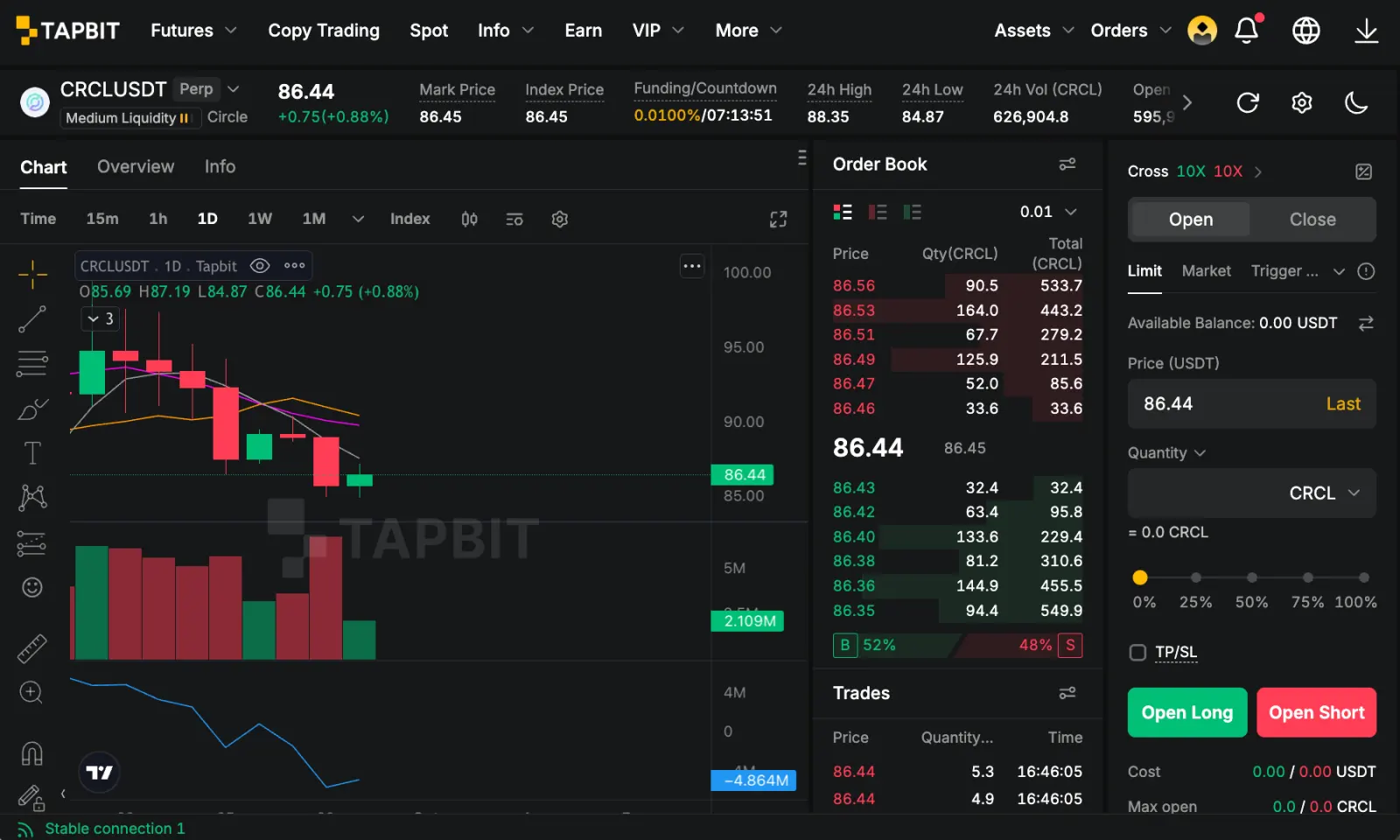
USDf is a protocol-issued synthetic dollar, while Circle is a public stablecoin company. Watching CRCL-USDT can help readers follow the business side of stablecoin adoption alongside the onchain collateral model described above.
 、
、
Circle is part of the stablecoin industry. CRCL-USDT offers stock-linked derivatives exposure to Circle price moves, not ownership of USDf or CRCL shares.
How to Trade CRCL-USDT Futures on Tapbit
- Register and prepare USDT: Create a Tapbit account or log in, complete the security setup shown on the platform, and prepare USDT in the futures balance.
- Open and configure the market: Open CRCL-USDT, confirm the contract name, then select the available margin mode and leverage level.
- Build the order: Choose Long or Short, select a market or limit order, enter the position size, and set take-profit and stop-loss levels where appropriate.
- Review and manage: Check direction, entry price, margin, fees and liquidation price before confirming. Monitor the position and use Close when ready to exit.
What Is USDf Token? Falcon Finance's Synthetic Dollar Explained FAQ
Is USDf a stablecoin?
USDf is commonly described as a synthetic dollar because it targets one U.S. dollar through collateralized onchain mechanisms.
Is USDf the same as FF?
No. USDf is the synthetic dollar, while FF is Falcon Finance’s governance and ecosystem token.
What is sUSDf?
sUSDf is a yield-bearing representation connected to USDf deposited through an eligible Falcon strategy.
Can USDf lose its peg?
Any market-traded dollar asset can move away from one dollar. Collateral, redemption and liquidity determine how effectively the price returns.


