
If you’ve spent more than a week in the cryptocurrency markets, you already know the emotional rollercoaster. You watch a chart, wait for the "perfect" dip to buy, only to watch the price plummet further. Or worse, you succumb to FOMO during a massive green candle, only to buy the exact local top.
Trying to perfectly time the top and bottom of a market as volatile as crypto is a fool’s errand. Even the most seasoned institutional traders rarely get it right.
So, how do you survive—and actually build wealth—in a market that swings wildly on a daily basis? You remove the emotion entirely. You rely on math and discipline. This is where Dollar Cost Averaging (DCA) comes in.
It is one of the oldest, most battle-tested investment strategies in traditional finance, and it is arguably even more vital in the highly volatile crypto space. In this guide, we’ll strip away the jargon and break down exactly what DCA is, the brutal realities of its pros and cons, and how you can implement it today.
What is Dollar Cost Averaging (DCA)?
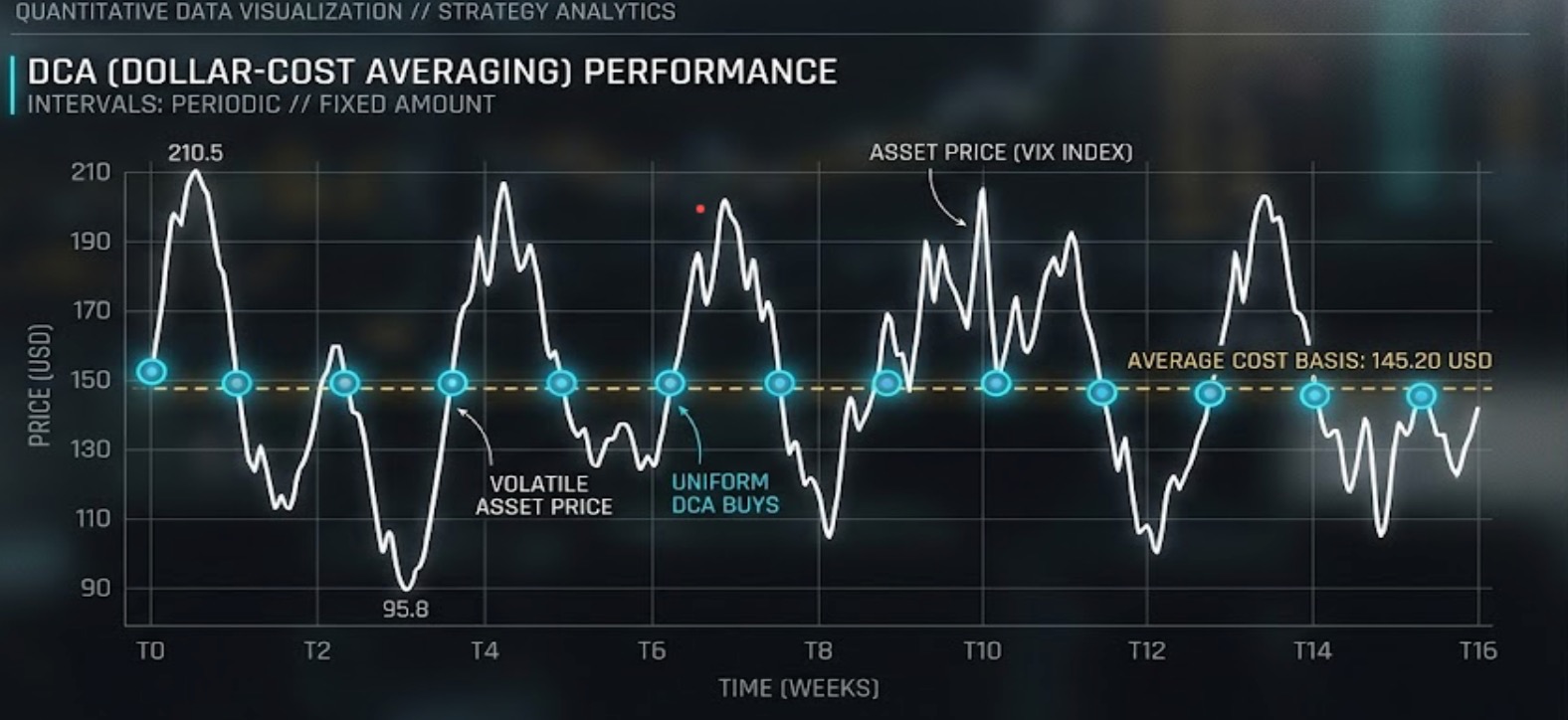
At its core, DCA is a painfully simple trading strategy: You buy a fixed dollar amount of an asset at regular, consistent intervals over a long period, completely ignoring the current price.
Here is the classic example: Imagine you have $1,200 to invest in Bitcoin. Instead of throwing the entire lump sum into the market today and praying the price goes up tomorrow, you set up a DCA plan. You decide to buy $100 worth of BTC on the 1st of every month for a year.
-
When the market crashes, your $100 buys more Bitcoin.
-
When the market rallies, your $100 buys less Bitcoin.
By the end of the year, you have mathematically "averaged out" your entry price. You didn't catch the absolute bottom, but you also completely protected yourself from buying the absolute top.
Why the Smart Money Uses DCA
While DCA sounds boring compared to 100x leveraged futures trading, it solves the most expensive problem in retail investing: human psychology.
1. It kills the "Timing Anxiety" Staring at charts trying to guess macroeconomic shifts is exhausting. DCA liberates you from the screen. Because you are buying regardless of whether the market is up 10% or down 20% today, the daily price action stops dictating your mood.
2. It smooths out violent volatility Crypto can, and will, draw down 30% in a weekend. If you are fully deployed in a lump-sum trade, a drawdown like that can trigger panic selling. If you are DCA-ing, a 30% drop is actually a mathematical advantage, as your scheduled buy will acquire significantly more tokens at a discount.
The Hard Truth: Pros and Cons of DCA
To be a profitable trader, you need an objective view of your tools. DCA is highly effective, but it is not flawless. Here is the reality check.
The Advantages
-
The Ultimate Beginner Guardrail: If you don't know how to read RSI, MACD, or volume profiles, DCA is the safest way to gain market exposure without getting destroyed by your lack of technical knowledge.
-
Enforced Trading Discipline: DCA forces you to do the hardest thing in investing: buying when there is blood in the streets. It automates courage during bear markets.
-
Lowering Cost Basis in Choppy Markets: In a sideways or declining market, DCA mathematically lowers your average entry price, meaning you hit profitability much faster when the trend finally reverses.
The Disadvantages
-
Lump-Sum Wins in a Bull Market: This is the mathematical tradeoff. If an asset just goes straight up for a year, buying it all on Day 1 will yield significantly higher returns than slowly averaging in at higher and higher prices. DCA sacrifices maximum upside for maximum safety.
-
The "Slow Bleed" Fatigue: DCA takes immense psychological endurance during a multi-year bear market. Continuing to buy an asset every month while your overall portfolio value slowly bleeds red goes against every human instinct. (This is why you only DCA into high-conviction assets).
-
Fee Accumulation: Making 50 small trades incurs more transaction fees than making one large trade. You have to ensure you are using a platform with highly competitive fee structures so the costs don't eat your margins.
Who Actually Benefits from DCA?
DCA isn't just for total beginners; it fits a variety of profiles:
-
The 9-to-5 Professional: If you have a demanding day job and cannot watch trading terminals, DCA allows you to passively convert your fiat income into crypto wealth on autopilot.
-
The Emotional Trader: If you have a history of buying high out of FOMO and selling low out of panic, DCA takes the steering wheel out of your hands.
-
The Veteran Macro Trader: Even hardcore day traders use DCA. They often dedicate a separate portfolio to slowly building a "core spot bag" of assets like BTC or ETH over years, independent of their high-risk active trading.
Building Your DCA Strategy on Tapbit
Ready to implement this? Don't just start buying randomly. Whether you are restructuring your current portfolio or just registering your first account, follow a strict framework:
-
Select High-Conviction Assets: DCA is a long-term game. It works brilliantly for foundational assets like Bitcoin (BTC) or Ethereum (ETH). It is a terrible strategy for low-cap meme coins that might literally go to zero. Never DCA into a dying asset.
-
Define Your Parameters and Stick to Them: Decide your amount and frequency (e.g., $50 every Friday). Ensure this is an amount of money you can afford to part with regularly without impacting your real-life finances. If you have to stop your DCA plan halfway through because you need to pay rent, the strategy fails.
-
Review, Don't React: "Set and forget" doesn't mean "ignore forever." Review your DCA strategy every few quarters. If macroeconomic conditions change fundamentally, or if we enter a euphoric, blow-off top in a bull market, it might be time to pause the DCA and begin scaling out.
The Bottom Line
In a market defined by chaos, DCA is your anchor. It isn't a get-rich-quick scheme. It is a slow, methodical, and proven strategy for capturing the long-term growth of the cryptocurrency asset class while protecting you from your own worst instincts. Execute your discipline and start building your automated spot portfolio today at Tapbit.com.


