

As of October 19, 2026, the public material reviewed for this article does not establish that Value Aligned Research Advisors, commonly called VARA, has collapsed or entered forced liquidation. Reports describe liquidation rumors, not a confirmed fund shutdown.
That distinction matters. A falling stock price cannot identify who is selling, and an old holdings disclosure cannot reveal a fund’s current financial condition. Still, the speculation raises a useful question: how can leveraged exposure turn confidence in AI’s long-term growth into an immediate financing problem?

What Do the VARA Liquidation Rumors Actually Say?
According to an October 16 report from Bloomingbit, speculation circulated on social media and investor forums on October 15 that VARA was unloading investments after suffering losses. The report explicitly said the alleged liquidation had not been confirmed. It did not establish a liquidation amount or a completed wind-down.
The careful description is therefore unverified liquidation rumors. “Blown up” is market slang, not a precise financial status. It might refer to a large drawdown, forced position reductions, a fund closure or insolvency—very different outcomes.
Nor does a lack of public confirmation prove the rumors false. It means the available evidence does not support treating them as an established event.
Why the $40.1 Billion Holdings Figure Needs Context
One figure helps explain why the story attracted attention. VARA’s Form 13F for the quarter ended June 30, 2026, reported approximately $40.1 billion in aggregate information-table value across 123 entries. That number comes from a dated regulatory disclosure, not a real-time portfolio statement.
Calling this a “$40 billion fund that disappeared” would go beyond what the filing establishes.
A 13F is not a complete balance sheet. It excludes short equity positions and written options, while reported option entries generally describe the underlying securities rather than the premiums paid. The aggregate cannot simply be read as investor capital, net assets or money lost. The SEC explains these reporting limitations in its Form 13F guidance.
There is also a timing problem: June holdings do not establish October positions. Applying subsequent share-price declines to an unchanged historical portfolio would produce a hypothetical estimate, not verified fund performance.
How Leverage Can Turn a Sell-Off Into Forced Selling
The following example illustrates the mechanism; it is not an estimate of VARA’s actual leverage.
Imagine a portfolio with $100 million of investor equity and $300 million of borrowed funding. It holds $400 million of assets, giving it four times gross asset exposure relative to equity.
If those assets fall 10%, their value drops to $360 million. Assuming the debt remains $300 million and ignoring costs, equity falls to $60 million—a 40% loss.
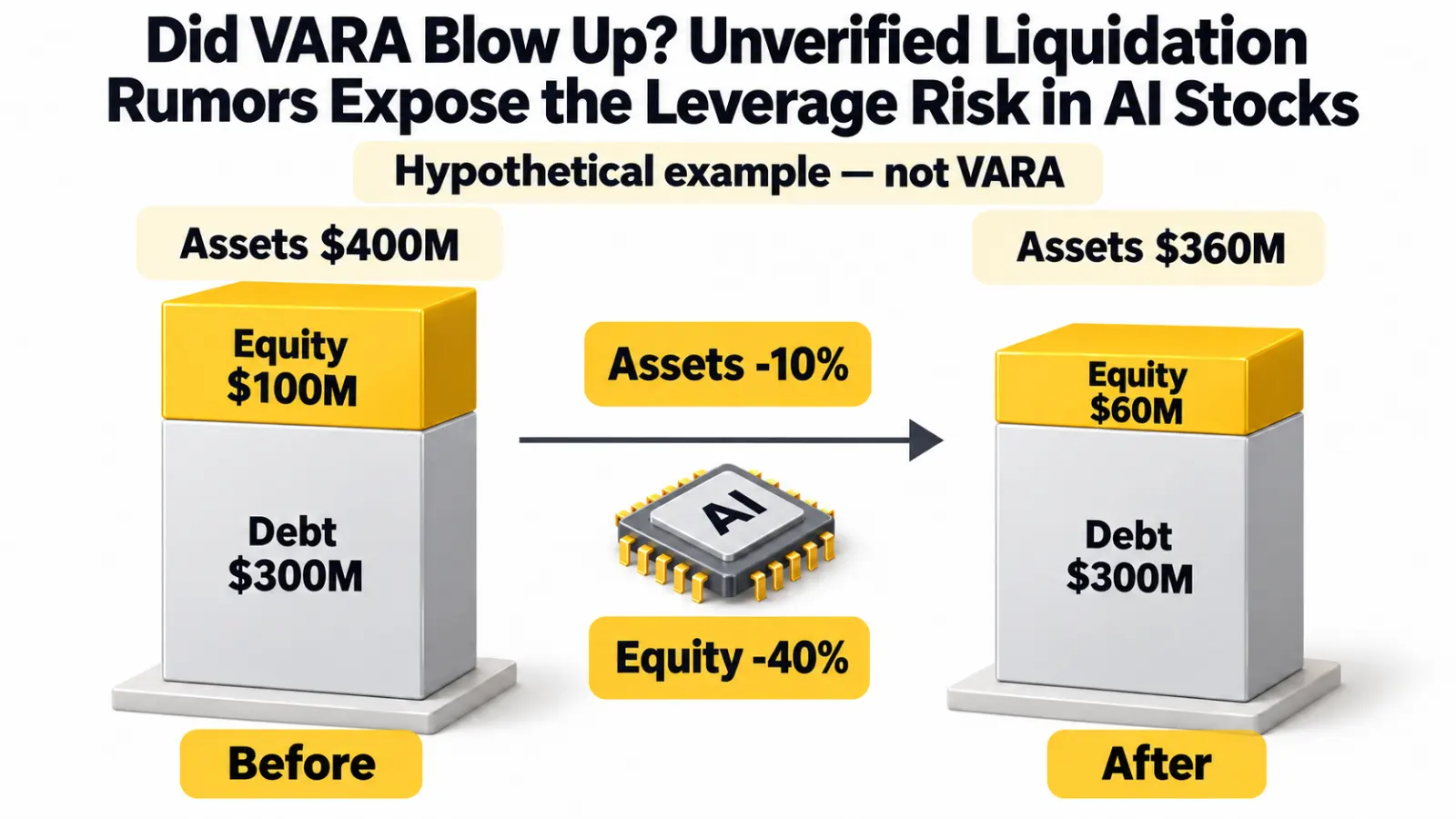
Simplified hypothetical example, not VARA’s actual leverage or losses. Debt is assumed unchanged; financing costs and other portfolio exposures are excluded.
The borrowing has not fallen alongside the assets. The portfolio now has $360 million of exposure against $60 million of equity, raising that ratio from four times to six times.
A lender may demand more collateral or require exposure reductions. Selling to meet that requirement can push prices lower, creating pressure on other leveraged holders.
Options add further complexity. Their sensitivity to price, volatility and time changes, so multiplying a stock’s decline by a single leverage figure may not describe the actual result.
Why Different AI Stocks Can Fall Together
A portfolio can hold many companies while remaining exposed to one dominant economic assumption.
Chip suppliers, cloud operators, data-center developers and power-equipment businesses occupy different industries. Yet their valuations may all depend partly on continued AI infrastructure spending.
If expectations for that spending weaken—or financing becomes more expensive—several holdings can come under pressure simultaneously. Owning different tickers does not necessarily diversify the underlying risk.
Forced selling can reinforce that connection. A manager facing a cash requirement may sell its most liquid investments, not simply the companies with the weakest outlook. Other funds holding similar positions then experience losses, potentially prompting further reductions.
This is one plausible explanation for synchronized declines. It is not proof that a particular fund caused them. Price action alone cannot distinguish margin-driven selling from ordinary profit-taking, valuation changes or deteriorating business expectations.
A Financing Problem Is Not the Same as an AI Demand Collapse
The investment case for AI and the financing structure of an AI trade are separate questions.
A company might continue growing revenue while its stock falls because investors previously priced in faster growth. A fund could also hold a broadly correct long-term view but use borrowing that leaves too little room for short-term losses.
Conversely, describing every decline as “just deleveraging” can be equally misleading. Financing stress may expose genuine weaknesses: expensive expansion, uncertain utilization, customer concentration or cash flows that arrive later than debt payments.
For AI infrastructure businesses, the useful questions concern the conversion of demand into cash:
- Are announced commitments producing recognized revenue?
- Is operating cash generation keeping pace with expansion?
- When does debt mature, and what could refinancing cost?
- How dependent is the business on a small number of customers?
These questions help separate a temporary positioning shock from a lasting change in business value. Neither answer can be inferred from the VARA rumor alone.
What Would Actually Clarify the Situation?
Stronger evidence would include an attributable statement from the manager, authenticated investor communications or independently verified reporting explaining the scope of any position reductions.
The details would matter. A partial reduction in leverage is not the same as closing a fund. An orderly return of capital is not automatically insolvency. A large loss does not establish that all positions were liquidated.
Later holdings disclosures may provide additional historical information, but they would not necessarily reveal who sold on a particular trading day or why.
For traders, uncertainty should be reflected in position sizing rather than replaced with a confident narrative. A presumed forced seller can keep selling longer than expected. Equally, an unsupported collapse story can reverse abruptly.
Using leverage to trade either interpretation adds the possibility of liquidation before the underlying thesis has time to play out.
Frequently Asked Questions
Has VARA’s collapse been confirmed?
The public material reviewed for this article does not establish a confirmed collapse or forced liquidation. The allegation should remain labeled unverified.
Does the $40.1 billion disclosure show VARA’s losses?
No. It is a historical 13F reporting figure, not a loss statement, net-asset calculation or record of current holdings.
Would forced selling guarantee a rebound?
No. Prices might recover if selling pressure fades, but valuation, earnings and financing concerns could continue weighing on the affected companies.
Conclusion
The VARA liquidation rumors should not be reported as a confirmed fund failure. Historical holdings and simultaneous stock declines do not establish current leverage, realized losses or insolvency.
The broader lesson is more durable: a promising industry does not make every financing structure sustainable. AI demand, business profitability and a trader’s ability to survive volatility are three different things.


