
SK Hynix’s record U.S. listing gave American investors direct access to one of the AI memory market’s biggest beneficiaries. Its strong Nasdaq debut was followed by a sharp fall in Seoul, highlighting both the strength of the HBM story and the risks already reflected in the valuation.
SK Hynix entered a new chapter on July 10, 2026, when its American depositary receipts began trading on Nasdaq.
The South Korean memory-chip manufacturer priced the offering at $149 per depositary receipt. The receipts opened at $170 and finished their first session at $168.01, a gain of 12.8% from the offering price. The company raised approximately $26.5 billion, making it the largest U.S. share offering by a foreign company on record.
The strong debut appeared to confirm Wall Street’s appetite for companies supplying the infrastructure behind artificial intelligence.
Yet the picture changed when trading resumed in South Korea. SK Hynix shares fell as much as 8.2% during early Seoul trading on July 13 as investors took profits and reassessed expectations for the company’s upcoming earnings and HBM shipments.
At first glance, a rising U.S. receipt and a falling Korean share may look contradictory. In practice, they reflect two sides of the same investment debate.
SK Hynix remains one of the clearest public-market ways to gain exposure to AI memory demand. It is also a stock whose price already assumes that demand, pricing and technological leadership will remain unusually strong.
What Is SKHY?
SK Hynix’s ordinary shares continue to trade on the Korea Exchange under the code 000660.
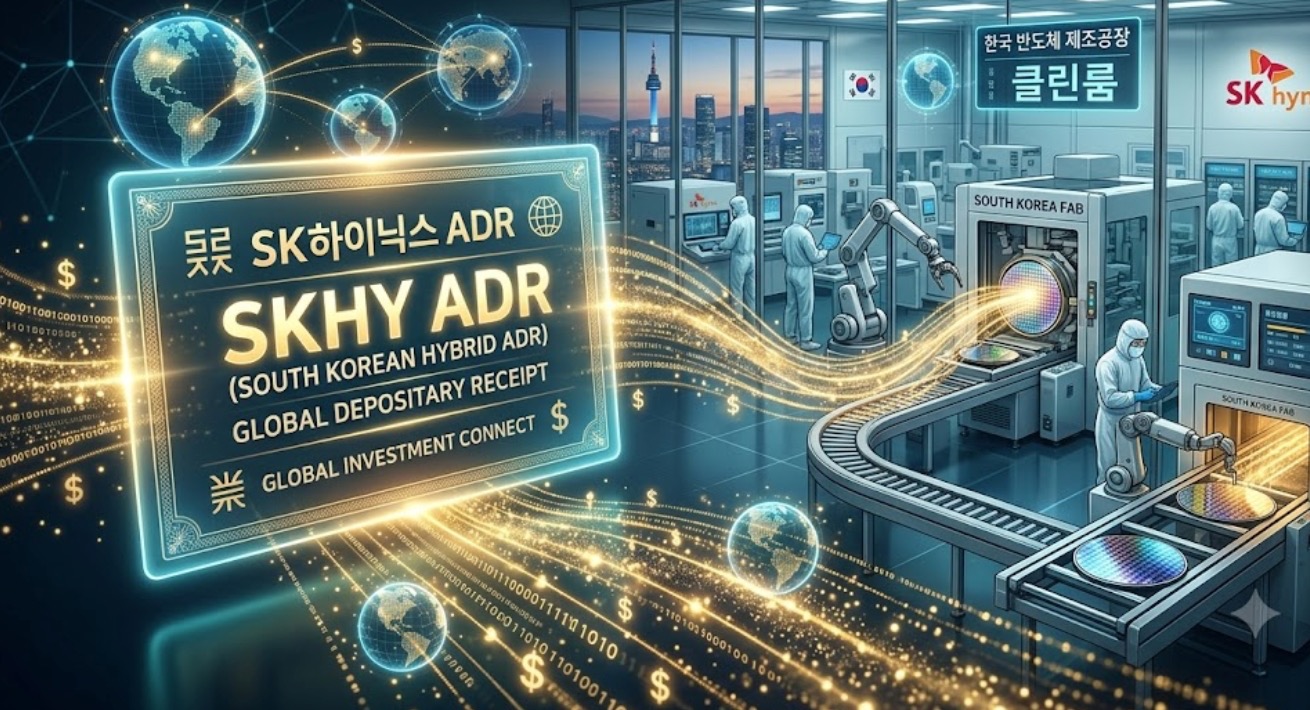
The new U.S.-listed security trades under the ticker SKHY. It was initially quoted under the temporary ticker SKHYV on a “when-issued” basis on July 10 before regular trading under SKHY began on July 13.
Each American depositary share represents one-tenth of one SK Hynix common share. This means ten SKHY depositary shares correspond to one Korea-listed ordinary share.
SKHY is not a separate operating company, cryptocurrency or synthetic AI token. It is a dollar-denominated depositary receipt representing an economic interest in the same South Korean semiconductor business.
For international investors, the difference is mainly one of access. SKHY can be traded through U.S. brokerage accounts during American market hours, without directly purchasing Korean shares or settling the transaction in Korean won.
Why Did SKHY Rise on Its Nasdaq Debut?
The first-session rally was driven by more than the novelty of a new listing. SK Hynix occupies a strategically important position in high-bandwidth memory, or HBM. These vertically stacked memory products are installed alongside advanced AI processors, allowing large volumes of data to move quickly between memory and computing units.
As AI models become larger and data-center workloads become more demanding, memory bandwidth has emerged as one of the main constraints on system performance.
SK Hynix led the HBM market with an estimated 58% revenue share in the first quarter of 2026, according to Counterpoint Research data cited by Reuters. Samsung Electronics and Micron Technology each held around 21%.
This leadership gives investors a fairly direct way to participate in AI infrastructure spending. A software company may benefit from AI adoption in several ways, but SK Hynix earns revenue by supplying a physical component that advanced accelerators and servers require.
The U.S. listing also broadened the potential investor base. American institutions that previously faced operational or mandate-related barriers to buying Korean shares can now obtain exposure through a Nasdaq-listed instrument.
That combination—scarce AI infrastructure, strong earnings and improved market access—helps explain why investors were willing to pay above the offer price on the first day.
Why Did the Korean Stock Fall?
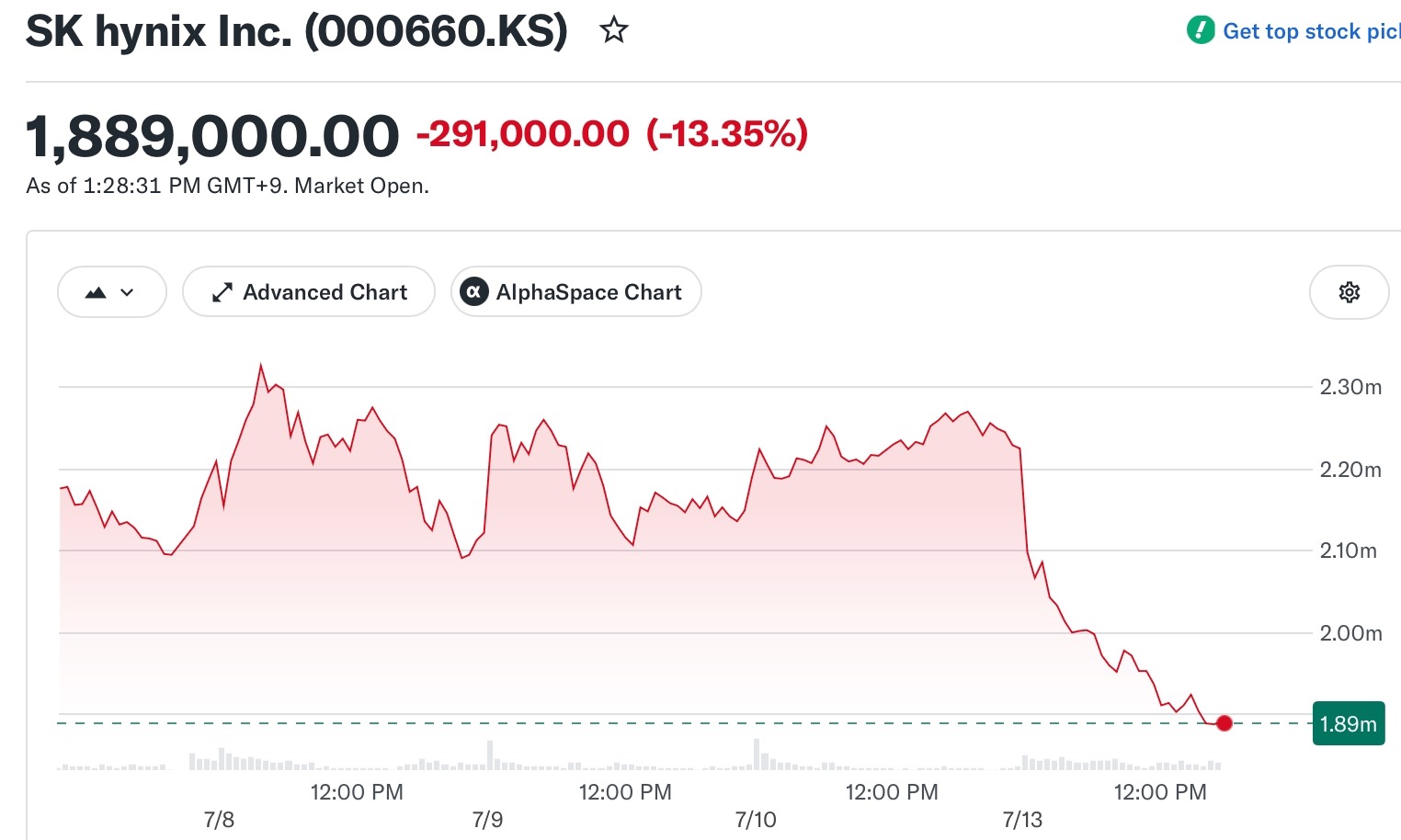
The July 13 decline in Seoul did not necessarily mean that SK Hynix’s long-term AI position had suddenly deteriorated.
Part of the move reflected profit-taking after the U.S. listing. The Korea-listed stock had already delivered an extraordinary rise over the previous year, leaving investors with substantial gains and making the shares vulnerable to any reduction in optimism.
There was also a more fundamental concern. Investors had expected HBM4 shipments to begin increasing from the second quarter, but an analyst quoted by Reuters said the ramp did not appear to have materialized at the scale anticipated. Earnings expectations were also being moderated because SK Hynix has greater exposure to HBM than Samsung, leaving it less exposed to the recent increase in conventional DRAM prices.
That distinction is important. SK Hynix’s HBM specialization is its greatest advantage when demand for premium AI memory is accelerating. However, it can become a relative disadvantage during periods when conventional DRAM pricing improves faster than HBM shipments.
The Seoul decline therefore looked less like a rejection of the AI memory thesis and more like a debate over timing, valuation and the composition of near-term earnings.
The Financial Results Behind the AI Story
SK Hynix’s recent growth has not been based solely on market enthusiasm.
The company reported first-quarter 2026 revenue of 52.5763 trillion won, operating profit of 37.6103 trillion won and net profit of 40.3459 trillion won. Its operating margin reached 72%, while its net margin was 77%. Revenue exceeded 50 trillion won for the first time in a single quarter.
Those figures demonstrate the strength of the current memory environment. They also raise an uncomfortable question for investors:
How much of this profitability can be sustained?
A 72% operating margin is exceptional for a hardware manufacturer. It reflects favorable product mix, strong pricing and constrained supply. If those conditions persist, the company could continue generating substantial cash to fund new capacity and product development.
But extraordinary profitability often encourages competitors to expand production. Customers also have an incentive to qualify alternative suppliers and reduce their dependence on a single company.
The current results support the bullish case. They do not remove the memory industry’s long-standing tendency to move through expansion and correction cycles.
HBM4 Is the Next Major Test
SK Hynix announced in September 2025 that it had completed HBM4 development and prepared its mass-production system.
The company said HBM4 doubled bandwidth compared with the previous generation, improved power efficiency by more than 40% and achieved operating speeds above 10Gbps, exceeding the 8Gbps JEDEC standard. The product uses 2,048 input/output terminals, twice the number used by the previous generation.
These specifications matter because AI data centers are not limited only by raw processor performance. Power consumption, memory bandwidth and data movement all affect the cost of training and running AI models.
However, completing development is not the same as generating large-scale commercial revenue.
Investors wimer qualification, manufacturing yield, delivery schedules and the actual pace of HBM4 orders. The July 13 selloff showed that expectations around the production ramp can move the stock even when the long-term technology story remains intact.
In other words, HBM4 is both the next growth engine and the next execution test.
The Main Risks Investors Should Not Ignore
Memory remains a cyclical industry
HBM has improved SK Hynix’s product mix, but it has not eliminated semiconductor cycles.
New production capacity takes time to build. Once it arrives, however, supply can grow quickly. If demand fails to keep pace, memory prices and margins may fall.
SK Hynix’s own 2026 market outlook acknowledged that some researchers expect HBM pricing to face a correction after 2026 as competition intensifies and production expands.
Expectations are extremely high
A company can report strong earnings and still see its stock fall when results fail to exceed investor expectations.
The market is no longer asking whether SK Hynix can benefit from AI. That is already broadly accepted. Investors are asking whether it can grow faster than the ambitious assumptions embedded in its valuation.
Samsung and Micron are still serious competitors
SK Hynix currently holds a strong position, but Samsung Electronics and Micron have the resources to invest heavily in product development and capacity.
Customer qualification of competing HBM products could reduce supply constraints and weaken SK Hynix’s pricing power.
Customer concentration matters
The most advanced HBM demand is connected to a relatively small number of AI processor designers and cloud-computing companies.
Changes in accelerator design, purchasing schedules or supplier strategy could have a disproportionate effect on orders.
Expansion creates execution risk
New facilities and advanced packaging lines require large upfront investment.
Construction delays, yield problems or weaker-than-expected demand could reduce returns on that capital.
Currency affects international returns
The Korea-listed shares are priced in won, while SKHY trades in dollars. Exchange-rate movements can affect comparative valuations, investor returns and the movement of capital between the two listings.
Is SK Hynix Stock Still an AI Investment?
Yes, but with an important qualification. SK Hynix is one of the most direct listed beneficiaries of the AI memory buildout. Its products are used in the hardware that allows advanced processors to operate efficiently, and its recent financial performance demonstrates that this position has considerable economic value.
It is not, however, a simple bet that “AI will grow.”
An investment in SK Hynix also requires a view on manufacturing yields, memory prices, capital expenditure, competition, customer qualification and valuation.
The company can remain technologically strong while its stock falls. The July 13 decline in Seoul is a clear example of how quickly the market can shift from celebrating growth to questioning whether that growth is already priced in.
Final Thoughts
SK Hynix’s Nasdaq debut was a landmark event for both the company and the global semiconductor market.
The 12.8% first-session gain showed that U.S. investors remain eager to own businesses supplying critical AI infrastructure. The sharp decline in Seoul days later showed that enthusiasm does not remove the risks surrounding earnings expectations and valuation.
Both moves can be true at the same time.
SK Hynix has a leading HBM position, record profitability and a credible next-generation product roadmap. It also operates in a capital-intensive, highly competitive industry where demand and supply can change faster than expected.
The central question is no longer whether SK Hynix is important to AI. It is whether the company can convert that importance into sustainable earnings quickly enough to justify the expectations now attached to both SKHY and 000660.
Traders can track live market conditions through the Tapbit homepage. Existing users can access their accounts through Tapbit login, while new users can begin from the Tapbit registration page.
Frequently Asked Questions (FAQ)
What is the SK Hynix U.S. stock ticker?
SK Hynix’s American depositary shares trade on Nasdaq under the ticker SKHY. The temporary ticker SKHYV was used for when-issued trading on July 10, 2026.
What is the SK Hynix stock code in South Korea?
Its ordinary shares trade on the Korea Exchange under the code 000660.
How did SKHY perform on its Nasdaq debut?
The receipts were offered at $149, opened at $170 and closed their first trading session at $168.01, representing a 12.8% increase from the offer price.


