

Hunter Biden’s LAPTOP meme coin crashed more than 95% shortly after launching on the Base blockchain on September 9, 2026. The Wall Street Journal reported that the token rose to a peak of $199.51 before falling to roughly $1.30 by 4:15 p.m. Eastern Time. The launch began through decentralized trading rather than a major centralized exchange, leaving the first price vulnerable to thin liquidity and automated trading.
The fall does not have to mean that every token holder lost 95% or that billions of dollars left the market. Very few tokens may have traded near the highest quote. The more useful question is how the pool was structured, how much capital supported the peak and who could actually buy or sell at each price.
What Happened to the LAPTOP Meme Coin?
The `$LAPTOP` token launched on Base, an Ethereum Layer 2 network developed by Coinbase. It began trading through a decentralized exchange, where a liquidity pool allowed users and bots to swap other assets for LAPTOP.
According to The Wall Street Journal’s September 9 report, LAPTOP reached $199.51 and then dropped to about $1.30. That represents a decline of approximately 99.3% from the quoted high. MarketWatch separately reported a move from around $37 to more than $222 and then to about $1.80, alongside roughly $39 million in trading volume.
Those numbers differ because a new decentralized market does not have one long-established reference price. Data providers can use different pools, time stamps or methods for excluding irregular trades. The direction is consistent across the reports: an extreme early spike was followed by an almost complete reversal.
Why Did the LAPTOP Token Price Move So Fast?
The launch combined high public attention with a market that had little trading history. That is the exact setting in which price can move much faster than the underlying amount of money entering or leaving.
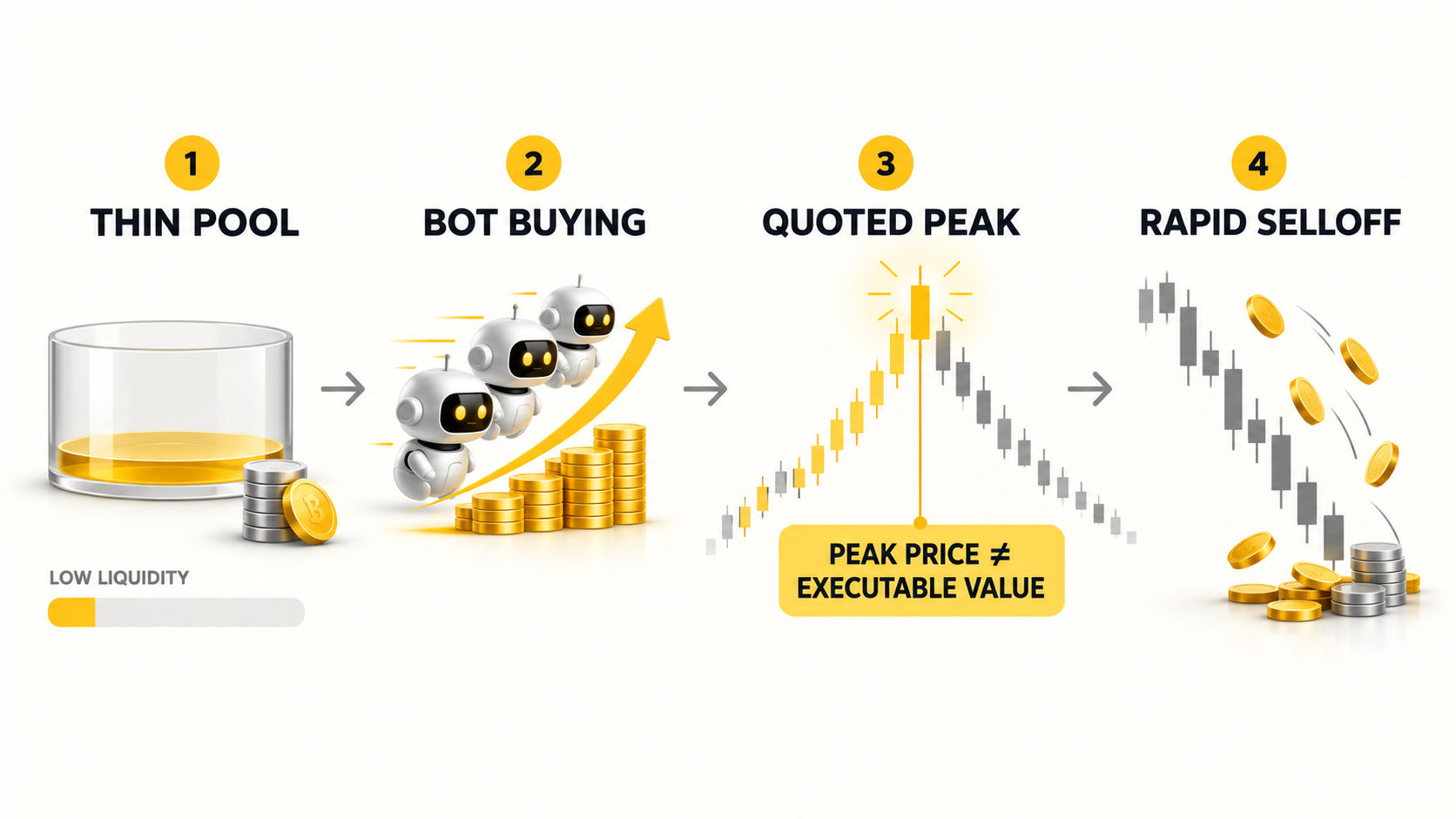
Thin Initial Liquidity Distorted the First Trades
A decentralized exchange does not match every buyer with an individual seller. Many DEX markets use a pool containing the new token and another asset. A formula changes the quoted price as users trade against that pool.
If a pool is small, one large buy removes a meaningful share of the available tokens and pushes the next quote sharply higher. A second buyer then pays more. The screen may display a dramatic gain even though only a small amount traded near the peak.
The same mechanism works in reverse. When early holders sell back into the pool, the quote can collapse because each sale leaves fewer reserve assets supporting the next trade. This is why pool depth and slippage are essential launch-day metrics.
Sniper Bots Reached the Market First
A sniper bot is automated software that watches for a new trading pool and submits a transaction as soon as liquidity appears. The bot can buy before most people have opened the project page, checked the address and prepared a trade.
Early automated purchases can drive the price upward. A human buyer arriving minutes later sees a high chart and may assume a broad market has already valued the token. In reality, the visible high may reflect a short series of automated trades in a shallow pool.
The Wall Street Journal noted that LAPTOP’s first price was vulnerable to sniper-bot activity because there was no centralized-exchange benchmark. That does not mean every bot manipulated the market. It explains why the first quote was a weak measure of stable demand.
A Small Tradable Float Increased Volatility
Reports described a total supply of 1 billion LAPTOP tokens. The Wall Street Journal reported that founders were expected to receive 30% of the supply, with those tokens locked for six months and released over two years. Another 20% was described as an airdrop allocation, including distributions connected to people who lost money in `$TRUMP`.
If much of a token’s supply is locked, reserved or not yet placed in a trading pool, the immediately tradable float can be small. A small float increases the distance the price can travel when attention suddenly arrives. It also makes “price multiplied by total supply” a fragile valuation measure.
Why Was LAPTOP’s Fully Diluted Valuation Misleading?
Fully diluted valuation, or FDV, multiplies the current token price by the entire maximum supply. If LAPTOP traded at $199.51 and had a total supply of 1 billion, the simple formula would imply an enormous valuation. That does not mean buyers placed that amount of capital into the token.
Only a limited number of tokens traded near the peak, and the pool could not have allowed every holder to sell the full supply at that price. Once selling began, the executable price moved sharply lower. A launch-day FDV should therefore be read with pool liquidity, circulating float, volume and the number of trades.
| Metric | What it measures | Main limitation at launch |
|---|---|---|
| Quoted price | The latest trade or pool quote | A very small trade can set it |
| Trading volume | The value traded during a period | Includes repeated turnover and bot activity |
| Liquidity | Assets available to support trades | Can be far smaller than headline valuation |
| FDV | Price multiplied by total supply | Assumes every token has the same executable price |
| Circulating float | Tokens available for trading | May be difficult to verify immediately |
Was the LAPTOP Meme Coin a Rug Pull?
Some commentators described the collapse as a rug pull. That term normally refers to developers or insiders removing liquidity, selling into buyers or abandoning a project after attracting funds. A large price decline by itself does not establish that sequence.
At the time of the initial reporting, there was no confirmed finding that Hunter Biden or the LAPTOP project committed fraud. There was also no verified evidence in the cited reports that Biden personally sold founder tokens during the collapse. Reports said the founder allocation was locked, though the contract and lock mechanism still need independent onchain verification.
The project attributed the move to liquidity that could not sustain launch interest. That statement is the project’s explanation, not an independent conclusion. A complete answer requires the canonical contract, liquidity-pool history, deployer wallets, allocation wallets and transfers around the launch.
How Was the LAPTOP Token Supply Reportedly Allocated?
Media reports described a 1 billion-token design with several planned groups. Founders were allocated 30%, another 20% was intended for community distributions and affected meme-coin holders, and other portions were connected to liquidity, administration, charity or conditional burns.
The project also described unusual burn conditions tied to political or market events. A burn permanently removes tokens from the available supply. It can reduce future supply, but it does not automatically create demand or provide liquidity. Traders should confirm whether a burn is coded into an enforceable contract or depends on a later decision.
What Does the LAPTOP Crash Show About Political Meme Coins?
Political meme coins combine two attention markets: crypto speculation and partisan media. A post, interview or public argument can bring thousands of potential traders to a token within minutes. That attention can create volume, but it does not create deep liquidity, transparent allocation or long-term utility.
The result can resemble the behavior described in Tapbit’s guide to meme stocks and narrative-driven markets: price responds to identity and attention faster than conventional financial information. In a token market, the effect can be more extreme because trading runs around the clock and new pools can launch without a centralized listing process.
The event also arrives while the United States continues to debate digital-asset rules. Tapbit’s guides to the crypto market structure bill and the latest CLARITY Act developments explain the wider policy questions. A token’s political branding does not replace disclosures about control, supply and market structure.
What Should Traders Check in a New Meme Coin?
- Canonical contract: obtain the address from a verified project source and match it with the block explorer.
- Pool liquidity: compare the amount available for trading with the position size.
- Slippage: preview how much the actual execution price changes for the planned order.
- Holder concentration: inspect the largest wallets and exclude known pool, burn or lock addresses.
- Unlock schedule: verify when founder and team allocations can move.
- Trading venue: distinguish permissionless deployment on Base from endorsement or listing by Coinbase.
Base is an open network. A token can deploy there without Coinbase reviewing or endorsing it. The same distinction applies across permissionless blockchains: network availability is not a quality certificate.
Final Answer
Hunter Biden’s LAPTOP meme coin lost more than 95% from its early quoted peak because launch-day attention hit a thin decentralized market. Sniper bots, limited liquidity and a small tradable float pushed the first price upward, then made the reversal equally fast.
The collapse is a market-structure lesson before it is a political story. Traders need to inspect liquidity, allocation and executable prices instead of treating a brief high or fully diluted valuation as money that the whole market could realize. Tapbit does not claim a LAPTOP listing in this guide. To explore a supported market safely:
- Create a Tapbit account and complete the required account checks.
- Open Markets and search for the intended token ticker.
- Match the full asset name and canonical contract details; do not rely on the ticker alone.
- Continue only if Tapbit currently supports the exact asset and intended trading pair.
- Choose the order type and size, review the market and order details, then confirm.
Frequently Asked Questions
What is the LAPTOP meme coin?
LAPTOP is a political meme coin associated with Hunter Biden and named after the laptop controversy surrounding him. It launched on Base on September 9, 2026.
Why did the LAPTOP token crash?
The first market combined high attention with thin DEX liquidity, automated buying and a limited tradable float. The early peak could not be sustained when selling began.
Was LAPTOP a confirmed rug pull?
No confirmed fraud finding or verified founder sale had been established in the initial reports. The price collapse and public accusations require separate treatment from proven onchain actions.
Is LAPTOP listed by Coinbase?
Launching on Base does not mean Coinbase listed or endorsed the token. Reports described early trading through a decentralized exchange.


