

BitMine Immersion Technologies has turned Ethereum treasury buying into one of the market’s most closely followed institutional trades. Since starting its ETH strategy in June 2025, the company has bought almost every week, building a position north of 6 million ETH.
That strategy is nearing a clear limit. Chairman Tom Lee said BitMine will stop accumulating once its holdings reach 5% of Ethereum’s total supply. That’s not a plan to sell — but it does mean the market may soon lose one of its most consistent sources of spot demand.
The bigger issue for ETH traders: who replaces that buying pressure?
BitMine Is Close to Its 5% Ethereum Limit
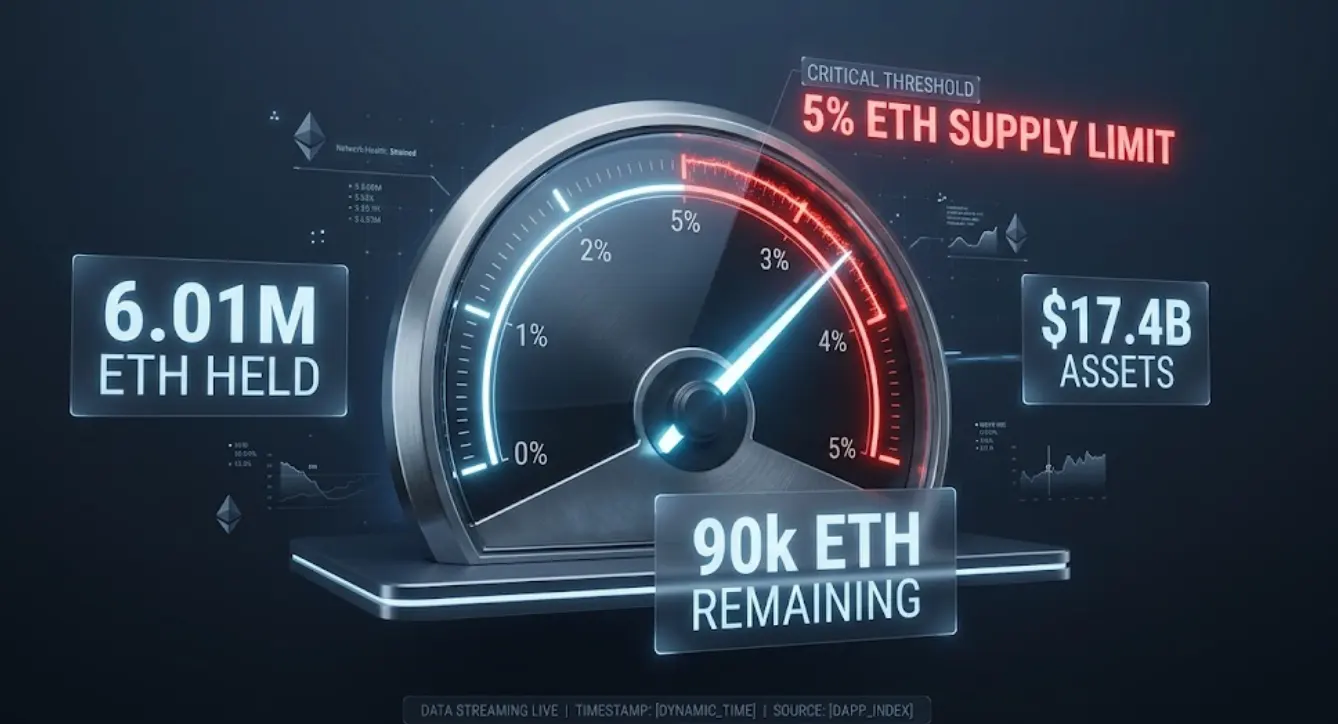
According to BitMine’s latest filing, the company held 6,016,414 ETH as of October 4, representing approximately 4.9% of the 122.1 million ETH supply figure used in its disclosure. It also reported 5,067,309 ETH in staking arrangements and total crypto, cash and marketable securities holdings of approximately $17.4 billion.
The company bought 15,112 ETH during the latest reporting week. Based on the figures disclosed by BitMine, roughly 90,000 ETH remains before it reaches the 5% ceiling. The exact timing is uncertain because the pace of future purchases can change, and the circulating supply is not fixed.
Tom Lee described the 5% level as a hard cap rather than a temporary milestone. That changes the meaning of the strategy. For more than a year, every weekly purchase reinforced the same market message: BitMine was still adding ETH, even when prices weakened. Once the cap is reached, that message will disappear.
Stopping Purchases Is Not the Same as Selling

The distinction matters. A buyer leaving the market is not the same as a large holder sending tokens to exchanges or liquidating its position.
BitMine has not announced a plan to sell its existing ETH after reaching the cap. Its stated strategy is likely to shift toward staking, treasury management and the use of its existing holdings. The company has already placed most of its ETH into staking, turning the treasury from a passive reserve into an asset that may generate recurring yield.
BitMine has projected annualized staking rewards of hundreds of millions of dollars once its holdings are fully deployed. That figure is a company estimate, not guaranteed revenue. It depends on the staking rate, network conditions, operational performance and the market value of ETH.
The cap also creates a practical issue. Staking rewards increase the number of ETH under BitMine’s control. If the company reaches 5% and continues receiving rewards, it will need to decide whether to retain, sell or use those rewards in another way.
Ethereum ETF Flows Are Sending a Different Signal

BitMine’s accumulation campaign is ending at a difficult time for ETH demand. U.S. spot Ethereum ETFs have recently recorded significant outflows.
Farside Investors’ data shows net outflows of approximately $201.9 million on October 6, $160.9 million on October 7, $72.5 million on October 8 and $56.1 million on October 9. The figures are not a forecast, but they show that ETF demand has not yet become a reliable replacement for BitMine’s weekly purchases.
This creates a less comfortable setup for Ethereum. One source of demand is nearing its planned end while another is moving in the opposite direction. If ETF flows recover, the market may absorb BitMine’s reduced buying without much difficulty. If outflows continue, ETH could face a period in which available supply is met by fewer aggressive buyers.
That does not automatically imply a crash. It does mean that the market will have to prove that institutional demand is broader than one corporate treasury.
Who Could Become Ethereum’s Next Major Buyer?

The obvious candidates are spot ETFs, other public companies, crypto funds and investors using ETH for staking or on-chain activity. None has yet demonstrated the same regular buying pattern as BitMine.
Other corporate treasuries may continue accumulating ETH, but smaller purchases spread across several companies do not necessarily create the same psychological effect as one highly visible buyer. Market participants have been able to track BitMine’s weekly updates, making the company’s purchases part of the ETH narrative itself.
The second source of demand is Ethereum’s own economic activity. ETH is used to pay transaction fees, secure the network through staking and support applications across DeFi, stablecoins and tokenized assets. Those uses matter over time, but they do not always generate immediate spot demand on the scale required to replace a large treasury buyer.
This is why the next phase of the market may depend less on headlines about BitMine and more on measurable activity across Ethereum’s ecosystem.
The 5% Cap Is a Stress Test, Not an ETH Verdict
BitMine has shown that a public company can build a very large Ethereum treasury and use staking as part of its financial strategy. Reaching the 5% limit will mark the end of one phase, but not necessarily the end of BitMine’s involvement with Ethereum.
For ETH, however, the change is important. The network is about to lose a highly visible recurring buyer at a time when ETF flows are weak. That leaves the market with a straightforward test: can other forms of demand replace BitMine’s accumulation?
A successful transition would show that Ethereum’s institutional story is broader than one company. A weak transition would suggest that recent demand was more concentrated than many traders assumed.
The coming weeks should therefore be read through flows, staking activity, exchange balances and actual network use, rather than through the 5% headline alone. Traders following ETH market developments can explore crypto markets and educational coverage through Tapbit. Existing users can log in, while new users can register.
Frequently Asked Questions
Why is BitMine stopping its Ethereum purchases?
BitMine plans to stop buying ETH after reaching 5% of Ethereum’s total supply. Tom Lee has described that level as a hard cap for the company’s treasury strategy.
How much ETH does BitMine hold?
BitMine reported holdings of approximately 6.02 million ETH as of October 4, 2026, equal to about 4.9% of the supply figure used in its filing.
Is BitMine selling its ETH?
No sale plan was announced alongside the 5% cap. Stopping new purchases is different from selling existing holdings.


