
On September 15, 2022, Ethereum completed one of the most significant upgrades in blockchain history. Known as "the Merge," this event marked Ethereum's transition from Proof-of-Work (PoW) to Proof-of-Stake (PoS) — reshaping how the network reaches consensus, validates transactions, and scales for the future.
If you've been searching for the Ethereum 2.0 release date or trying to understand what actually changed, this guide covers everything: the timeline, the technical shifts, what happened to your ETH, and what's coming next.
What Is Ethereum 2.0?
Ethereum 2.0 — sometimes called the Consensus Layer — is not a new blockchain or a new coin. It's a series of protocol-level upgrades that transformed how Ethereum operates under the hood.
The headline change: replacing energy-intensive mining with staking, where validators lock up ETH to participate in consensus instead of competing to solve computational puzzles.
Key facts at a glance:
-
Official release date: September 15, 2022
-
Core event: The Merge — Ethereum Mainnet joined the Beacon Chain
-
User impact: No token migration, no new coins, no wallet changes required
Why Did Ethereum Need This Upgrade?
Ethereum 1.0 gave the world DeFi, NFTs, and smart contracts — but the original architecture struggled to keep up with demand. Three problems drove the push for Ethereum 2.0:
Surging transaction fees. During peak periods, Gas fees regularly exceeded $20 per transaction, making everyday use impractical for most users.
Environmental concerns. PoW mining consumed enormous amounts of electricity, drawing sustained criticism and regulatory scrutiny.
Limited scalability. Transaction throughput had a hard ceiling, and competing blockchains were gaining ground by offering faster, cheaper alternatives.
The upgrade wasn't optional — it was the foundation for everything Ethereum needed to become next.
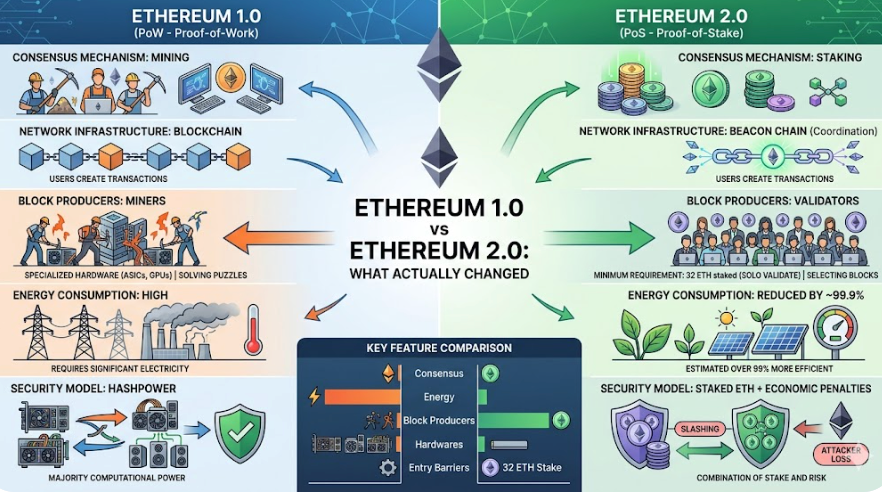
Ethereum 1.0 vs Ethereum 2.0: What Actually Changed
|
Feature |
Ethereum 1.0 (PoW) |
Ethereum 2.0 (PoS) |
|
Consensus mechanism |
Mining |
Staking |
|
Energy consumption |
High |
Reduced by ~99.9% |
|
Block producers |
Miners |
Validators |
|
Participation requirements |
Specialized hardware |
32 ETH minimum to solo validate |
|
Security model |
Hashpower |
Staked ETH + economic penalties |
The Ethereum 2.0 Roadmap: Phase by Phase
Phase 0 — Beacon Chain Launch (December 1, 2020)
The Beacon Chain went live as a separate, parallel chain designed exclusively to test and refine PoS mechanics. It coordinated validators, tracked staked ETH, and built the infrastructure the Merge would eventually rely on.
The Merge — September 15, 2022
Ethereum's Mainnet merged with the Beacon Chain, handing consensus responsibilities from miners to validators. The transition happened with zero downtime. Every wallet address, smart contract, NFT, and DeFi position continued operating without interruption — no migration required.
Dencun Upgrade — 2024
The Dencun upgrade introduced Proto-Danksharding, a mechanism that uses "blobs" of data to dramatically reduce transaction costs on Layer 2 networks. For users of rollups like Arbitrum and Optimism, this translated directly into lower fees.
Full Sharding — 2025 and Beyond
The long-term roadmap points toward complete sharding, which would split the network into parallel processing lanes and push throughput to thousands of transactions per second.
How Proof-of-Stake Secures the Network
Under PoS, validators replace miners. To participate, a validator locks up ETH as collateral — and risks losing it if they attempt to manipulate the network. This "slashing" mechanism makes attacks economically irrational: the cost of cheating outweighs any potential gain.
Two ways to participate in ETH staking:
Solo validation requires a minimum of 32 ETH and running your own node. In return, you receive full staking rewards and maintain direct control over your validator.
Pooled or exchange staking has no minimum threshold. A platform manages the technical infrastructure on your behalf and distributes rewards proportionally. The tradeoff is that you're relying on the platform's security and fee structure.
Current annual staking yields typically range between 3% and 5%, fluctuating with overall network participation.
Did ETH Become Deflationary After the Merge?
Potentially, yes. EIP-1559, which launched in August 2021, introduced a mechanism that burns a portion of ETH with every transaction. Post-Merge, new ETH issuance dropped sharply as the network no longer needed to compensate miners. During periods of high on-chain activity, the amount of ETH burned can exceed the amount newly issued — resulting in net supply reduction. You can track this in real time at ultrasound.money.
What Happened to ETH Holders During the Merge?
Nothing — in the best possible way. When the Merge completed on September 15, 2022:
-
All ETH balances remained exactly as they were
-
Wallet addresses stayed the same
-
Smart contracts, NFTs, and DeFi positions continued without interruption
-
No token swap, migration, or manual action was required
Any communication claiming otherwise — including fake "ETH2 migration" messages circulating around that time — was a scam.
Did Gas Fees Drop After the Merge?
Not directly. The Merge was primarily an upgrade to consensus mechanics and energy efficiency, not a fee reduction. Transaction costs on Ethereum are still driven by block space demand. The upgrades targeting fees — specifically Dencun and future sharding phases — came later and are separate from the Merge itself.
Ethereum 2.0 Timeline: Quick Reference
|
Milestone |
Date |
What It Did |
|
Beacon Chain launch |
December 2020 |
Established the PoS test environment |
|
The Merge |
September 15, 2022 |
Switched Mainnet to PoS consensus |
|
Dencun upgrade |
2024 |
Reduced L2 fees via Proto-Danksharding |
|
Full sharding |
2025+ |
Large-scale throughput improvements |
FAQ
What is the Ethereum 2.0 release date?
The Merge — the defining event of the Ethereum 2.0 upgrade — was completed on September 15, 2022.
Is Ethereum 2.0 a new coin?
No. It's a protocol upgrade, not a new token. No coins were issued, and no airdrop took place.
Did I need to do anything with my ETH during the Merge?
No. The transition was seamless for holders. ETH on exchanges, in wallets, or locked in smart contracts was unaffected.
How do I stake ETH?
You can run your own validator node with 32 ETH, or stake any amount through pooled options via exchanges or decentralized protocols. Annual yields currently sit around 3–5%.
When will Ethereum fees get cheaper?
The Dencun upgrade (2024) already reduced costs on Layer 2 networks. Further reductions are expected as full sharding rolls out.


