

CyberLeek could face serious legal exposure if investigators identify the person or group behind the alleged GTA 6 leaks, but the potential charges depend on evidence that is not yet public. The decisive questions are how the material was obtained, whether any computer system was accessed without permission, whether confidential files were knowingly received, and whether the leaks were used to promote a crypto token or pressure Rockstar Games.
Readers following the story should separate verified developments from social-media claims. They can also create a Tapbit account to explore supported crypto markets and market-analysis tools, but CyberLeek-related tokens should not be confused with assets officially supported by the platform.
What Is Known About the CyberLeek GTA 6 Case?
In August 2026, an anonymous account using the CyberLeek name published clips presented as unreleased GTA 6 gameplay and promoted a token using the same branding. Reporting from Axios said that multiple purported clips had circulated, while Rockstar Games had not publicly authenticated the material at the time. PC Gamer also reported copyright takedown activity and the promotion of a CyberLeek-branded token.
Those facts do not establish who obtained the files, whether a hack occurred, or whether the token promoter and the original source were the same person. A reposting account, an insider, and an external intruder would face different legal theories. Until authorities or the companies disclose evidence, CyberLeek remains an online identity rather than a proven defendant.
Unauthorized Computer Access Could Be the Central Charge
If CyberLeek entered a Rockstar, Take-Two, contractor, or cloud system without authorization, U.S. prosecutors could consider charges under the Computer Fraud and Abuse Act. 18 U.S.C. §1030 covers several forms of unauthorized access, obtaining information from a protected computer, computer-enabled fraud, damage, and certain extortionate threats.
The exact subsection would depend on the conduct. Credential theft, phishing, malware, password trafficking, deleting files, or causing service disruption can change both the charges and sentencing exposure. Simply viewing a leak online is not equivalent to breaking into a protected system. Prosecutors would need evidence connecting an identified suspect to the access itself or to a conspiracy that arranged it.
Could GTA 6 Files Be Treated as Stolen Trade Secrets?
Unreleased source code, internal builds, design documents, maps, and production assets may qualify as trade secrets if they have economic value from being secret and the owner took reasonable steps to protect them. Under 18 U.S.C. §1832, knowingly stealing, copying, transmitting, receiving, or possessing a trade secret can be criminal when the required intent and knowledge are proved.
This is broader than the question of who performed the original hack. A recipient who knowingly accepts stolen confidential files and uses them for someone else’s economic benefit may attract scrutiny even without personally bypassing a login. However, prosecutors would still need to prove the information was legally a trade secret, that the defendant knew it was misappropriated, and that the statutory intent requirements were met.
Copyright Claims Are More Likely Than Criminal Copyright Charges
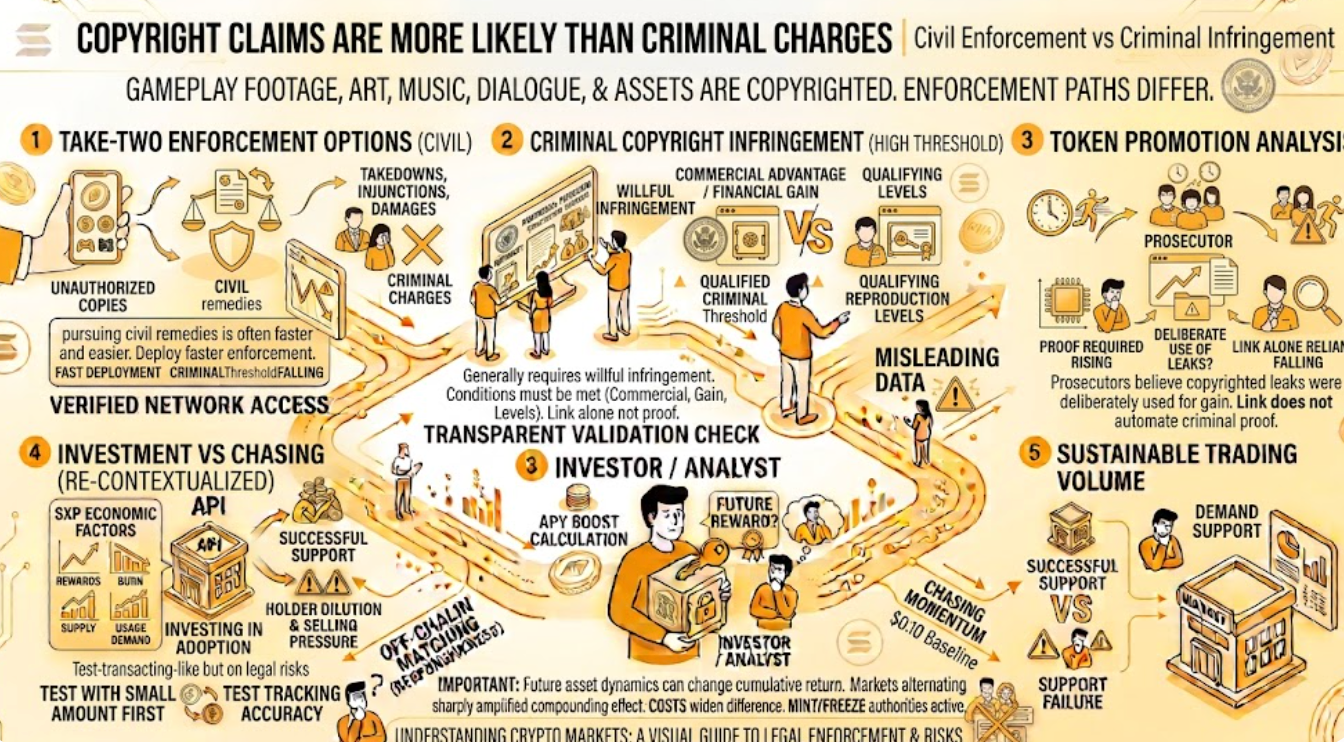
Gameplay footage, art, music, dialogue, and other game assets are copyrighted works. Take-Two can pursue takedowns, injunctions, damages, and claims against people who distribute unauthorized copies. These civil remedies are often faster and easier to deploy than a criminal case.
Criminal copyright infringement has a higher threshold. It generally requires willful infringement plus additional statutory conditions, such as commercial advantage, private financial gain, or qualifying levels of reproduction or distribution. Token promotion could become relevant if prosecutors believe copyrighted leaks were deliberately used to generate financial gain, but a promotional link alone does not automatically prove criminal infringement.
Could Demands Turn the Case Into Extortion?
Some reports described demands or threats tied to further releases. If authenticated evidence showed that a person threatened to expose stolen information unless a company paid money, changed policy, or provided another thing of value, investigators could examine extortion or blackmail statutes. The CFAA itself includes a provision addressing certain threats involving protected computers or information obtained through unauthorized access.
Context matters. Public advocacy, criticism, or a boycott demand is not automatically extortion. Prosecutors would look for a wrongful threat, an intent to obtain value, control over the threatened material, and a provable link between the communication and the accused person.
How the CyberLeek Token Could Expand the Investigation
The crypto component creates a separate evidence trail. Investigators could examine wallet creation, early purchases, promotional posts, liquidity movements, coordinated trading, and transfers after each leak. If someone knowingly made false statements or staged publicity to inflate a token before selling into demand, wire-fraud or market-manipulation theories could become relevant.
That does not mean every volatile meme coin is fraudulent. The U.S. Department of Justice has brought crypto market-manipulation cases where indictments alleged artificial volume, price inflation, and planned sales to unwitting buyers. A CyberLeek case would require its own proof of deception, coordination, intent, victims, and financial benefit. Authorities might also trace proceeds for possible forfeiture or money-laundering issues if the funds were connected to an underlying crime.
Possible Legal Exposure at a Glance
| Possible theory | What investigators would need to establish | Key uncertainty |
|---|---|---|
| Computer fraud | Unauthorized access, obtained data, damage, fraud, or qualifying threats | No public proof yet of how the files were acquired |
| Trade-secret theft | Protected secret information, knowing misappropriation, and required intent | Whether the published material meets the legal definition |
| Copyright infringement | Unauthorized distribution; criminal cases require additional willfulness and statutory elements | Civil liability may be more likely than prosecution |
| Extortion | A wrongful threat linked to a demand for money or another thing of value | Authenticity, context, and identity behind the messages |
| Crypto fraud or manipulation | Deception or artificial trading intended to profit at others’ expense | Token ownership, trading coordination, and promotional intent |
Jurisdiction and Identity Would Shape the Case
The country where the suspect lives, the location of affected systems, the nationality of victims, and the path of financial transactions could determine which agencies and laws apply. A non-U.S. suspect could still face extradition requests or local computer-misuse charges. Investigators may also distinguish between the original source, intermediaries, token deployers, and social-media promoters rather than treating “CyberLeek” as one actor.
Digital evidence would likely include platform records, IP logs, device data, domain registration information, exchange records, blockchain transactions, and communications with journalists or community members. None of those items alone proves guilt; they must be authenticated and connected to specific conduct.
Conclusion
If CyberLeek is identified, the most serious potential exposure would likely arise from proof of unauthorized computer access, knowing trade-secret theft, extortionate threats, or a deceptive token-profit scheme. Copyright claims and emergency injunctions could proceed separately through civil litigation. For now, no public evidence establishes which person obtained the material or whether all activity attributed to CyberLeek came from one operator. The legal outcome therefore depends less on the viral name than on the acquisition method, intent, financial trail, and admissible evidence.
FAQ
Has CyberLeek been arrested or charged?
No publicly confirmed arrest or criminal charge was identified in the reporting reviewed for this article. CyberLeek remains an anonymous online identity, and allegations should not be treated as a conviction.
Is leaking GTA 6 footage automatically a federal crime?
No. Liability depends on how the footage was obtained, what the person knew, how it was distributed, and whether the conduct satisfied a specific criminal statute. Civil copyright liability can exist even when criminal charges are not filed.
Could a person be charged without performing the original hack?
Potentially. A person who knowingly receives or distributes stolen trade secrets, joins a conspiracy, makes extortionate threats, or participates in a fraudulent token scheme may face exposure based on that conduct.
Does promoting a token make the leak market manipulation?
Not by itself. Investigators would need evidence of deceptive statements, coordinated artificial trading, hidden financial interests, or another scheme intended to mislead buyers and generate profit.
Could Rockstar sue even if prosecutors do not bring charges?
Yes. Civil claims involving copyright, trade secrets, contracts, and related remedies have different standards and can proceed independently of a criminal prosecution.


