Cardano is back in the market conversation, but not in the way ADA holders would like. The token is still trading far below its 2021 peak. That alone is enough to make traders pay attention. But the bigger issue is not just the price chart.
The real question is whether Cardano can still turn its technical reputation into real ecosystem growth.
For years, Cardano has had one of the strongest technical stories in crypto. Proof-of-stake. Academic research. Formal verification. A careful development culture. A loyal community that has stayed through multiple cycles.
Those things still matter. But the market is asking for something more practical now. That is where Cardano is under pressure.
ADA Is Cheap for a Reason
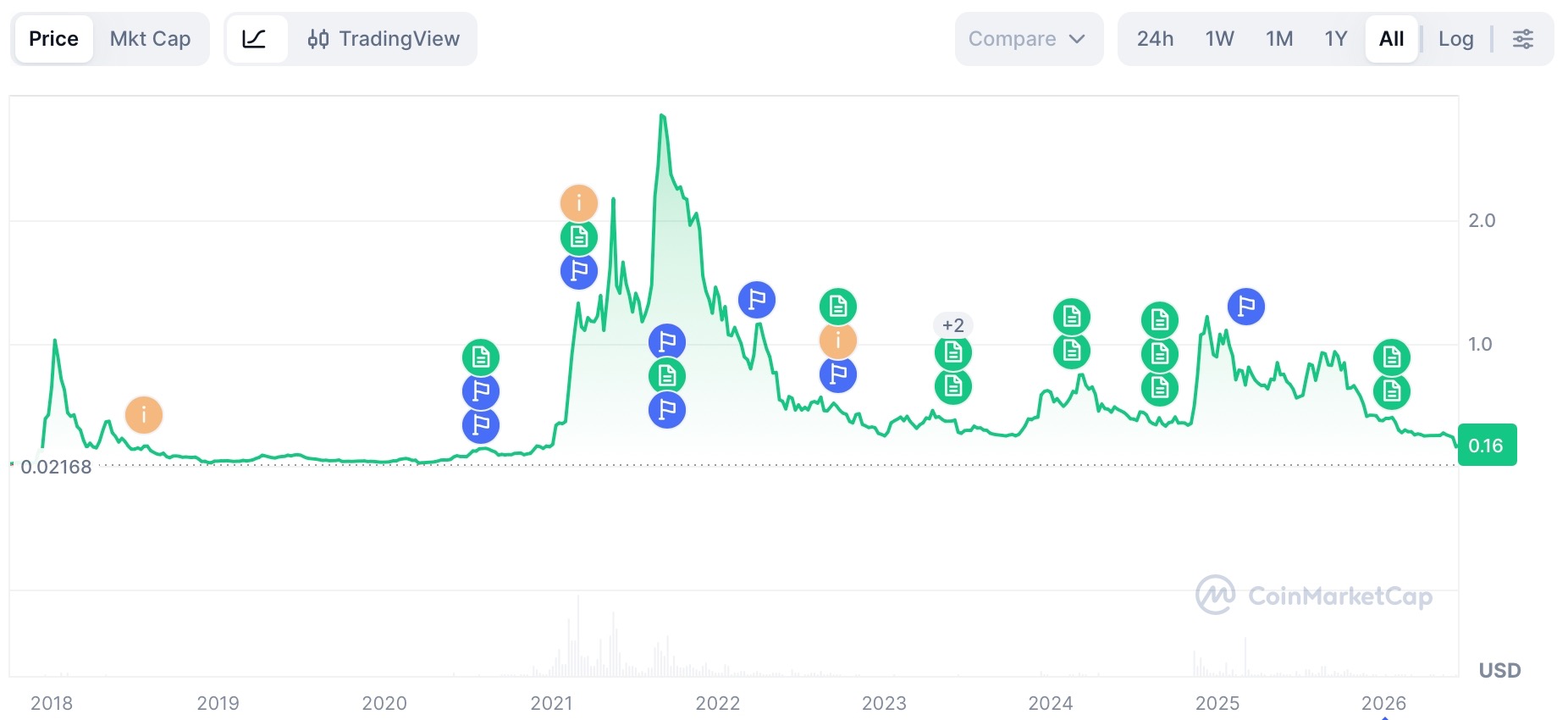
ADA is down heavily from its all-time high. For some traders, that makes it look attractive. A familiar Layer 1 token trading at a deep discount can always spark the “maybe this is the bottom” conversation.
But a big drawdown alone is not a bull case. A token can fall 90% and still struggle if the ecosystem behind it is not growing. The market is not only asking whether ADA is cheap. It is asking whether there is a reason for new capital to come back.
That reason has to come from usage.
If Cardano can rebuild activity, deepen liquidity and attract stronger applications, ADA may start to look like a recovery candidate. If not, the discount may simply reflect weaker market demand.
That is the difference traders need to watch.
Cardano’s DeFi Footprint Is Still Small
The clearest pressure point is DeFi. Cardano has DeFi protocols, but the overall footprint remains small compared with Ethereum, Solana and BSC. That matters because DeFi is one of the simplest ways to measure whether a chain is being used.
A healthy DeFi ecosystem usually brings swaps, lending, borrowing, stablecoins, liquidity pools and active users. It keeps capital on-chain and gives traders reasons to interact with the network.
Cardano has pieces of that ecosystem. Names like Minswap, SundaeSwap, Liqwid, Indigo and Surf Lending still matter within the community.
But the scale is limited. Cardano does not need to beat Ethereum overnight. That is not the point. What it does need is visible growth. Traders want to see TVL improve, DEX volume pick up, stablecoin liquidity deepen and new applications give users more reasons to stay.
Right now, the market is still waiting.
Technical Strength Is Not Enough Anymore
Cardano’s technical foundation remains one of its strongest arguments. Supporters often point to Ouroboros, the extended UTXO model and formal methods as reasons the network is built for the long term. That case has not disappeared.
But the market has become less patient with pure technical narratives. A chain can be carefully designed and still lose attention. It can be secure and still lack liquidity. It can have a loyal community and still fall behind faster-moving ecosystems.
This is the uncomfortable part of the Cardano story. The technology may be serious, but traders are judging the chain by adoption.
Solana and BSC Raised the Bar
Cardano’s challenge looks sharper when compared with other major Layer 1s.
Solana has become a center for retail trading, meme coins, DeFi activity and fast-moving consumer crypto. BSC continues to benefit from deep liquidity and a large base of retail users. Ethereum remains the main venue for high-value DeFi and institutional liquidity.
Cardano sits in a harder position. It has brand recognition. It has a committed community. It has serious engineering. But it has not captured the same level of application-layer energy.
That matters because Layer 1 competition has changed.
In earlier cycles, investors often bought roadmaps. Now they buy traction. The market wants fees, volume, active wallets, stablecoin flows, developer activity and apps that can keep users engaged.
Cardano has to compete on those terms.
Governance Is a Test, Not Just a Feature

Cardano’s governance model is another important part of the story.
The network is moving further into community-driven governance, with DReps, stake pool operators and constitutional structures playing larger roles. In theory, that can be a strength. It reduces dependence on a single leader and gives the community more influence over network direction.
But governance is not only about decentralization. It is also about getting things done. A treasury is useful only if the ecosystem can agree on how to use it. Voting matters only if it leads to timely decisions. Decentralization is powerful only if it does not become gridlock.
For Cardano, this may be one of the biggest tests ahead. The ecosystem needs funding decisions, builder support, infrastructure investment and clearer execution. If governance can deliver that, it becomes a strength. If it slows everything down, it becomes another reason capital looks elsewhere.
What ADA Traders Should Watch
The first thing to watch is DeFi TVL. If Cardano’s TVL stays weak while competitors keep growing, the market may continue to treat ADA as a lagging Layer 1.
The second is DEX volume. Real trading activity is one of the clearest signs that users are active on-chain.
The third is stablecoin liquidity. Without deeper stablecoin markets, DeFi growth becomes harder.
The fourth is developer activity. Cardano needs more applications that users actually want, not just more technical upgrades.
The fifth is governance execution. Treasury decisions and ecosystem funding will matter more as Cardano leans further into decentralized governance.
The sixth is whether upgrades turn into usage. The market does not care about upgrades as headlines forever. It wants to see what they change in practice.
Bottom Line
Cardano’s biggest problem is not just that ADA is far below its peak. The bigger issue is that the market is waiting for Cardano to prove it can compete again.
The network still has technical credibility. It still has a strong community. It still has one of the better-known brands in crypto. But in today’s Layer 1 market, that is not enough.
Liquidity, users, applications and execution matter more than reputation.
ADA traders should watch whether Cardano can rebuild DeFi activity, improve governance execution and attract real application demand. Until that happens, the market may continue to see Cardano as a technically serious chain that still needs to prove it can win back users and capital.
Traders can follow more market updates on Tapbit, log in, or register to stay connected with global crypto opportunities.
Frequently Asked Questions (FAQ)
What is Cardano?
Cardano is a proof-of-stake Layer 1 blockchain known for its research-driven development, Ouroboros consensus protocol, extended UTXO model and formal verification approach.
What is ADA?
ADA is the native token of the Cardano network. It is used for staking, transaction fees, governance participation and ecosystem activity.
Why is ADA under pressure?
ADA is under pressure because the market is questioning whether Cardano can turn its technical strengths into real ecosystem growth. Weak DeFi activity, limited liquidity and stronger competition from other Layer 1 chains have all weighed on sentiment.


