
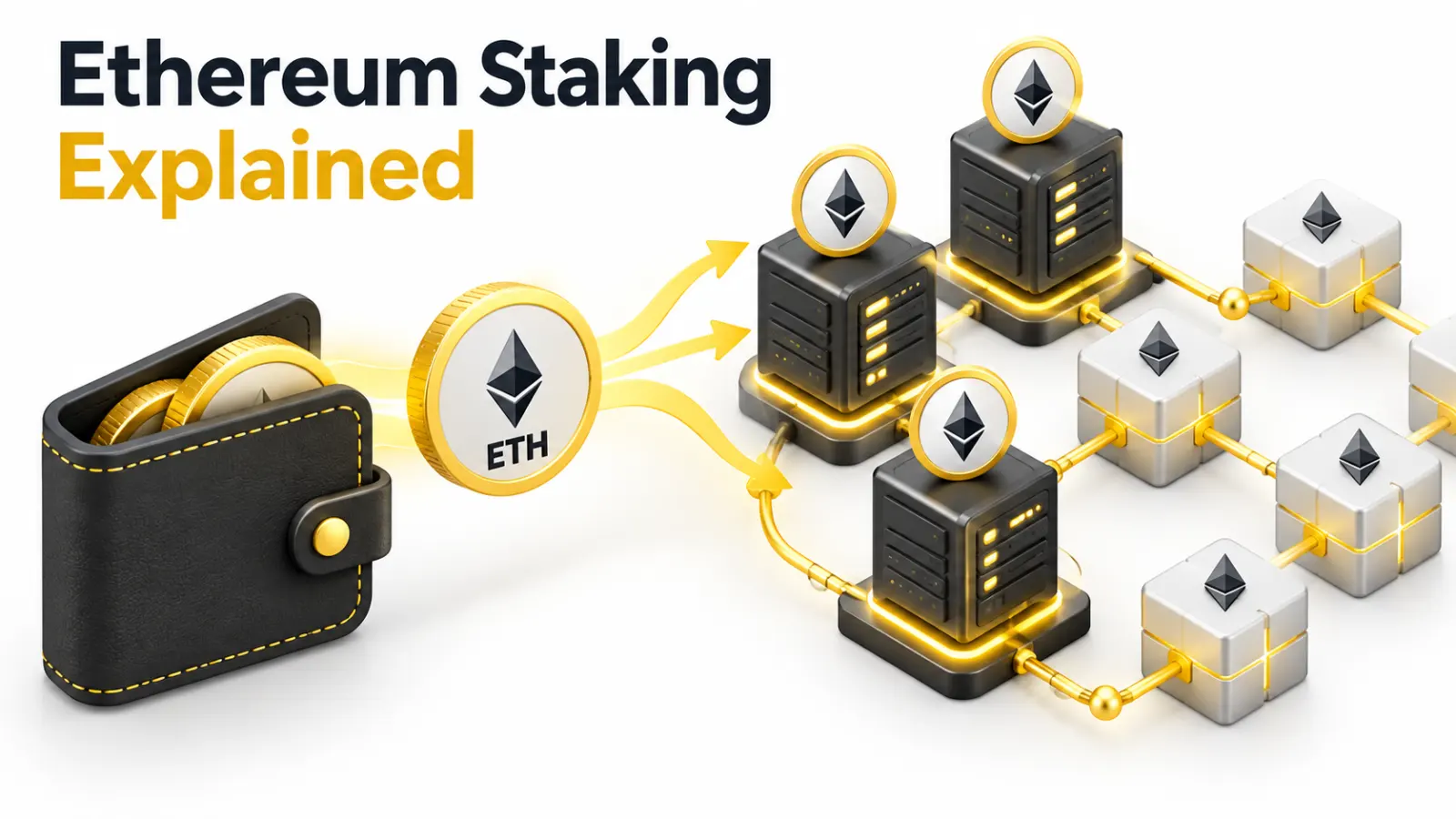
Ethereum staking means committing ETH to help secure Ethereum’s proof-of-stake network. Validators perform duties such as proposing blocks and checking other validators’ work, earning rewards for participating correctly.
Staking can increase the amount of ETH you hold, but it does not guarantee a profit. ETH’s price can fall, validator mistakes can cause penalties, and third-party services introduce additional risks. The important question is not simply how much a staking product pays, but what responsibilities, restrictions and potential losses come with that return.
How Does Ethereum Staking Work?
Ethereum uses staked ETH to make dishonest behavior costly. Validators put capital at risk and run software that participates in reaching agreement about the blockchain’s state. Correct participation earns rewards; missed duties or certain protocol violations can result in losses.
Activating a validator requires at least 32 ETH. People with smaller amounts can participate through third-party pools or custodial services, although these arrangements are not equivalent to operating a validator directly. Ethereum’s official staking guide explains the available approaches and their trade-offs.
Staking is also different from simply holding ETH in a wallet. Unstaked ETH does not automatically earn protocol staking rewards, and an exchange product labeled “Earn” or “Savings” should not automatically be treated as native Ethereum staking.
For a platform-based starting point, readers can explore Tapbit Earn products and review the current eligibility requirements, yield terms and redemption conditions. Product availability varies, and this link does not imply that every Earn product uses Ethereum validators.
Where Do ETH Staking Rewards Come From?
Validators can receive protocol rewards for consensus participation. Proposing blocks can also generate execution-layer income, including transaction priority fees. Depending on the operator’s setup, block production may generate additional income associated with transaction ordering.
These components vary. Network conditions, the amount of ETH participating in staking, validator performance and provider fees can all influence the return received by a user. Ethereum’s base transaction fee is burned rather than paid to validators.
A displayed yield should therefore be read as an estimate, not a fixed promise. Check whether it is quoted before or after service fees and whether it includes temporary incentives.
APR and APY are not interchangeable: APY incorporates an assumed compounding effect. If rewards are not reinvested on the assumed schedule, the realized return may differ from the advertised figure.
What Are the Main Ways to Stake ETH?
The method you choose determines who operates the validator, who controls withdrawals and which additional risks you accept.
| Method | How it works | Main trade-off |
|---|---|---|
| Solo staking | You operate validator infrastructure and manage your keys | More control, but technical and operational responsibility |
| Staking as a service | A provider operates validator software for you | Less maintenance, but reliance on the operator |
| Pooled staking | Users combine ETH to fund validators | Smaller entry amounts, with additional pool and contract risks |
| Liquid staking | A pool issues a token representing a staking position | Transferable exposure, but token pricing and redemption risks |
| Custodial staking | A platform manages assets and staking participation | Convenience, but custody and platform withdrawal restrictions |
These categories can overlap. A custodial platform may use a staking pool behind the scenes, while a liquid staking protocol may distribute validators across several operators.
Rather than relying on a product label, inspect the custody arrangement, withdrawal credentials, operator selection and fee structure. Two products advertising similar yields may expose users to very different risks.
What Are the Main Ethereum Staking Risks?
ETH price risk remains the most direct exposure. Staking rewards are generally measured in ETH, while many investors assess performance in dollars. Earning additional tokens does not offset every market decline.
For example, assume someone starts with 10 ETH valued at $3,000 each. A hypothetical 3% increase in their ETH balance would produce 10.3 ETH. If ETH subsequently trades at $2,000, that position would be worth $20,600—below the original $30,000 despite the token rewards.
Operational penalties and slashing are different. Ordinary missed validator duties can lead to missed rewards and penalties. Slashing addresses specific prohibited behavior, such as signing conflicting messages, and involves a financial penalty and forced validator exit. Ethereum’s rewards and penalties documentation explains this distinction.
Third-party exposure adds another layer. Depending on the arrangement, users may face smart-contract vulnerabilities, compromised administrative controls or a provider that cannot return assets. An audit can help assess a defined codebase, but cannot eliminate every technical or business risk.

Can You Withdraw Staked ETH at Any Time?
Ethereum supports staking withdrawals, but that does not mean every staking position can become spendable ETH immediately.
Exiting a validator can involve protocol queues and processing delays. A staking provider may add its own redemption schedule, liquidity management process or account restrictions. Users of pools normally depend on the pool’s withdrawal mechanism rather than directly controlling the underlying validator withdrawal.
Before committing funds, distinguish three separate actions: requesting redemption, completing the validator or provider exit process, and receiving usable ETH. The timing of one does not establish the timing of the others.
This matters most during market stress. If you may need funds at short notice, a yield estimate alone is not enough to evaluate the product.
Does Liquid Staking Remove the Liquidity Problem?
Liquid staking makes a staking position transferable through a separate token. Depending on the design, rewards may appear through an increasing token balance or through a changing exchange rate against the underlying ETH.
That flexibility does not guarantee an immediate exit at full underlying value. Selling the token depends on available market liquidity; redeeming it depends on the protocol’s rules and processing capacity.
A liquid staking token can trade below its underlying claim when selling pressure rises or confidence weakens. Using it as collateral in another lending protocol introduces further risks, including liquidation.
Restaking adds another distinction: it can expose staked assets to additional services and their associated conditions. Extra rewards should be evaluated alongside the extra obligations, rather than treated as a free enhancement to ordinary staking.
Conclusion
Ethereum staking can suit holders who understand ETH volatility and are comfortable with the operational or third-party risks of their chosen method. It is not a substitute for cash, and a higher ETH balance does not necessarily mean a higher portfolio value.
Compare net rewards, custody, withdrawal conditions and potential losses together. The most useful staking decision begins with understanding how the product works—not selecting the largest advertised yield.
FAQ
Do I need 32 ETH to start staking?
You need at least 32 ETH to activate your own validator. Third-party pools and some custodial services accept smaller amounts.
Can I lose ETH while staking?
Yes. Validator penalties, slashing, security failures and provider problems can reduce or jeopardize holdings. ETH’s market price can also decline.
Is Ethereum staking the same as lending ETH?
No. Native staking supports network consensus. Lending makes assets available to borrowers and creates a different set of risks.
Are Ethereum staking rewards fixed?
No. Rewards depend on network participation, validator performance, block-related income and provider fees.
Can I sell a liquid staking token immediately?
You may be able to sell it if a market is available, but the execution price depends on liquidity. A sale may return less ETH than redemption through the protocol.


