

Bitcoin has never had a demand problem. It is the asset people trust most in crypto. It has the deepest liquidity, the strongest brand, and the longest track record. But for all of that, Bitcoin has one obvious weakness: most of it just sits there.
That is not necessarily a bad thing. Many BTC holders want exactly that. They hold Bitcoin because they do not want extra complexity, bridge risk, smart contract risk, or some yield farm promising too much.
Still, the question keeps coming back: can Bitcoin do more without becoming less Bitcoin?
That is the question BOB is trying to answer. BOB, short for Build on Bitcoin, is part of the growing BTCFi movement. Its goal is to make BTC more usable across DeFi while staying closer to Bitcoin’s security assumptions than older wrapped-BTC models..
Why BOB Is Getting Attention

The BOB story is not just about a new token listing. The more interesting part is what the project is trying to build.
Most DeFi activity today still lives outside native Bitcoin. If a user wants to use BTC in lending, swaps, vaults, or yield strategies, they usually need some version of wrapped BTC or a bridge. That works, but it adds trust assumptions. Users are no longer only relying on Bitcoin. They are relying on custodians, bridges, multisigs, or external systems.
BOB wants to offer a cleaner route. The project describes itself as a hybrid Bitcoin Layer 2. In simple terms, it is trying to combine Bitcoin’s liquidity and security with the kind of programmability that made Ethereum useful for DeFi.
That is why the market is paying attention. If BOB can make BTC more productive without asking users to take too much extra trust risk, it could sit in a valuable part of the Bitcoin ecosystem.
The BitVM Angle
The key piece in BOB’s roadmap is BitVM.
BitVM matters because it gives builders a way to bring more complex verification around Bitcoin without changing Bitcoin itself. For BOB, that opens the door to a more Bitcoin-aligned bridge design.
This is important because bridges are usually the weakest part of DeFi. They are where large amounts of value move between systems, and they are often where security assumptions become messy.
BOB’s long-term pitch is that users should be able to bring native BTC into DeFi with fewer trust compromises than traditional wrapped BTC routes.
But the market will not judge this on theory. It will judge it on whether people actually bridge BTC, whether liquidity stays, whether apps get used, and whether the system behaves safely under stress.
Funding Helps, But Usage Matters More
BOB has raised meaningful funding, including a $9.5 million strategic round in 2025 that brought total funding to around $21 million. That gives the team more runway to build the infrastructure.
It also gives the project credibility.
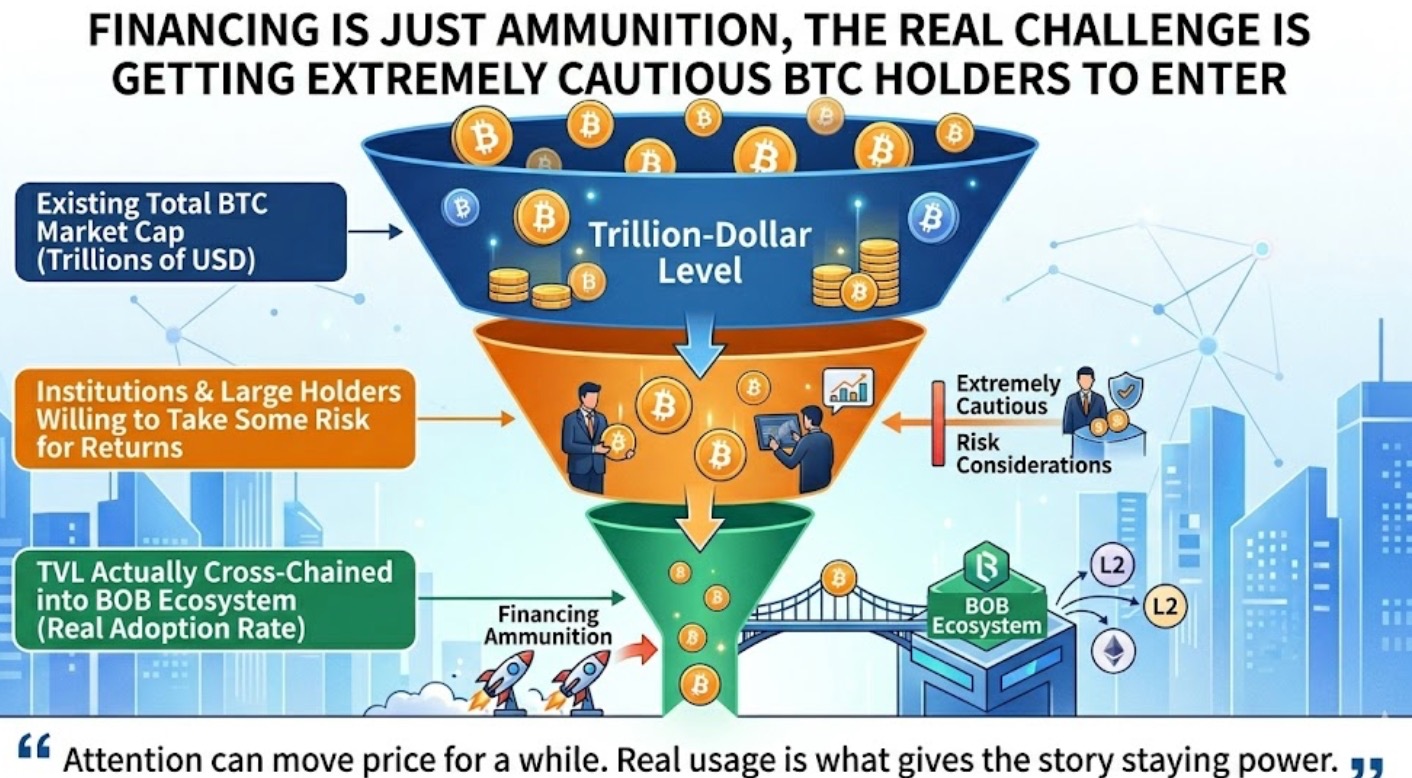
But funding is not the same as adoption. Crypto has seen many well-funded infrastructure projects struggle to bring in real users.
For BOB, the challenge is especially difficult because Bitcoin users are cautious by nature. Many of them would rather earn nothing than take risks they do not fully trust. That means BOB cannot rely only on attractive yields or token incentives. It needs to convince users that the infrastructure is safe enough, useful enough, and liquid enough to justify moving BTC.
That is a much higher bar than launching another DeFi chain.
The Token Needs the Network to Work
BOB’s token story depends on whether the network becomes useful.
Market trackers show a maximum supply of 10 billion BOB, though circulating supply and market cap figures can vary between platforms. That means traders should be careful when looking at valuation and should avoid relying on only one data source.
The token could gain relevance if BOB becomes a real hub for BTCFi activity. Staking, delegation, governance, bridge security, solver networks, and ecosystem incentives can all matter if the network grows.
But if actual BTC usage remains thin, the token may trade mostly on narrative.
That is the difference between an infrastructure asset and a short-term listing trade. Attention can move price for a while. Real usage is what gives the story staying power.
The Risks Are Clear
The main risk is bridge risk.
Any project trying to move BTC into DeFi has to deal with trust, withdrawals, security assumptions, and failure modes. If users do not understand how the bridge works, or if the system feels too complicated, adoption may stay limited.
The second risk is liquidity. A BTCFi project needs more than a token. It needs deep BTC liquidity, reliable apps, strong partners, and reasons for users to return after incentives fade.
The third risk is competition. BOB is not the only project trying to build around Bitcoin DeFi. The space includes Bitcoin L2s, restaking-style protocols, wrapped BTC products, and other bridge designs. Not all of them will win.
And finally, there is token risk. If BOB price moves faster than actual network usage, the market may eventually ask whether the token is supported by real activity or only by BTCFi optimism.
Bottom Line
BOB is interesting because it is trying to solve one of Bitcoin’s oldest problems: how to make BTC useful without making it feel unsafe.
That is the heart of the BTCFi trade.
The opportunity is large. Bitcoin has massive idle liquidity, and even a small portion moving into DeFi could create meaningful demand. But the challenge is just as large. Bitcoin holders do not move capital easily, and they do not forgive weak security assumptions.
BOB does not need to turn Bitcoin into Ethereum. It needs to give BTC holders a reason to use DeFi without feeling like they are giving up what makes Bitcoin valuable.
BOB is not just betting on Bitcoin DeFi. It is betting that BTC can become productive without losing its trust premium. If it can prove that, the market will pay attention. If not, the BTCFi story may remain more promise than reality.
Traders can follow more market updates on Tapbit, log in to explore market tools, or register to stay connected with global crypto opportunities.
Frequently Asked Questions
What is BOB?
BOB stands for Build on Bitcoin. It is a BTCFi-focused project that aims to bring Bitcoin liquidity into DeFi while staying closer to Bitcoin’s security assumptions than traditional wrapped-BTC models.
What is BTCFi?
BTCFi refers to Bitcoin DeFi. It is a growing sector focused on making BTC usable in financial applications such as lending, borrowing, swaps, yield strategies, collateral markets, and settlement.
Why is Bitcoin DeFi important?
Bitcoin is the largest and most trusted crypto asset, but much of its liquidity remains passive. BTCFi tries to make BTC more productive by allowing holders to use it in DeFi without fully abandoning Bitcoin’s security-first value proposition.


