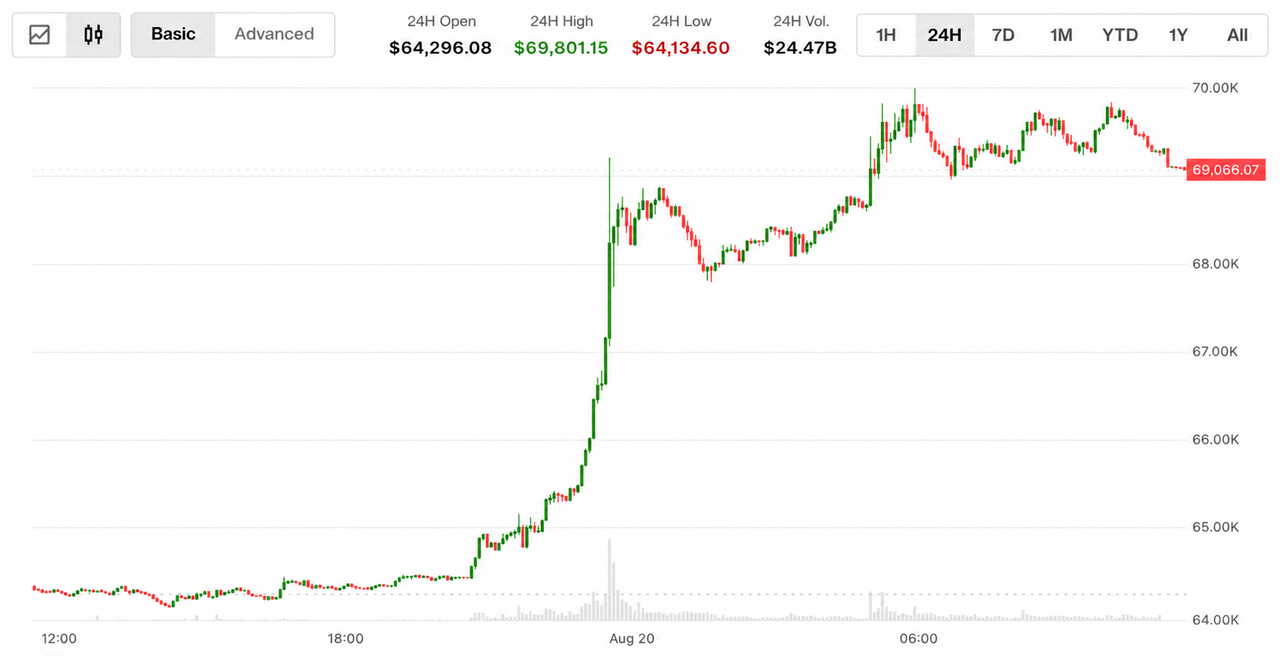
Bitcoin surged from approximately $64,900 at around 12:54 UTC on August 19 to nearly $70,000 at around 15:40 UTC, gaining roughly 7.5% in less than three hours. The move marked Bitcoin’s highest level since early June and briefly pushed the cryptocurrency back toward the closely watched $70,000 threshold.
The rally followed two major U.S. policy developments that reshaped investor expectations around both crypto regulation and financial conditions: the SEC’s proposed framework for digital assets on August 18 and the U.S. Treasury’s expansion of long-end bond buybacks on August 19. The move coincided with a broad market repricing. Shortly after the Treasury announcement, the 30-year Treasury yield fell about 8 basis points to 5.20%, the dollar weakened by roughly 0.5%, Nasdaq futures rose 0.55%, and Bitcoin climbed to around $64,900 as gold and other risk assets also advanced.
Treasury Signal Triggers Broader Market Repricing
The immediate macro catalyst was the U.S. Treasury’s August 19 announcement that it would increase the size of liquidity-support buybacks for 10-to-30-year Treasury securities from $2 billion to at least $4 billion per operation, beginning September 9.
The direct market impact of the additional purchases is limited relative to the size of the Treasury market. The more significant question for investors was what the move represented.
Mohamed El-Erian, chief economic adviser at Allianz, said the announcement raised the possibility of a shift toward some form of yield-curve management, suggesting that markets may be interpreting the move as a broader signal of policymakers’ sensitivity to rising long-term yields.
For Bitcoin, the significance of the announcement may therefore lie less in the immediate liquidity added by the buybacks than in the possibility that markets are beginning to price greater policy sensitivity to rising long-term yields.
If that interpretation persists, it would reduce one of the macro headwinds that has weighed on liquidity-sensitive assets.
SEC Proposal Adds a Regulatory Tailwind
The Treasury announcement was not the only policy development shaping sentiment toward digital assets.
On August 18, the U.S. Securities and Exchange Commission proposed a new framework for crypto assets aimed at providing clearer regulatory pathways for certain digital asset offerings and issuers. The proposal introduced exemptions that would allow eligible crypto projects to raise up to $5 million over a four-year period and up to $75 million annually under specific conditions. It also outlined clearer compliance pathways for digital asset issuers seeking to operate within the federal securities framework.
The proposal marked a significant shift in the regulatory backdrop after years of uncertainty around token offerings and digital asset classification. Rather than changing Bitcoin’s underlying market structure, the immediate market impact came through expectations: greater regulatory clarity could reduce uncertainty for crypto companies and improve broader sentiment toward digital assets.
The timing of the two announcements was notable. A more defined regulatory framework for crypto markets coincided with improving financial conditions across traditional markets, creating a rare combination of crypto-specific and macro tailwinds.
What Determines Whether the Breakout Can Continue?
The next question is whether the move represents a sustainable trend shift or a temporary repricing driven by short-term catalysts.
The first level to watch is whether Bitcoin can sustain trading above the $69,000 area. Glassnode’s short-term holder cost basis data identified the level as an important breakeven zone for recent buyers, making it a key area where investors may determine whether the breakout attracts further demand or triggers profit-taking.
The second signal will come from the macro backdrop that initiated the move. Long-term Treasury yields and the dollar will remain critical indicators. If yields remain contained and the dollar continues weakening, the environment that supported Bitcoin’s breakout would remain intact.
The final test is whether improving regulatory expectations and financial conditions translate into sustained capital flows. Continued ETF inflows, stable funding rates and moderate open interest growth would suggest that new capital is supporting the move. A rapid increase in leverage without corresponding spot demand would make the rally more vulnerable to reversal.
How to Trade Bitcoin on Tapbit
Tapbit offers BTC-USDT spot trading for users who want to purchase or sell Bitcoin directly. Traders seeking leveraged exposure can also access BTC-USDT perpetual futures to take long or short positions.
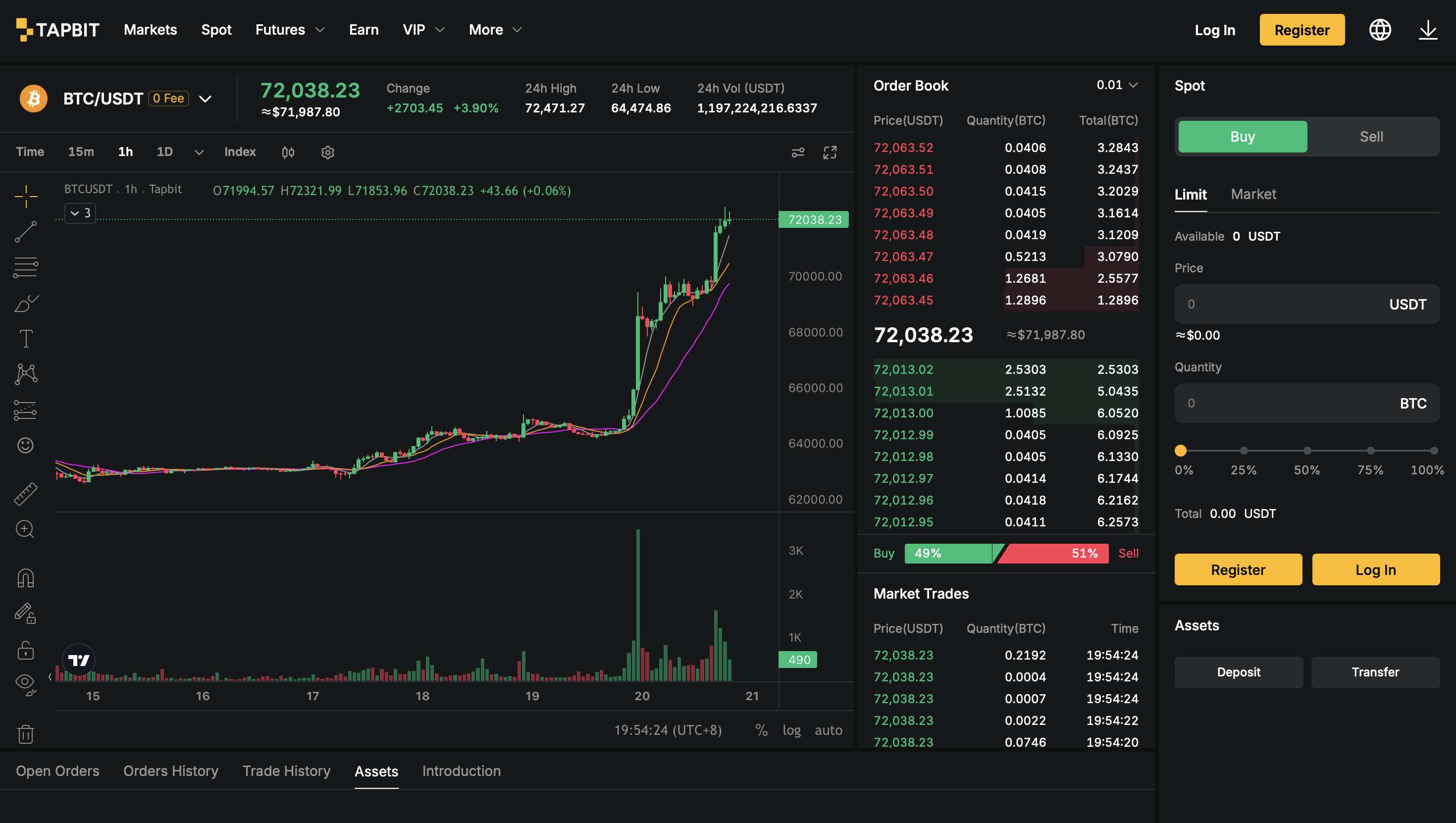
Spot trading is generally more straightforward because you buy BTC directly at the current market price. Perpetual futures are derivative products that involve leverage and carry a risk of liquidation if margin is not managed properly.
- Create a Tapbit account or sign in to your existing account.
- Select the BTC-USDT spot market or open the BTC-USDT perpetual futures contract. Before trading futures, review the mark price, index price and funding rate.
- Choose your order type and position size. For futures trades, also set your leverage and margin mode before opening a long or short position.
- Set take-profit and stop-loss orders where appropriate, and continue monitoring your margin level and liquidation risk.
FAQ
Why did Bitcoin surge above $69,000?
Bitcoin rallied after expanded U.S. Treasury bond buybacks pushed long-term yields lower, while the SEC’s proposed crypto framework improved expectations for regulatory clarity.
Is $69,000 an important level for Bitcoin?
Yes. Short-term holder cost-basis data identifies the $69,000 area as an important breakeven zone. Strong demand around this level could support the breakout, while profit-taking could limit further gains.
What indicators should traders monitor next?
Traders should watch long-term Treasury yields, the U.S. dollar, ETF flows, funding rates, open interest, spot demand and Bitcoin’s ability to remain above $69,000.