
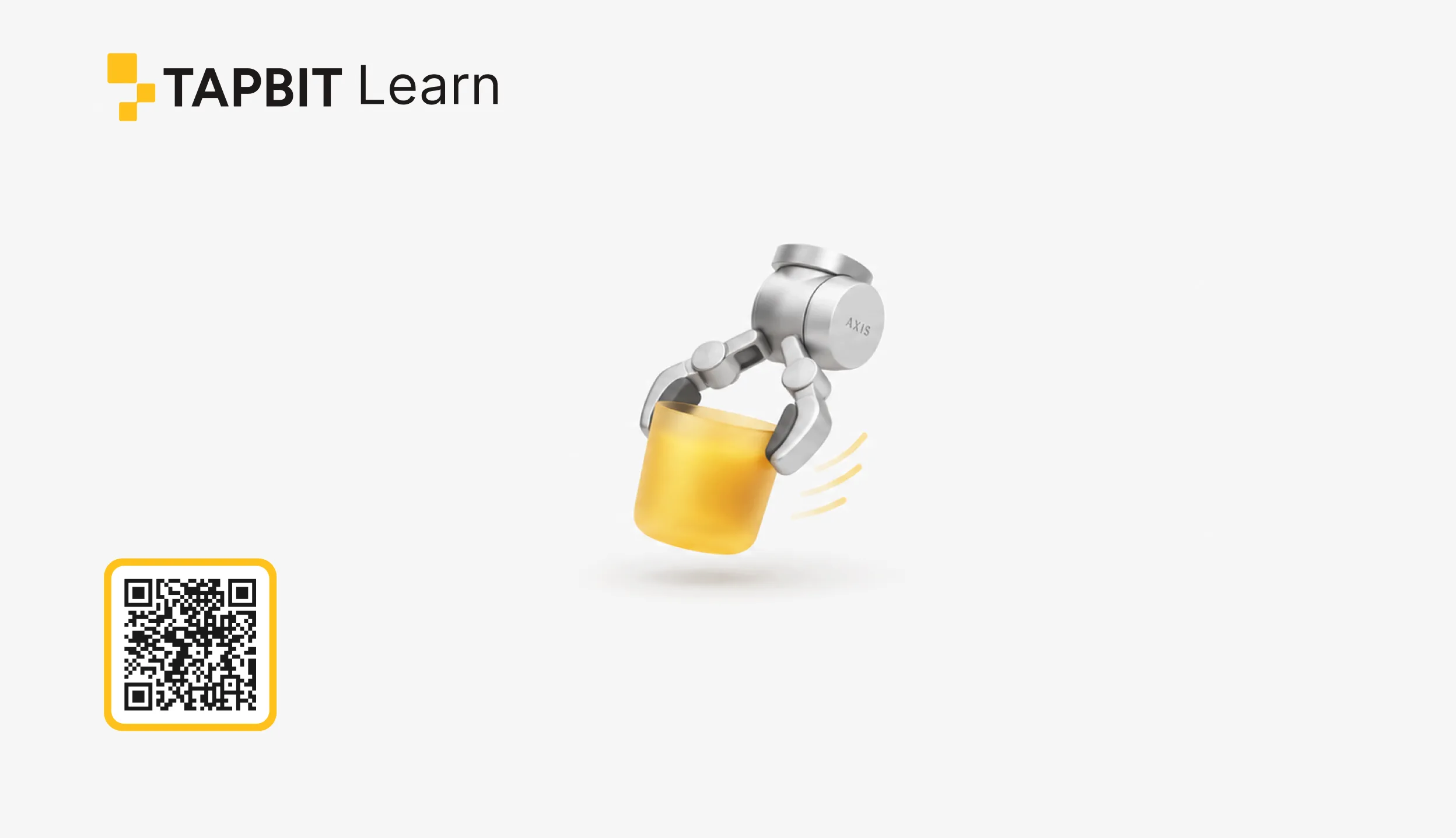
AXIS is the native token of Axis Robotics, a project that collects and processes training data for robots. It runs on Base. The project uses human demonstrations and corrections to help robot models learn physical tasks such as picking up a cup.
Axis Robotics supplies data; AXIS funds ecosystem programs and contributor rewards. The platform needs customers who use its data. The token has a separate supply and unlock schedule.
What Is Axis Robotics?
Axis Robotics turns human demonstrations and robot failures into training material. Its official website describes a robotics data platform. It does not manufacture the robot used in every task.
To learn cup handling, a robot needs more than a picture. A demonstration records how the hand approaches, grips, lifts and releases the cup. A failed attempt reveals errors such as a weak grip or a missed handle. Both help identify which actions the model needs to learn.
This is one part of Physical AI: AI that helps machines understand their surroundings and act. Axis supplies the training material. Hardware provides movement, sensors collect observations, and control software sends commands to the motors.
How Does Axis Turn Actions Into Robot Training Data?
Axis records human demonstrations, cleans the recordings, and uses them to train robot models. It then collects corrections where the models fail. The data-engine documentation describes a browser simulation platform; its mobile capture product remains in development.

For example, a contributor controls a simulated gripper to pick up a cup. The platform records what the robot sees and how it moves at each moment. This sequence is called a trajectory. It links a scene with the action needed to complete the task.
The processing pipeline removes unusable data, aligns recordings and labels actions. Developers can vary lighting and object position to train and test the model across different scenes.
If the robot reaches behind the cup, a person corrects its movement. That correction supplies the missing example. Testing the trained model on new cup positions shows whether the correction improved its performance.
What Is the AXIS Token Used For?
AXIS funds ecosystem development and rewards accepted data contributions. Staking and governance remain proposed features in the official tokenomics.

Contributor rewards pay for useful data. A long recording can contain little usable information; a short correction can fix a recurring failure. Reward quality therefore depends on which submissions the platform accepts and how it scores them.
A submitted task, a points balance and a token reward are three separate things. The platform records the task, assesses the contribution and applies the reward program rules. Points do not have a fixed token conversion rate unless the program terms explicitly provide one.
Proposed staking is a planned feature, not a current source of yield. Its access rules, participation requirements and launch terms will determine what holders can do with it.
AXIS Tokenomics: Supply, Allocation and Unlocks
AXIS has a fixed total supply of 1 billion tokens. Its published TGE schedule lists 165 million in circulation, or 16.5%. TGE means token generation event; the figure describes launch supply.

| Allocation | Share of total supply |
|---|---|
| Ecosystem | 51.08% |
| Contributor rewards | 10.00% |
| Core team | 15.20% |
| Private A | 9.80% |
| Private B | 6.67% |
| Liquidity | 6.00% |
| Sonar | 1.00% |
| Kaito reward pool | 0.25% |
Source: Axis tokenomics, checked October 26, 2026; percentages are rounded. The page lists team and private-round releases from month 12 through month 35, with full unlocking by month 35.
Circulating supply counts tokens available in the market under the data provider's method. Total supply counts the broader token quantity. Circulating market capitalization equals price times circulating supply. Fully diluted value uses the full supply. At the same token price, a smaller circulating amount produces a smaller market capitalization.
Unlocks make previously restricted tokens transferable. Holders then decide whether to keep or sell them. A large release puts more tokens within reach of the market; trading volume and order-book depth show how much buying and selling the market can handle.
Why Is AXIS Getting Attention?
AXIS gives crypto investors a link to robot training data, a specific part of the Physical AI market. Its appeal is the need to teach robots physical actions, from gripping objects to correcting a failed movement.
A chatbot can explain how to lift a cup. A robot must locate it, reach it and adjust its grip as it moves. Training data connects those observations with actions. The strongest product evidence is a measured improvement in a named task, on identified hardware, under stated test conditions.
Token trading measures investor activity. Repeat data purchases measure customer demand. A listing can increase trading quickly; lasting platform growth requires customers to keep using the data and models to improve with it.
What Shows Whether the Network Is Growing?
More accepted data, repeat customers and better robot performance show that the network is growing. Contributor count measures participation, but a platform also needs to show how much useful data those contributors produce.
| Measure | What it helps establish |
|---|---|
| Accepted trajectories by task | Useful output rather than submissions alone |
| Success on unseen scenes | Whether training transfers beyond familiar examples |
| Repeat customer use | Demand that continues after an initial trial |
| Cost per accepted demonstration | Whether collection scales economically |
| Correction and rejection rates | Where quality control is working or struggling |
Compare models on the same task and under the same conditions. Lifting a rigid cup from an empty table is easier than handling a soft object in clutter. A success rate has meaning only when the task, number of attempts and level of human help are clear.
AI chips and robotics data serve different customers. Chip suppliers sell computing capacity; Axis sells or supplies training material. Our AI chip market analysis covers the compute side. Growth in that market does not automatically create demand for AXIS.
How to Explore Related AI Markets on Tapbit
Tapbit offers NVDA/USDT perpetuals, a derivative linked to NVIDIA. This is an AI-compute market, not an AXIS trading pair.
- Register or log in to Tapbit, then prepare USDT in the appropriate account.
- Open NVDA/USDT and read the contract information. Select the margin mode and leverage that fit the position.
- Choose direction, order type and quantity, then set take-profit and stop-loss levels.
- Review price, margin, fees and liquidation price before submitting. Monitor the position and use the close controls when exiting.
FAQ
Which blockchain is AXIS on?
The official documentation identifies AXIS as an ERC-20 token on Base. Its listed contract is 0x5bE75e3b0aFf5D1A042A5363Ae36AcB1d6d755ea.
Does AXIS ownership represent shares in Axis Robotics?
No. AXIS is an ecosystem token. The published terms do not grant company shares or an automatic share of business revenue.
Is staking already available?
The October 26 tokenomics page lists staking and governance as proposed. It provides no live staking terms.
What matters most when evaluating Axis Robotics?
Check whether accepted data improves robot performance, whether customers keep using it, and how token releases compare with market demand.


